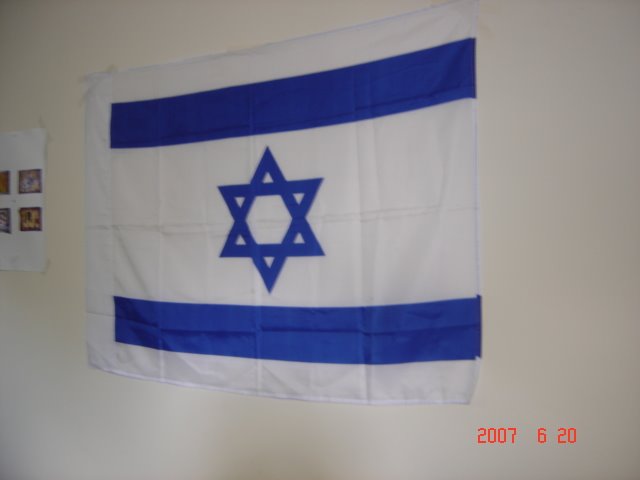
VI Festival de Música Sefardí.
Desde el 20 hasta el 23 de junio, en el Jardín Botánico de Córdoba (Avda. del Linneo), a las 22’30h tendrá lugar el VI Festival Internacional de Música Sefardí con el siguiente programa: Miercoles 20, Paco Díez;
jueves 21, Rania “Legado Sefardí”;
viernes 22, Mashalá;
sábado 23, Klezmática Trío. Importe 5 €. Por otra parte, continúa hasta el 5 de junio el XI Ciclo de Música de las Tres Culturas en la Iglesia de la Magdalena (Pza. de la Magdalena) a las 20,30 horas, con entrada gratuita. Para conocer el programa en detalle llamar a la Dirección General de Cultura del Ayuntamiento de Córdoba, Tel. 957 48 50 01.
Postagem: Andre Moshe Pereira
Kehillah Or Ahayim, Presidente
Director CEIMOM
Thursday, June 14, 2007
Anselm Kiefer en el Guggenheim
“Kiefer. Una historia sin memoria”, comisariado por Germano Celant, se presenta hasta el 3 de septiembre en el Museo Guggenheim Bilbao (Abandoibarra, 2. Bilbao).
Entre sus piezas destaca Merkaba (2005-2007). Kiefer es un artista difícil, que sobrecoge por su monumentalidad, por la reiterada alusión a lo cósmico, lo trascendente... Y lo alemán. En sus inicios fue uno de los primeros artistas en abordar el pasado nazi que nadie quería recordar (como en Sefer Hechaloth, 2001). En los últimos diez años, la obra de Kiefer ha tomado una deriva diferente, ocupándose de asuntos alejados de la historia reciente de su país, aunque no de sus materiales y temas habituales, ni de los fundamentos de la condición humana, cuyo reflejo busca en otras culturas o en el ansia de saber. Pero sus campos de estrellas (varios de los cuadros de esta serie llevan el título de Sternen lager) nos remiten, otra vez, al recurrente tema de la memoria. La reducción de las estrellas a cadenas numéricas, la identificación de unas pocas entre la miríada de puntos, nos recuerda la de los individuos de los campos de concentración a un simple número tatuado en su brazo. La cábala aparece claramente aludida en la serie de pinturas realizadas para la capilla del antiguo hospital psiquiátrico de La Salpetrière, en París. Aunque sigue siendo Merkaba (literalmente, el carro, en idish y hebreo) la pieza que nos devuelve a la desesperanza. Colgando precariamente de la pared, desparramados por el suelo, varios segmentos de escalera de hormigón ocupan la sala señalando que la vieja conexión con el cielo (la escalera) hace tiempo que se ha venido abajo.
Entre sus piezas destaca Merkaba (2005-2007). Kiefer es un artista difícil, que sobrecoge por su monumentalidad, por la reiterada alusión a lo cósmico, lo trascendente... Y lo alemán. En sus inicios fue uno de los primeros artistas en abordar el pasado nazi que nadie quería recordar (como en Sefer Hechaloth, 2001). En los últimos diez años, la obra de Kiefer ha tomado una deriva diferente, ocupándose de asuntos alejados de la historia reciente de su país, aunque no de sus materiales y temas habituales, ni de los fundamentos de la condición humana, cuyo reflejo busca en otras culturas o en el ansia de saber. Pero sus campos de estrellas (varios de los cuadros de esta serie llevan el título de Sternen lager) nos remiten, otra vez, al recurrente tema de la memoria. La reducción de las estrellas a cadenas numéricas, la identificación de unas pocas entre la miríada de puntos, nos recuerda la de los individuos de los campos de concentración a un simple número tatuado en su brazo. La cábala aparece claramente aludida en la serie de pinturas realizadas para la capilla del antiguo hospital psiquiátrico de La Salpetrière, en París. Aunque sigue siendo Merkaba (literalmente, el carro, en idish y hebreo) la pieza que nos devuelve a la desesperanza. Colgando precariamente de la pared, desparramados por el suelo, varios segmentos de escalera de hormigón ocupan la sala señalando que la vieja conexión con el cielo (la escalera) hace tiempo que se ha venido abajo.


Monday, June 11, 2007
Korach
Rabino Kalman Packouz
GOOD MORNING! This week's Torah portion, Korach, is about disputes created for one's personal gain though they are disguised in philosophic terms and in seemingly lofty values. Disputes are destructive in relationships and especially in marriages. Discussions are productive! I thought it might be of some help to someone to share some ways to avoid arguments, particularly with one's spouse!
HOW TO NOT ARGUE
It takes two to argue. If you don't answer back, there cannot be an argument. Just say, "I don't want to talk about it now" and just softly repeat that phrase.
Arguments escalate with the volume of the arguers. "A soft answer turns away wrath" (Proverbs 15:1). The more forcefully the other person argues, the quieter your response becomes. You will see the other side tone down his/her voice in response.
You can't have an argument if you agree. "That's a good point." "I hadn't thought about that." "You are definitely right." Focus on where you can agree, not where you differ.
Admit you were wrong. No one is ever totally right. Find something to apologize for, to take responsibility for. The other person will feel better and may even own up to some mistakes of his/her own.
Do not accuse or attack. Don't say, "You said this!" "You did that!" Ask questions, don't make statements. And ask questions with sincerity not as a cutting sword to make an attack.
Remember your goal! In the case of marriage, you want harmony, peace, a good atmosphere, love. Arguments breed stress and anxiety, not peace and pleasantness. Tell yourself: I love my spouse, I love my kids, I love my money (divorces cost a lot of money).
Don't be foolish to show disrespect to your chosen one and to yourself by saying things that are damaging, mean or not worthwhile. You chose this person to be your spouse. This is the person above all others who has the qualities to be chosen over the other billions of people on this planet.
Turn the argument into a discussion. Don't defend a position; set forth an idea or problem to be clarified. People of good will who reason together can come to a common conclusion. Listen with an open mind. Be a judge, not a lawyer!
Ask yourself, "Is this argument really worth it?" In the end, whatever you are arguing about may be ultimately trivial. Likely, there are other issues regarding communication, respect, responsibilities which create the angst and anger leading to arguments - rather than discussions.
Torah Portion of the Week
Korach
___There are two rebellions this week. First, Korach, a Levite who was passed over for the leadership of his tribe, challenges Moshe over the position of High Priest. No good rebellion can be "sold" as a means for personal gain, so Korach convinces 250 men of renown that they must stand up for a matter of principle - that each and every one of them has the right to the office of High Priest (which Moshe had announced that God had already designated his brother Aharon to serve).
___Fascinatingly, all 250 followers of Korach accept Moshe's challenge to bring an offering of incense to see who God will choose to fill the one position. This meant that every man figured he would be the one out of 250 to not only be chosen, but to survive the ordeal. Moshe announces that if the earth splits and swallows up the rebels it is a sign that he (Moshe) is acting on God's authority. And thus it happened!
___The next day the entire Israelite community rises in a second rebellion and complains to Moshe, "You have killed God's people!" The Almighty brings a plague which kills 14,700 people and only stops when Aharon offers an incense offering.
___To settle the question once and for all, Moshe has the head of each tribe bring a staff with his name on it. The next morning only Aharon's staff had blossomed and brought forth almonds. The people were shown this sign. Aharon's staff was placed in front of the curtain of the ark as testimony for all time.
* * *
Dvar Torah
___This week's Torah portion tells the story of Korach's dispute with Moshe (see above, the Torah Portion, section for details!). The Mishna (a teaching) in Pirke Avot 5:20 (Ethics of the Fathers - a book of concise Jewish wisdom available from your local Jewish book store or by calling toll-free 877-758-3242), states :
"Any dispute that is for the sake of Heaven will be of lasting worth and one not for the sake of Heaven will not be of lasting worth. Which dispute was for the sake of Heaven? That of Hillel and Shamai. Which was not for the sake of Heaven? That of Korach and his company."
___The Mishna should have said that the dispute not for the sake of Heaven was that of Korach and Moshe, not between Korach and his fellow conspirators! Why didn't the Mishna mention Moshe as the antagonist? Korach started the dispute for his own personal gain (not for the sake of Heaven) while Moshe was upholding the Almighty's word and the Almighty's honor (you can't get more "for the sake of Heaven" than this!)
___Why then does the Mishna mention that a dispute not for the sake of Heaven is the one between "Korach and his company"? We might think that Korach and his company were united in their argument with Moshe. The Mishna is telling us that each of the 250 was challenging Moshe for his own gain (remember each one brought incense to see if he himself would be chosen as the Cohen Gadol, High Priest.) In truth, Korach and his congregation were in dispute amongst themselves as to who should be the High Priest.
CANDLE LIGHTING - June 15
Jerusalem 7:11Guatemala 6:14 - Hong Kong 6:51 - Honolulu 6:56J'Burg 5:04 – PORTO OR AHAYIM 9:01 - Los Angeles 7:48Melbourne 4:49 - Mexico City 7:58 - Miami 7:56New York 8:11 - Singapore 6:53 - Toronto 8:42
QUOTE OF THE WEEK:
Treat others as you would have them treat you ...if they had better sense!-- Earl Pertnoy
GOOD MORNING! This week's Torah portion, Korach, is about disputes created for one's personal gain though they are disguised in philosophic terms and in seemingly lofty values. Disputes are destructive in relationships and especially in marriages. Discussions are productive! I thought it might be of some help to someone to share some ways to avoid arguments, particularly with one's spouse!
HOW TO NOT ARGUE
It takes two to argue. If you don't answer back, there cannot be an argument. Just say, "I don't want to talk about it now" and just softly repeat that phrase.
Arguments escalate with the volume of the arguers. "A soft answer turns away wrath" (Proverbs 15:1). The more forcefully the other person argues, the quieter your response becomes. You will see the other side tone down his/her voice in response.
You can't have an argument if you agree. "That's a good point." "I hadn't thought about that." "You are definitely right." Focus on where you can agree, not where you differ.
Admit you were wrong. No one is ever totally right. Find something to apologize for, to take responsibility for. The other person will feel better and may even own up to some mistakes of his/her own.
Do not accuse or attack. Don't say, "You said this!" "You did that!" Ask questions, don't make statements. And ask questions with sincerity not as a cutting sword to make an attack.
Remember your goal! In the case of marriage, you want harmony, peace, a good atmosphere, love. Arguments breed stress and anxiety, not peace and pleasantness. Tell yourself: I love my spouse, I love my kids, I love my money (divorces cost a lot of money).
Don't be foolish to show disrespect to your chosen one and to yourself by saying things that are damaging, mean or not worthwhile. You chose this person to be your spouse. This is the person above all others who has the qualities to be chosen over the other billions of people on this planet.
Turn the argument into a discussion. Don't defend a position; set forth an idea or problem to be clarified. People of good will who reason together can come to a common conclusion. Listen with an open mind. Be a judge, not a lawyer!
Ask yourself, "Is this argument really worth it?" In the end, whatever you are arguing about may be ultimately trivial. Likely, there are other issues regarding communication, respect, responsibilities which create the angst and anger leading to arguments - rather than discussions.
Torah Portion of the Week
Korach
___There are two rebellions this week. First, Korach, a Levite who was passed over for the leadership of his tribe, challenges Moshe over the position of High Priest. No good rebellion can be "sold" as a means for personal gain, so Korach convinces 250 men of renown that they must stand up for a matter of principle - that each and every one of them has the right to the office of High Priest (which Moshe had announced that God had already designated his brother Aharon to serve).
___Fascinatingly, all 250 followers of Korach accept Moshe's challenge to bring an offering of incense to see who God will choose to fill the one position. This meant that every man figured he would be the one out of 250 to not only be chosen, but to survive the ordeal. Moshe announces that if the earth splits and swallows up the rebels it is a sign that he (Moshe) is acting on God's authority. And thus it happened!
___The next day the entire Israelite community rises in a second rebellion and complains to Moshe, "You have killed God's people!" The Almighty brings a plague which kills 14,700 people and only stops when Aharon offers an incense offering.
___To settle the question once and for all, Moshe has the head of each tribe bring a staff with his name on it. The next morning only Aharon's staff had blossomed and brought forth almonds. The people were shown this sign. Aharon's staff was placed in front of the curtain of the ark as testimony for all time.
* * *
Dvar Torah
___This week's Torah portion tells the story of Korach's dispute with Moshe (see above, the Torah Portion, section for details!). The Mishna (a teaching) in Pirke Avot 5:20 (Ethics of the Fathers - a book of concise Jewish wisdom available from your local Jewish book store or by calling toll-free 877-758-3242), states :
"Any dispute that is for the sake of Heaven will be of lasting worth and one not for the sake of Heaven will not be of lasting worth. Which dispute was for the sake of Heaven? That of Hillel and Shamai. Which was not for the sake of Heaven? That of Korach and his company."
___The Mishna should have said that the dispute not for the sake of Heaven was that of Korach and Moshe, not between Korach and his fellow conspirators! Why didn't the Mishna mention Moshe as the antagonist? Korach started the dispute for his own personal gain (not for the sake of Heaven) while Moshe was upholding the Almighty's word and the Almighty's honor (you can't get more "for the sake of Heaven" than this!)
___Why then does the Mishna mention that a dispute not for the sake of Heaven is the one between "Korach and his company"? We might think that Korach and his company were united in their argument with Moshe. The Mishna is telling us that each of the 250 was challenging Moshe for his own gain (remember each one brought incense to see if he himself would be chosen as the Cohen Gadol, High Priest.) In truth, Korach and his congregation were in dispute amongst themselves as to who should be the High Priest.
CANDLE LIGHTING - June 15
Jerusalem 7:11Guatemala 6:14 - Hong Kong 6:51 - Honolulu 6:56J'Burg 5:04 – PORTO OR AHAYIM 9:01 - Los Angeles 7:48Melbourne 4:49 - Mexico City 7:58 - Miami 7:56New York 8:11 - Singapore 6:53 - Toronto 8:42
QUOTE OF THE WEEK:
Treat others as you would have them treat you ...if they had better sense!-- Earl Pertnoy
Saturday, June 09, 2007
Parashat Shlach
Rabino Kalman Packouz
GOOD MORNING! The story is told by Rabbi Yisroel Reissman of a man in a small Russian village observing the sale of a horse for the unbelievably cheap price of 500 rubles. After the conclusion of the deal, the man approaches the seller and asks, "That horse was worth at least 2,500 rubles! How could you possibly sell it for so little?" The seller sneered, "You idiot! That horse is so lame that in 2 blocks he'll have to carry it home on his shoulders!"
___The man runs to the buyer and breathlessly asks him, "Do you realize that the horse you bought is lame?" The buyer guffaws, "Fool! Of course I know he's lame! He has a nail in his hoof. As soon as I get it out, I'll have a perfectly good horse for only 500 rubles!"
___Running back to the seller, the man exclaims, "The horse has a nail in his hoof! Once he takes it out it will be perfectly fine." The seller laughs, "You're a bigger idiot than I thought! No one is going to buy a lame horse. I put the nail in the hoof to trick the buyer!"
___Huffing and puffing back to the buyer, "You've been swindled! He put the nail in the hoof to deceive you!" The buyer shrugs and throws up his hands, "It doesn't matter. The rubles are counterfeit anyway!"
___What does the Torah say about deceiving or cheating someone in a business deal?
"And if you sell anything to your fellow or buy anything from the hand of your fellow, you shall not wrong one another" (Leviticus 25:14)
___The Torah is a handbook for life. The word "Torah" means "Instruction." It is our guide for perfecting ourselves, being more God-like and coming closer to God. It governs three areas: between a person and the Almighty, a person and his fellow human being and a person and himself or herself. The laws governing business are an important part of living righteously and building a better world.
___The above verse forbids us to cheat others when buying or selling. The laws of this prohibition are sometimes complex, An halachic authority (an expert in Talmudic law) should be consulted whenever a question arises.
___The Shulchan Aruch, the Code of Jewish Law, informs us that you are obligated to inform the buyer of any defect in an item you are selling, even if the price is reasonable. (Choshen Mishpot 228:6).
___Rabbi Moshe Chaim Luzzato writes: "It is very easy for a person to fall prey to sin in regards to deceiving a customer. A person might consider it proper to attempt to make his merchandise attractive and to use sales talk on his customers to make them more receptive. However, if a person is not careful, he will violate the prohibition against deceiving others. Someone who deceives others is considered 'wrong,' 'hateful,' 'abominable,' 'despised,' and 'detested' (Sifra 19:35). Our Sages have stated, "Whenever someone steals even the value of the smallest coin from another person, it is considered as if he has taken his soul" (Bava Kama 119a).
___"If you ask: 'How is it possible not to try to influence a prospective customer to buy my merchandise?' you should know that there is a big distinction in the methods one might use. When you try to show a customer the true value and beauty of an article, it is good and proper. However, what is done to conceal the defects of an item is deceitful and forbidden. This is a basic principle in business integrity.
___"Someone who perfects himself in matters pertaining to the desire for acquisition has reached a very high level. For there are many who achieve righteousness in other areas, but do not achieve perfection in despising dishonest gain." (Mesilas Yesharim, Ch. 11)
___Is this important? The Talmud, Shabbos 31a, teaches that after a person dies, on Judgment Day he will be asked 6 questions - the first of which is, "Were you honest in your business dealings?"
(This piece draws greatly from "Love Your Neighbor" by Rabbi Zelig Pliskin, pages 321-325.)
Torah Portion of the Week
Shlach
___The Jewish people received the Torah on Mt. Sinai and were ready to enter the land of Israel. There was a consensus of opinion amongst the people that we should send spies to see if it was feasible to conquer the Land. Moshe knew that the Almighty's promise to give the Land included a guarantee to conquer it. However, one of the principles of life which we learn from this portion is: the Almighty allows each of us the free will to go in the direction we choose. Even though one man and the Almighty is a majority, Moshe by Divine decree, sent out the princes of the tribes (men of the highest caliber) to spy out the land.
___Twelve spies were sent. Ten came back with a report of strong fortifications and giants; they rallied the people against going up to the Land. Joshua ben Nun and Calev ben Yefunah (Moshe's brother-in-law) tried to stem the rebellion, but did not succeed. The Almighty decreed 40 years of wandering in the desert, one year for each day they spied in the land of Israel. This happened on the 9th of Av, a date noted throughout Jewish history for tragedy - the destruction of both Temples in Jerusalem and the expulsion of the Jews from Spain amongst them.
* * *
Dvar Torah
based on Growth Through Torah by
Rabino Zelig Pliskin
___The Torah tells us about the negative response of the 10 spies to Calev's positive report about going into the Promised Land:
"And the men (the 10 spies) who went up with him (Calev, one of the 2 good spies) said, 'We cannot go up to that people (the present inhabitants of the land of Canaan) because they are stronger than us.' " (Numbers 12:31)
___Why did the 10 spies feel they weren't strong enough to enter the land?
___The Chofetz Chaim used to say that the evil inclination tries in every possible way to prevent a person from doing good deeds. At times, a person is arrogant and feels that he is already on the highest level and need not do more. At other times, when a person tries to do something good, he starts feeling sad and guilt-ridden. He tells himself that the good thing he wants to do is only possible to accomplish for people on a much higher spiritual level that he has attained. He immediately remembers all the bad things he has done in his life. Even though he might have already regretted those things and repented, he forgets this and starts feeling so inferior that he loses all desire to accomplish anything positive.
___This, said the Chofetz Chaim, was their mistake in being afraid to enter the Land of Israel. They remembered the things they did wrong in the past and said that they were unworthy to enter the land. Especially since the people who lived there were very mighty. They would need a special merit to be victorious and they felt too lowly for this. However, we should never be deterred from doing what is good out of misplace humility. Do not allow guilt feelings to prevent you from doing the will of the Almighty. (Shmiras Haloshon, Vol.2, Shelach).
* * *
CANDLE LIGHTING - June 8
Jerusalem 7:08Guatemala 6:12 - Hong Kong 6:47 - Honolulu 6:53J'Burg 5:04 – Porto KEHILLAH OR AHAYIM 8:56 - Los Angeles 7:45Melbourne 4:49 - Mexico City 7:55 - Miami 7:53New York 8:07 - Singapore 6:51 - Toronto 8:39
QUOTE OF THE WEEK:
A clear conscience is usually the signof a bad memory.
GOOD MORNING! The story is told by Rabbi Yisroel Reissman of a man in a small Russian village observing the sale of a horse for the unbelievably cheap price of 500 rubles. After the conclusion of the deal, the man approaches the seller and asks, "That horse was worth at least 2,500 rubles! How could you possibly sell it for so little?" The seller sneered, "You idiot! That horse is so lame that in 2 blocks he'll have to carry it home on his shoulders!"
___The man runs to the buyer and breathlessly asks him, "Do you realize that the horse you bought is lame?" The buyer guffaws, "Fool! Of course I know he's lame! He has a nail in his hoof. As soon as I get it out, I'll have a perfectly good horse for only 500 rubles!"
___Running back to the seller, the man exclaims, "The horse has a nail in his hoof! Once he takes it out it will be perfectly fine." The seller laughs, "You're a bigger idiot than I thought! No one is going to buy a lame horse. I put the nail in the hoof to trick the buyer!"
___Huffing and puffing back to the buyer, "You've been swindled! He put the nail in the hoof to deceive you!" The buyer shrugs and throws up his hands, "It doesn't matter. The rubles are counterfeit anyway!"
___What does the Torah say about deceiving or cheating someone in a business deal?
"And if you sell anything to your fellow or buy anything from the hand of your fellow, you shall not wrong one another" (Leviticus 25:14)
___The Torah is a handbook for life. The word "Torah" means "Instruction." It is our guide for perfecting ourselves, being more God-like and coming closer to God. It governs three areas: between a person and the Almighty, a person and his fellow human being and a person and himself or herself. The laws governing business are an important part of living righteously and building a better world.
___The above verse forbids us to cheat others when buying or selling. The laws of this prohibition are sometimes complex, An halachic authority (an expert in Talmudic law) should be consulted whenever a question arises.
___The Shulchan Aruch, the Code of Jewish Law, informs us that you are obligated to inform the buyer of any defect in an item you are selling, even if the price is reasonable. (Choshen Mishpot 228:6).
___Rabbi Moshe Chaim Luzzato writes: "It is very easy for a person to fall prey to sin in regards to deceiving a customer. A person might consider it proper to attempt to make his merchandise attractive and to use sales talk on his customers to make them more receptive. However, if a person is not careful, he will violate the prohibition against deceiving others. Someone who deceives others is considered 'wrong,' 'hateful,' 'abominable,' 'despised,' and 'detested' (Sifra 19:35). Our Sages have stated, "Whenever someone steals even the value of the smallest coin from another person, it is considered as if he has taken his soul" (Bava Kama 119a).
___"If you ask: 'How is it possible not to try to influence a prospective customer to buy my merchandise?' you should know that there is a big distinction in the methods one might use. When you try to show a customer the true value and beauty of an article, it is good and proper. However, what is done to conceal the defects of an item is deceitful and forbidden. This is a basic principle in business integrity.
___"Someone who perfects himself in matters pertaining to the desire for acquisition has reached a very high level. For there are many who achieve righteousness in other areas, but do not achieve perfection in despising dishonest gain." (Mesilas Yesharim, Ch. 11)
___Is this important? The Talmud, Shabbos 31a, teaches that after a person dies, on Judgment Day he will be asked 6 questions - the first of which is, "Were you honest in your business dealings?"
(This piece draws greatly from "Love Your Neighbor" by Rabbi Zelig Pliskin, pages 321-325.)
Torah Portion of the Week
Shlach
___The Jewish people received the Torah on Mt. Sinai and were ready to enter the land of Israel. There was a consensus of opinion amongst the people that we should send spies to see if it was feasible to conquer the Land. Moshe knew that the Almighty's promise to give the Land included a guarantee to conquer it. However, one of the principles of life which we learn from this portion is: the Almighty allows each of us the free will to go in the direction we choose. Even though one man and the Almighty is a majority, Moshe by Divine decree, sent out the princes of the tribes (men of the highest caliber) to spy out the land.
___Twelve spies were sent. Ten came back with a report of strong fortifications and giants; they rallied the people against going up to the Land. Joshua ben Nun and Calev ben Yefunah (Moshe's brother-in-law) tried to stem the rebellion, but did not succeed. The Almighty decreed 40 years of wandering in the desert, one year for each day they spied in the land of Israel. This happened on the 9th of Av, a date noted throughout Jewish history for tragedy - the destruction of both Temples in Jerusalem and the expulsion of the Jews from Spain amongst them.
* * *
Dvar Torah
based on Growth Through Torah by
Rabino Zelig Pliskin
___The Torah tells us about the negative response of the 10 spies to Calev's positive report about going into the Promised Land:
"And the men (the 10 spies) who went up with him (Calev, one of the 2 good spies) said, 'We cannot go up to that people (the present inhabitants of the land of Canaan) because they are stronger than us.' " (Numbers 12:31)
___Why did the 10 spies feel they weren't strong enough to enter the land?
___The Chofetz Chaim used to say that the evil inclination tries in every possible way to prevent a person from doing good deeds. At times, a person is arrogant and feels that he is already on the highest level and need not do more. At other times, when a person tries to do something good, he starts feeling sad and guilt-ridden. He tells himself that the good thing he wants to do is only possible to accomplish for people on a much higher spiritual level that he has attained. He immediately remembers all the bad things he has done in his life. Even though he might have already regretted those things and repented, he forgets this and starts feeling so inferior that he loses all desire to accomplish anything positive.
___This, said the Chofetz Chaim, was their mistake in being afraid to enter the Land of Israel. They remembered the things they did wrong in the past and said that they were unworthy to enter the land. Especially since the people who lived there were very mighty. They would need a special merit to be victorious and they felt too lowly for this. However, we should never be deterred from doing what is good out of misplace humility. Do not allow guilt feelings to prevent you from doing the will of the Almighty. (Shmiras Haloshon, Vol.2, Shelach).
* * *
CANDLE LIGHTING - June 8
Jerusalem 7:08Guatemala 6:12 - Hong Kong 6:47 - Honolulu 6:53J'Burg 5:04 – Porto KEHILLAH OR AHAYIM 8:56 - Los Angeles 7:45Melbourne 4:49 - Mexico City 7:55 - Miami 7:53New York 8:07 - Singapore 6:51 - Toronto 8:39
QUOTE OF THE WEEK:
A clear conscience is usually the signof a bad memory.
Friday, June 08, 2007
BEIT AKIVA 22 Sivan 5767
BS''H
Foi criada a partir de 08 de Junho, 22 Sivan 5767, a Beit Knesset (Sinagoga) Beit Akiva em Lisboa Oriente - para já apenas uma casa de oração de 15 membros. Está ligada ao judaísmo ortodoxo moderno e depende na sua formação do rabinato de Jerusalém, tem relações irmãs com organizações irmãs no judaísmo sefardita israelita, ibérico e brasileiro. Segue o Siddur de rito sefaradí. Tem relações irmãs com a Kehillah Or Ahayim, comunidade judaica Luz da Vida Porto, que é co-patrocinadora.
Presidente: André Moshe Pereira (Veríssimo)
Vice-Presidente: Rahel Mendes Pinto
Secretário: Isabel Pinto
Foi criada a partir de 08 de Junho, 22 Sivan 5767, a Beit Knesset (Sinagoga) Beit Akiva em Lisboa Oriente - para já apenas uma casa de oração de 15 membros. Está ligada ao judaísmo ortodoxo moderno e depende na sua formação do rabinato de Jerusalém, tem relações irmãs com organizações irmãs no judaísmo sefardita israelita, ibérico e brasileiro. Segue o Siddur de rito sefaradí. Tem relações irmãs com a Kehillah Or Ahayim, comunidade judaica Luz da Vida Porto, que é co-patrocinadora.
Presidente: André Moshe Pereira (Veríssimo)
Vice-Presidente: Rahel Mendes Pinto
Secretário: Isabel Pinto
Thursday, June 07, 2007
COMO SE CHAMA O VENTO?

Manuel Barreiro
COMO SE CHAMA O VENTO?
Que me importa se as balas/podem matar o meu corpo,/mas a minha alma não...
Se o vento estrangeiro/feroz e vadio sobre a minha terra sopra,/se lhe leva a poeira,/mas a minha Pátria não...
Se os lobos vizinhos/me devoram os anhos,/se lhes comem a carne,/mas não podem assimilar/e tornar-se melhores,/guardando no corpo da gula insaciável a paz e a ternura/que vivos eles tinham...
Que me interessa Chaverim,/se o meu inimigo/pode aprisionar-me as águias,/mas o céu delas não...nem aprender a voar...
Querer destruir-me/não é destruir-me/porque há coisas/que só podem ser minhas.
Afinal, Israel,/como se chama o vento/que espalha as areias/mas a minha Pátria não?
futuramente em Planalto IV
Rimas de la vida y la muerte: la nueva novela de Amos Oz
Tamara Rajczyk
“Un libro nace en soledad. El hombre que lo escribe, lo hace solo en su habitación. No hay nadie más mientras él conversa con sus personajes. Dialoga con ellos como si estuviesen presentes en el cuarto. A veces se pelea con ellos. Otras, se enoja. Otras veces ellos se ríen y se burlan de él. El escritor se encuentra en un ambiente lleno de fantasmas. El libro se escribe en soledad y también es leído por el lector en soledad”.
Estas palabras fueron pronunciadas por Amos Oz frente al numeroso público que concurrió al café literario en el que presentó su última novela, Rimas de la vida y la muerte, el pasado mes de febrero en la Feria Internacional del Libro, en Jerusalem.
Después de la exitosa recepción que tuvo su anterior novela Una historia de amor y oscuridad, en Israel y en el mundo entero, Amos Oz declara que no quiso publicar ahora un "hijo" de su libro anterior, sino plantear un desafío a sus lectores: abordar un texto totalmente diferente, en el que desentraña el oficio de la escritura en sus detalles más elementales y permite husmear el universo del escritor. Este es un libro dentro de otro libro. Oz dice que Una historia de amor y oscuridad es una saga, mientras que Rimas de la vida y la muerte está escrito como una creación musical: es música de cámara. Cada capítulo funciona como contrapunto al capítulo anterior.
La novela, basada en un relato escrito en los años setenta, es un cuento sobre la anatomía del cuento. La trama se desarrolla durante ocho horas en la vida de un escritor cuarentón, que goza de prestigio pero necesita trabajar en un estudio contable para subsistir, y que es invitado a un encuentro de lectura pública en Tel Aviv. En el camino hacia el evento, durante su desarrollo y posteriormente, el personaje principal va relatando sus vivencias: algunas de ellas reales, otras imaginarias y la mayoría ocurren en una zona de vigilia, entre la imaginación y la realidad. El protagonista, denominado "el autor", observa a las personas, escucha sus conversaciones en la cafetería, "les roba" material para su escritura. Al observar a las personas, les inventa una biografía, se introduce bajo la piel de esos seres extraños. Critica íntimamente al público, pero lo necesita para seguir escribiendo.
"…El autor detecta la iracunda imagen de un hombre grande, compacto, dueño de un evidente aspecto histadrutí , que seguramente fue hasta hace diez o quince años uneducador enérgico, pleno de ideales, en una escuela antigua de uno de los barrios proletarios, que se aburguesó o quizás hasta es un vice-director retirado de la secretaría de educación regional. (…) El autor supone que antes del fin del debate tendrán aquí la oportunidad de escuchar de boca de este hombre enérgico su concepción esencial: seguramente no vino aquí esta noche para ampliar sus horizontes ni para disfrutar, sino con la irrevocable intención de aguardar a que los demás terminen de hablar, ponerse de pie, golpear la mesa y expresar de una vez por todas su opinión negativa acerca de lo que se llama "la literatura israelí actual", que no tiene
nada de lo que nosotros necesitamos en estos tiempos, en los comienzos de los años ochenta, sino que por el contrario, está plagada de todo lo que no necesitamos".
Amos Oz sostiene que cualquier situación puede convertirse en un relato y que todos mantenemos diálogos imaginarios en nuestro interior. En esta novela, él quiso desentrañar cómo el escritor crea, cómo traslada al papel todo lo que va recogiendo. Desde que publicó su primer libro Mi querido Mijael a los 28 años de edad, ya va por su libro número 31. Ha recibido numerosos premios en Israel y en el exterior, es profesor en las universidades Ben Gurión y Princeton y miembro de la Academia de Lengua Hebrea. Paralelamente a su actividad literaria, no deja de hacer públicas sus opiniones políticas, tal como lo hizo durante la última guerra del Líbano, en la que junto a sus colegas David Grossman y A. B. Yehoshúa llamó a un cese de fuego bilateral e inmediato. En febrero último firmó una solicitada junto a otros intelectuales en la que reclamaban al gobierno que atienda la situación de los colonos evacuados de Gaza durante la desconexión.
Pronto a cumplir 68 años, Amos Oz nos sigue ofreciendo lo mejor de sí. No es condescendiente con el lector y no escribe según lo que se espera de él. Sigue apelando a un lector inteligente y activo, al que se acerca a un libro con el deseo de crear en su propia cabeza esa producción compartida entre el escritor y el lector, que constituye un libro.
Notas:
En alusión a la Histadrut, la Central Obrera.
2 Traducido al español por Editorial Siruela, Madrid, 2005.
“Un libro nace en soledad. El hombre que lo escribe, lo hace solo en su habitación. No hay nadie más mientras él conversa con sus personajes. Dialoga con ellos como si estuviesen presentes en el cuarto. A veces se pelea con ellos. Otras, se enoja. Otras veces ellos se ríen y se burlan de él. El escritor se encuentra en un ambiente lleno de fantasmas. El libro se escribe en soledad y también es leído por el lector en soledad”.
Estas palabras fueron pronunciadas por Amos Oz frente al numeroso público que concurrió al café literario en el que presentó su última novela, Rimas de la vida y la muerte, el pasado mes de febrero en la Feria Internacional del Libro, en Jerusalem.
Después de la exitosa recepción que tuvo su anterior novela Una historia de amor y oscuridad, en Israel y en el mundo entero, Amos Oz declara que no quiso publicar ahora un "hijo" de su libro anterior, sino plantear un desafío a sus lectores: abordar un texto totalmente diferente, en el que desentraña el oficio de la escritura en sus detalles más elementales y permite husmear el universo del escritor. Este es un libro dentro de otro libro. Oz dice que Una historia de amor y oscuridad es una saga, mientras que Rimas de la vida y la muerte está escrito como una creación musical: es música de cámara. Cada capítulo funciona como contrapunto al capítulo anterior.
La novela, basada en un relato escrito en los años setenta, es un cuento sobre la anatomía del cuento. La trama se desarrolla durante ocho horas en la vida de un escritor cuarentón, que goza de prestigio pero necesita trabajar en un estudio contable para subsistir, y que es invitado a un encuentro de lectura pública en Tel Aviv. En el camino hacia el evento, durante su desarrollo y posteriormente, el personaje principal va relatando sus vivencias: algunas de ellas reales, otras imaginarias y la mayoría ocurren en una zona de vigilia, entre la imaginación y la realidad. El protagonista, denominado "el autor", observa a las personas, escucha sus conversaciones en la cafetería, "les roba" material para su escritura. Al observar a las personas, les inventa una biografía, se introduce bajo la piel de esos seres extraños. Critica íntimamente al público, pero lo necesita para seguir escribiendo.
"…El autor detecta la iracunda imagen de un hombre grande, compacto, dueño de un evidente aspecto histadrutí , que seguramente fue hasta hace diez o quince años uneducador enérgico, pleno de ideales, en una escuela antigua de uno de los barrios proletarios, que se aburguesó o quizás hasta es un vice-director retirado de la secretaría de educación regional. (…) El autor supone que antes del fin del debate tendrán aquí la oportunidad de escuchar de boca de este hombre enérgico su concepción esencial: seguramente no vino aquí esta noche para ampliar sus horizontes ni para disfrutar, sino con la irrevocable intención de aguardar a que los demás terminen de hablar, ponerse de pie, golpear la mesa y expresar de una vez por todas su opinión negativa acerca de lo que se llama "la literatura israelí actual", que no tiene
nada de lo que nosotros necesitamos en estos tiempos, en los comienzos de los años ochenta, sino que por el contrario, está plagada de todo lo que no necesitamos".
Amos Oz sostiene que cualquier situación puede convertirse en un relato y que todos mantenemos diálogos imaginarios en nuestro interior. En esta novela, él quiso desentrañar cómo el escritor crea, cómo traslada al papel todo lo que va recogiendo. Desde que publicó su primer libro Mi querido Mijael a los 28 años de edad, ya va por su libro número 31. Ha recibido numerosos premios en Israel y en el exterior, es profesor en las universidades Ben Gurión y Princeton y miembro de la Academia de Lengua Hebrea. Paralelamente a su actividad literaria, no deja de hacer públicas sus opiniones políticas, tal como lo hizo durante la última guerra del Líbano, en la que junto a sus colegas David Grossman y A. B. Yehoshúa llamó a un cese de fuego bilateral e inmediato. En febrero último firmó una solicitada junto a otros intelectuales en la que reclamaban al gobierno que atienda la situación de los colonos evacuados de Gaza durante la desconexión.
Pronto a cumplir 68 años, Amos Oz nos sigue ofreciendo lo mejor de sí. No es condescendiente con el lector y no escribe según lo que se espera de él. Sigue apelando a un lector inteligente y activo, al que se acerca a un libro con el deseo de crear en su propia cabeza esa producción compartida entre el escritor y el lector, que constituye un libro.
Notas:
En alusión a la Histadrut, la Central Obrera.
2 Traducido al español por Editorial Siruela, Madrid, 2005.
Rabino Eliahu
Hay que atacar a terroristas aún si se daña a civiles
El ex Gran Rabino de Israel Mordejai Eliahu envió una carta al Primer Ministro Ehud Olmert en la que da a conocer su posición halájica (ley judía) por la cual insta a atacar a terroristas en la Franja de Gaza aún si durante los ataques son heridos civiles palestinos.
Detalles de la carta fueron publicados esta mañana en Maariv.
El Rabino Eliahu es considerado uno de los rabinos más importantes de esta generación, y dijo citando palabras del Rey David que ´perseguiré al enemigo y los alcanzaré y no regresaré hasta destruirlos´ explicando que ´estas palabras son una guia a todos los líderes de Israel que no hay que utilizar la ´midat harajamim´ -benevolencia- sobre personas que disparan desde la población civil.´
´No puede ser que los residentes de Sderot esten en peligro de vida y nosotros evitemos atacar a terroristas que se esconden entre civiles´, dijo Rab Eliahu.
El Rabino Eliahu citando al Maimonides comparó a los palestinos con los residentes de Shjem que no hicieron nada cuando su líder secuestró a la hija de Yaacov, Dina.
´Los civiles palestinos no estan libres de culpa ya que son participes del crimen permitiendo que se dispare contra los civiles (israelíes)´ y no haciendo nada al respecto.
´Nos esta prohibido poner en peligro, aún la vida de una sola persona o soldado por temor a dañar a civiles que apoyan al terror´, dijo.
El Rabino Eliahu también dijo que los acuerdos con promesas de otros estados de que habrá paz a cambio de que Israel ceda no pueden ser considerados.
´Nos esta prohibido confiar en esas promesas y poner en peligro aún la vida de una sola persona. Ellos violan todas sus promesas y nunca cumplen sus compromisos´, aseguró.
Postagem: Andre Moshe Pereira, Presidente Koah
Director CEIMOM
El ex Gran Rabino de Israel Mordejai Eliahu envió una carta al Primer Ministro Ehud Olmert en la que da a conocer su posición halájica (ley judía) por la cual insta a atacar a terroristas en la Franja de Gaza aún si durante los ataques son heridos civiles palestinos.
Detalles de la carta fueron publicados esta mañana en Maariv.
El Rabino Eliahu es considerado uno de los rabinos más importantes de esta generación, y dijo citando palabras del Rey David que ´perseguiré al enemigo y los alcanzaré y no regresaré hasta destruirlos´ explicando que ´estas palabras son una guia a todos los líderes de Israel que no hay que utilizar la ´midat harajamim´ -benevolencia- sobre personas que disparan desde la población civil.´
´No puede ser que los residentes de Sderot esten en peligro de vida y nosotros evitemos atacar a terroristas que se esconden entre civiles´, dijo Rab Eliahu.
El Rabino Eliahu citando al Maimonides comparó a los palestinos con los residentes de Shjem que no hicieron nada cuando su líder secuestró a la hija de Yaacov, Dina.
´Los civiles palestinos no estan libres de culpa ya que son participes del crimen permitiendo que se dispare contra los civiles (israelíes)´ y no haciendo nada al respecto.
´Nos esta prohibido poner en peligro, aún la vida de una sola persona o soldado por temor a dañar a civiles que apoyan al terror´, dijo.
El Rabino Eliahu también dijo que los acuerdos con promesas de otros estados de que habrá paz a cambio de que Israel ceda no pueden ser considerados.
´Nos esta prohibido confiar en esas promesas y poner en peligro aún la vida de una sola persona. Ellos violan todas sus promesas y nunca cumplen sus compromisos´, aseguró.
Postagem: Andre Moshe Pereira, Presidente Koah
Director CEIMOM
Wednesday, June 06, 2007
Yad Ezra VeShulamit

Yad Ezra VeShulamit
Tel: 972-2-540 0058
Fax: 972-2-532 1882
Email: feedisrael@yadezra.net All donations are tax deductible in the USA & UK Donate on line www.yadezra.net
Or mail to:
American Friends of Yad Ezra VeShulamit 4907 18th Ave, Brooklyn, NY 11204
Main Office Yad Ezra VeShulamit
American Friends of Yad Ezra VeShulamit 4907 18th Ave, Brooklyn, NY 11204
Main Office Yad Ezra VeShulamit
P. O. Box 5885 Jerusalem, Israel
(if you don't need a tax deductible receipt)
British Friends of Yad Ezra VeShulamit
P. O. Box 57716 London, NW11 1DP

FILME ISRAELITA EM COMPETIÇÃO NO "FESTROIA 2007"

O "Festroia 2007", na sua 23ª edição, terá lugar em Setúbal, de 1 a 10 de Junho de 2007.
Na Secção Oficial do Festival e em competição, será apresentado o filme "Aviva My Love", do realizador israelita Shemi Zarhin que se desloca a Portugal e estará presente no evento bem como a actriz principal do filme, Assi Levy, que no ano passado foi galardoada com o prémio de melhor actriz principal, em Israel, com este mesmo filme. Assi é uma das principais actrizes israelitas do momento encontrando-se a trabalhar em teatro, cinema e televisão.
O filme será projectado na sexta-feira, 8/6, às 21H30 e no sábado, 9/6, às 24H00, no Fórum Luísa Todi, em Setúbal.
Shemi Zarhin, é também o realizador do filme israelita "Bonjour Mr. Shlomi", que em 2004 ganhou o Golfinho de Ouro no "Festroia 2004".
Na Secção Oficial do Festival e em competição, será apresentado o filme "Aviva My Love", do realizador israelita Shemi Zarhin que se desloca a Portugal e estará presente no evento bem como a actriz principal do filme, Assi Levy, que no ano passado foi galardoada com o prémio de melhor actriz principal, em Israel, com este mesmo filme. Assi é uma das principais actrizes israelitas do momento encontrando-se a trabalhar em teatro, cinema e televisão.
O filme será projectado na sexta-feira, 8/6, às 21H30 e no sábado, 9/6, às 24H00, no Fórum Luísa Todi, em Setúbal.
Shemi Zarhin, é também o realizador do filme israelita "Bonjour Mr. Shlomi", que em 2004 ganhou o Golfinho de Ouro no "Festroia 2004".
******
CSS: יום שלישי 29 מאי 2007 12:08To: pressSubject: shemi zarhin - aviva my love
Shemi Zarhin
Born in Tiberias (Israel) in 1962, of a family of Moroccan Sephardi Jews. He is one of the most important persons in the new Israeli cinema, responsible for some of the films that have met with greatest success in the country such as Tel Aviv stories (the script is his). His first film as director, Passover Fever, was awarded the trophy for best script in the Montreal Festival in 1995. He was also awarded the prize for best director at the Academy of Cinema and Television in Jerusalem for Dangerous Acts (1998). Bonjour Monsieur Shlomi won the prizes for best film and best script in the young sector at the Moscow International Festival, 2003.
Aviva My Love
a k a Aviva Ahuvati
2006-Israel
PLOT DESCRIPTION
A hotel cook who longs to eschew the demands of her job and highly eccentric family furtively dreams of becoming a successful writer in writer/director Shemi Zarhin's award-winning family drama. Between struggling to keep up with orders in the kitchen, tending to the quirky peccadilloes of her three children, and acknowledging the multiple suicide threats made by her unstable mother, aspiring writer Aviva Cohen (Asi Levi) barely has enough time to take the cap off of her pen - much less put that pen to paper and get her stories published. When Aviva's successful sister Anita (Rotem Abuhav) introduces her star-struck sibling to famous author Oded Zar (Sason Gabai) it appears as if things may be finally turning around for the hapless literary wannabe. Unfortunately for Aviva, Oded is suffering from a bad case of writer's block. Soon after accepting Oded's offer to serve as her personal writing tutor, Aviva begins to realize that the man whom she once idolized and who deviously assumed the guise of benevolent mentor is little more than a creatively devoid plagiarist. ~ Jason Buchanan.
Postagem: Andre Moshe-Pereira, Presidente Koah
A stroll down memory lane

(E.W.)
Sit with Teddy Kollek on the subject of Jerusalem for any length of time, and what you get is a little bit of history, a little bit of philosophy, and plenty of yarns, anecdotes, legends, tales and vignettes.
He'll readily admit that at his age - he turned 86 last week - names don't come as quickly to him anymore. But don't be fooled: he still remembers a thing or two about a thing or two, and if you give him enough time, the forgotten name comes back to him as well.
"I don't take pleasure out of getting old," he says, puffing on his cigar. "It's a very difficult thing."
Because you're the only one left of your generation? "No, because I have a terrific desire to do things, and I'm not capable anymore. I would love to run for the next elections, and have five more years. First of all to repair the mistakes that have been made the last four years, and to do a few other things that I still have in mind. I was very sorry not to be re-elected."
His career as mayor started in 1965 "very unexpectedly. I ran because I wanted to show solidarity with [David] Ben-Gurion, not in order to become mayor. I didn't think I had a chance to run against Mapai - then Mapai was still powerful."
He had worked for Ben-Gurion, first at the Jewish Agency in the 1940s and later as director-general of the Prime Minister's Office, which is where Kollek honed his skills at fund-raising. "I collected money to pay all the bills for Ben-Gurion for books - and they were expensive. Whenever he went abroad he went to bookshops, and then I had to cover the expenses... never anything personal, but books, that was his special thing."
Kollek sometimes stares off into space while he reminisces, and you can see it in his eyes that he is picturing the scene as it happened, whether it's the 1948 war or the 1967 war, exactly as if it were yesterday.
"During the War of Independence, Ben-Gurion constantly wanted to attack Jerusalem. Several times during the war he suggested it, that we should attack and take Jerusalem. It would have saved us all the arguments now if he would have done so."
Although Ben-Gurion lost that argument - "in spite of his reputation, he was very democratic" - to a decision by the executive of the Jewish Agency, which Kollek refers to as the "the government en route," Ben-Gurion won another one: to make Jerusalem the seat of government.
"There was an argument about where to have the capital," Kollek recalls. "Haifa was more in the center of the country, if you discounted the Negev, which was empty. Tel Aviv had all the prerogatives of Tel Aviv. I'm not certain that if Ben-Gurion, who had a historic sense, wouldn't have insisted that Jerusalem would have become the capital. So here you have a very decisive decision."
Nineteen years later, and it was Kollek who was faced with historic decisions.
"When the city was united, I had already been mayor for over a year. I was extremely worried how this would hold together, suddenly 70,000 Arabs [were part of city] - I started a great number of things at that time. The biggest one - at least in theory and to a very great extent in practice - was that we gave the Arabs equal rights. We gave free access to the holy places. We decided, partly under the influence of the rabbis, to give them the Temple Mount. The rabbis were for it because it was forbidden for a Jew to go up there.
"In 1948 there were approximately 70,000 Jews and 70,000 Arabs in the two parts of the city, when the city was divided. In '67' the population was the same on the Arab side, and we had increased by threefold. Since then the Arabs have increased at a rate similar to the Jews."
WHILE faced in 1967 with the practical problems of the city, there were also the political issues. It was a euphoric time, certainly, with the liberation of the Old City; but was unification good for peace between Arabs and Jews?
Again, Kollek remembers his mentor, Ben-Gurion, who by then had retired to his home in Sde Boker. "We went to the Western Wall with Ben-Gurion on the 11th of June. On the way we collected a number of people - a small British delegation with Lord Rothschild at the head; we met the commander of the air force on the street, so he joined us; and others, too. We went through Jaffa Gate - the war wasn't entirely over, we still heard shots in Jerusalem as we walked down there. He didn't say anything at the Wall, [but] you could see how moved he was.
"I had been through the whole city the day before, I had walked in behind Dayan, Narkiss and Rabin, the famous picture. I was in the line behind them - the first line certainly belonged to the army - and I had seen out of every window these white shmattes hanging out, and I felt this was too big a victory. I had very nebulous ideas about it, but it was very clear that this kind of victory wouldn't bring us only good.
"And Ben-Gurion expressed it much clearer. We went back to our house, we were about 20. Everybody said, 'now after this great disaster the Arabs will make peace.' That was the occasion when Ben-Gurion said, 'the Arabs won't make peace, they cannot make peace because of that disaster, they are after all a great nation, with millions of people. What we should do is decide now to give them everything back. What we can't give back is Jerusalem because of the history of Jerusalem, and maybe here or there we have to make some change in the border, but give it back to them now.'
"He was the only one, no one agreed with him. And I think we are now coming around to that exactly. Imagine what trouble we would have saved ourselves if Ben-Gurion had been prime minister [in 1967] and we had done that. Maybe we would have peace now, maybe not, I don't know. Maybe the Arabs would have become only too certain that they can win in a war, and would have started again and again, as they did eventually. But we would have saved ourselves some war, we would have saved ourselves a great deal of misery... also a great deal of joy, and our feeling of pride, but still... I don't know..."
He says the biggest change in the city since the Six Day War is the feeling of the people, and not necessarily for the better. "I think the '67 war was a disaster because it changed our ego - it made us so certain of everything, so absolutely..."Arrogant? "Yes." At that time, Kollek says, "There were some Jews who came and said, 'Look, let's destroy the mosques [Dome of the Rock and Al-Aksa] now'. That I didn't agree to this may have been a good decision..."
LOOKING back on his time as mayor, Kollek says "the two greatest successes in the city are the zoo and the museum. When we started the museum, everyone told us - everybody, Pinchas Sapir, Golda Meir - 'wait a little, you have so many other problems, now you want to build a museum? We'll solve all our problems and then we'll build a museum.'
"I had a different consideration. I was at the embassy in Washington for two years, and I had tried to ask people to give some works of art to the museum, which was then at Bezalel [in town.] Practically everybody refused. People who have collections are as attached to their pieces of art as they are to their children, and they want them - like their children should be married to a good person, they want [their art] in a nice surrounding with air-conditioning and everything else.
"And I saw that we wouldn't get anything if we didn't start a museum building. So it started partly because of this, and partly because agriculture changed, from a tiny little plow to a machine-driven plow." The new machinery allowed archeologists to plow deeper and find more relics, but the problem was how to care for those artifacts so they wouldn't disintegrate.
"You have to properly take care of it in a museum. So the museum started with the idea of an archeology museum on the one hand, and with getting good pieces of art on the other.
"I started an exhibition of 'gifts promised,' and we sent them back afterwards. Now they are coming back to the museum as people pass away, as permanent gifts to the museum."
As an example, "We are now getting a Pissarro which is the best Pissarro ever did. There are two of them that he did, one of them is in the Hermitage and this was in a private collection. We waited for it for 40 years, or 30 years, but we knew we would get it. Every time I visited New York I went to visit it," he says with a laugh.
Kollek says he has no regrets over the things he did as mayor, only the things he didn't get to accomplish.
"I think we should have built more kindergartens, and more schools." Asked how he'd like to be remembered, Kollek says "Not at all," but he understands his place in history is secure. "You have always to be in the right place at the right time. Yes, I was, and I made use of it." Perhaps that's Kollek's legacy: being in the right place at the right time - with the right stuff.
He'll readily admit that at his age - he turned 86 last week - names don't come as quickly to him anymore. But don't be fooled: he still remembers a thing or two about a thing or two, and if you give him enough time, the forgotten name comes back to him as well.
"I don't take pleasure out of getting old," he says, puffing on his cigar. "It's a very difficult thing."
Because you're the only one left of your generation? "No, because I have a terrific desire to do things, and I'm not capable anymore. I would love to run for the next elections, and have five more years. First of all to repair the mistakes that have been made the last four years, and to do a few other things that I still have in mind. I was very sorry not to be re-elected."
His career as mayor started in 1965 "very unexpectedly. I ran because I wanted to show solidarity with [David] Ben-Gurion, not in order to become mayor. I didn't think I had a chance to run against Mapai - then Mapai was still powerful."
He had worked for Ben-Gurion, first at the Jewish Agency in the 1940s and later as director-general of the Prime Minister's Office, which is where Kollek honed his skills at fund-raising. "I collected money to pay all the bills for Ben-Gurion for books - and they were expensive. Whenever he went abroad he went to bookshops, and then I had to cover the expenses... never anything personal, but books, that was his special thing."
Kollek sometimes stares off into space while he reminisces, and you can see it in his eyes that he is picturing the scene as it happened, whether it's the 1948 war or the 1967 war, exactly as if it were yesterday.
"During the War of Independence, Ben-Gurion constantly wanted to attack Jerusalem. Several times during the war he suggested it, that we should attack and take Jerusalem. It would have saved us all the arguments now if he would have done so."
Although Ben-Gurion lost that argument - "in spite of his reputation, he was very democratic" - to a decision by the executive of the Jewish Agency, which Kollek refers to as the "the government en route," Ben-Gurion won another one: to make Jerusalem the seat of government.
"There was an argument about where to have the capital," Kollek recalls. "Haifa was more in the center of the country, if you discounted the Negev, which was empty. Tel Aviv had all the prerogatives of Tel Aviv. I'm not certain that if Ben-Gurion, who had a historic sense, wouldn't have insisted that Jerusalem would have become the capital. So here you have a very decisive decision."
Nineteen years later, and it was Kollek who was faced with historic decisions.
"When the city was united, I had already been mayor for over a year. I was extremely worried how this would hold together, suddenly 70,000 Arabs [were part of city] - I started a great number of things at that time. The biggest one - at least in theory and to a very great extent in practice - was that we gave the Arabs equal rights. We gave free access to the holy places. We decided, partly under the influence of the rabbis, to give them the Temple Mount. The rabbis were for it because it was forbidden for a Jew to go up there.
"In 1948 there were approximately 70,000 Jews and 70,000 Arabs in the two parts of the city, when the city was divided. In '67' the population was the same on the Arab side, and we had increased by threefold. Since then the Arabs have increased at a rate similar to the Jews."
WHILE faced in 1967 with the practical problems of the city, there were also the political issues. It was a euphoric time, certainly, with the liberation of the Old City; but was unification good for peace between Arabs and Jews?
Again, Kollek remembers his mentor, Ben-Gurion, who by then had retired to his home in Sde Boker. "We went to the Western Wall with Ben-Gurion on the 11th of June. On the way we collected a number of people - a small British delegation with Lord Rothschild at the head; we met the commander of the air force on the street, so he joined us; and others, too. We went through Jaffa Gate - the war wasn't entirely over, we still heard shots in Jerusalem as we walked down there. He didn't say anything at the Wall, [but] you could see how moved he was.
"I had been through the whole city the day before, I had walked in behind Dayan, Narkiss and Rabin, the famous picture. I was in the line behind them - the first line certainly belonged to the army - and I had seen out of every window these white shmattes hanging out, and I felt this was too big a victory. I had very nebulous ideas about it, but it was very clear that this kind of victory wouldn't bring us only good.
"And Ben-Gurion expressed it much clearer. We went back to our house, we were about 20. Everybody said, 'now after this great disaster the Arabs will make peace.' That was the occasion when Ben-Gurion said, 'the Arabs won't make peace, they cannot make peace because of that disaster, they are after all a great nation, with millions of people. What we should do is decide now to give them everything back. What we can't give back is Jerusalem because of the history of Jerusalem, and maybe here or there we have to make some change in the border, but give it back to them now.'
"He was the only one, no one agreed with him. And I think we are now coming around to that exactly. Imagine what trouble we would have saved ourselves if Ben-Gurion had been prime minister [in 1967] and we had done that. Maybe we would have peace now, maybe not, I don't know. Maybe the Arabs would have become only too certain that they can win in a war, and would have started again and again, as they did eventually. But we would have saved ourselves some war, we would have saved ourselves a great deal of misery... also a great deal of joy, and our feeling of pride, but still... I don't know..."
He says the biggest change in the city since the Six Day War is the feeling of the people, and not necessarily for the better. "I think the '67 war was a disaster because it changed our ego - it made us so certain of everything, so absolutely..."Arrogant? "Yes." At that time, Kollek says, "There were some Jews who came and said, 'Look, let's destroy the mosques [Dome of the Rock and Al-Aksa] now'. That I didn't agree to this may have been a good decision..."
LOOKING back on his time as mayor, Kollek says "the two greatest successes in the city are the zoo and the museum. When we started the museum, everyone told us - everybody, Pinchas Sapir, Golda Meir - 'wait a little, you have so many other problems, now you want to build a museum? We'll solve all our problems and then we'll build a museum.'
"I had a different consideration. I was at the embassy in Washington for two years, and I had tried to ask people to give some works of art to the museum, which was then at Bezalel [in town.] Practically everybody refused. People who have collections are as attached to their pieces of art as they are to their children, and they want them - like their children should be married to a good person, they want [their art] in a nice surrounding with air-conditioning and everything else.
"And I saw that we wouldn't get anything if we didn't start a museum building. So it started partly because of this, and partly because agriculture changed, from a tiny little plow to a machine-driven plow." The new machinery allowed archeologists to plow deeper and find more relics, but the problem was how to care for those artifacts so they wouldn't disintegrate.
"You have to properly take care of it in a museum. So the museum started with the idea of an archeology museum on the one hand, and with getting good pieces of art on the other.
"I started an exhibition of 'gifts promised,' and we sent them back afterwards. Now they are coming back to the museum as people pass away, as permanent gifts to the museum."
As an example, "We are now getting a Pissarro which is the best Pissarro ever did. There are two of them that he did, one of them is in the Hermitage and this was in a private collection. We waited for it for 40 years, or 30 years, but we knew we would get it. Every time I visited New York I went to visit it," he says with a laugh.
Kollek says he has no regrets over the things he did as mayor, only the things he didn't get to accomplish.
"I think we should have built more kindergartens, and more schools." Asked how he'd like to be remembered, Kollek says "Not at all," but he understands his place in history is secure. "You have always to be in the right place at the right time. Yes, I was, and I made use of it." Perhaps that's Kollek's legacy: being in the right place at the right time - with the right stuff.
Follow the cobblestone road
By ELLI WOHLGELNERTER
Former Jerusalem mayor Teddy Kollek tells about the challenges of rehabilitating and integrating the reunited city.
June 10, 1967: a cease-fire was declared, the Six Day War was over, and where everyone stood was where everyone would stand.
Suddenly, Jerusalem was united, a blend of East and West, new and old, a mixture of two different cultures: a Jewish majority and an Arab minority. What to do now? Teddy Kollek, who had been elected mayor in 1965, knew he was facing something new, something he could not have imagined, or planned.
"When I looked at the city, [when I was elected] and even more so a year and a half later when it was united, I saw what a poor city it was, what tremendous needs there were, and what even greater possibilities there were."
"Also, that there were tremendous demands on the city that didn't concern the citizens themselves, [like] the restoration of the Via Dolorosa, or the walls of the Old City. You had needs of the city, but you also had needs that were demanded from the city, because it was Jerusalem to the entire world, and you had to live up to it."
On June 27, 20 days after Jerusalem was liberated, the Knesset formally added the eastern part to Israeli sovereignty, and passed a law protecting holy places from desecration and assuring freedom of access to all.
But what a mess the Old City was in! Years - if not centuries - of neglect had left it in an advanced stage of decay. It was time to get to work.
One of the first orders of business was the area in front of the Western Wall, which was completely cleared of all buildings in anticipation of the millions who would visit the site each year. Clearing dirt from the Wall itself was also undertaken, but it was decided to stop after uncovering one more layer of Herodian stone and build the plaza at that point.
More excavation took place beside the Wall further north, resulting in an unprecedented archeological and tourist site known as the Western Wall Tunnel.
A decision was made to entirely replace the Old City's dilapidated infrastructure, while at the same time salvaging and restoring its physical history. Modern sewage and drainage systems were installed, eliminating the unbearable stench that was prevalent there before the war, and the water, electricity, telephone and television grids were all renovated.
Special attention was given to strengthening defective foundations of buildings in danger of collapse. Included in that were the walls of the Old City itself, which were covered along their base with rubble and garbage.
"The walls of the city had been crumbling, there was very little of them left," says Kollek. "For three years a 15-member crew worked on rebuilding the city walls. They had been built from different quarries, and in every case we went back to the same quarry, to build it from the same stone that this part of the wall had been built. We built the city walls again - today it looks as it looked when Suleiman built them, with the foundations of the Herodian wall below."
A carpet of grass, called the Jerusalem Gardens National Park, was laid down around the circumference of the wall, creating a patchwork of some 30 parks and archeological gardens.
"Immediately when the city was united, I invited 30 or 40 people here, the best minds of the world, to consult on what we would do," Kollek recalls. "They sat here for a week and studied it together with us, and some turned out without any ideas, but some had [good ideas]. Amongst them were architects, university presidents, scientists - it was called the Jerusalem Committee.
"One of them was a man called Louis Kahn, a high priest of architecture at the time. I took him to two places and asked him [what we should do], and I got a reply in both cases that no other architect gave. We had a plan of a street going around the city walls. He and other architects said, 'Move this away.' They wanted to move it down below. He said 'No, move it farther away, leave a green belt around the city.' "
Around the walls much renovation and restoration was accomplished following excavations and a cleanup, including the ancient gates of the Old City.
Beneath the Damascus Gate, for example, excavations in the early 1980s revealed an entranceway from the Roman period. The whole area around that gate, as well as others, was cleared and restored to its earlier splendor.
The Tower of David, parts of which go back to the second century BCE, was excavated, and the Museum of the History of Jerusalem was opened there in 1983.
The Jewish Quarter, completely destroyed in the 19 years it was under Jordanian occupation, was reconstructed and developed. In the process, large-scale excavations revealed historical sites that were incorporated as tourist sites amid a thriving Jewish residential area. These include the Cardo, a section of the main Roman commercial street that existed in the second century; a section of the seven-meter-thick Broad Wall that was part of Hezekiah's northern city wall; The Burnt House, the basement of a house destroyed by the Romans in 70 CE, during the destruction of the Second Temple; the Nea Church, one of the largest churches of the Byzantine world that was built by Emperor Justinian (485-565); and the Wohl Archeological Museum, an archeological excavation of houses underneath Yeshivat Hakotel called the Herodian Quarter, where priests from the Temple are believed to have lived.
WESTERN Jerusalem, meanwhile, faced other problems. There was an urgent need to develop more housing for the swarms of people who suddenly wanted to come live in the unified city. New municipal boundaries were drawn up after the war to allow for urban expansion, and were designed to form a barrier against any future partition plan.
The first area of expansion linked Mount Scopus with the rest of the city, in the areas of Ramat Eshkol, Givat Hamivtar and French Hill. The second was the building of four new bedroom communities: Neveh Ya'acov, Ramot, East Talpiot and Gilo. More recently, the construction of Pisgat Ze'ev linked Neveh Ya'acov with French Hill.
One of the issues the city faced, both in the downtown area and the outlying suburbs, was how to build: what kind of material to use, and how high to construct the buildings. Kollek was advised by the Jerusalem Committee to build only in stone, and no high-rises. He took their advice, despite the price: He traded land for air space.
"There were some high-rises already: the Wolfson buildings had existed - three had existed and three still had to be built - the Hilton already had a permit, the Laromme had a permit for I don't know how many floors, the Hyatt had a permit for 26 floors... Then we added some land and convinced them [to lower the buildings' height].
"In some cases we didn't have additional land. For example the Migdal Ha'ir building. It would have cost us $8 million in 1967 or '68 when we started negotiations with them. We didn't have that [money] anyway, so the building went up. They had a permit, and you couldn't stop anybody with a permit unless you paid him his loss. So a number of high-rises went up." Kollek said the city council made a decision not to construct residential buildings higher than eight floors, which copied the building code of Washington, DC. The hard part was convincing the contractors to build in stone.
"It costs about 8 percent or 9 percent more in stone, but it repays itself over 10 or 20 years because you don't have to restore it as often. But when an investor builds, he sells the apartment afterwards, he doesn't care what happens in 10 or 20 years."
Non-residential development in the city included the eastern Jerusalem government complex, the restoration and development of the Hebrew University and Hadassah Hospital on Mount Scopus, the building of the City Hall complex known as Safra Square, and the doubling of hotel rooms in the city with the building of more than a dozen new hotels.
In the southwest part of the city, major development took place in the neighborhood of Malha, or Manahat, which was itself expanded into a much larger locality. The largest mall in the Middle East was built alongside, and next to it a technology park. Across the street saw the building of Teddy Stadium, and the Biblical Zoo was moved to a nearby location from its previous home in Sanhedria.
An infrastructure to accommodate all the new building was also undertaken, with major roads upgraded and new ones built along the former frontier between eastern and western Jerusalem, as well as the north-south Road No. 4 that is now under construction.
Kollek says one of his first priorities 30 years ago was building parks all over the city, much of which was done with the assistance of the Jerusalem Foundation.
"There was not a single tree in the city - every tree has been planted since then. Individual trees were planted in private plots near a house, but nobody took care of the public space. Since then the city is becoming a green city... not quite, it takes longer for a tree to grow than to build a house.
"[The Foundation] came to an agreement with the city - which was easy because it was the same person, now it's a little more difficult - the Foundation plants the garden, and brings it up to a first-class state, and the city takes over the permanent maintenance."
The Jerusalem Foundation has been the single biggest contributing organization to the city's welfare over the last 30 years, having raised some $430 million towards improving the quality of life in the capital.
Its focus is on five areas of development for the city: education, culture, community services, beautification and preservation of historic sites.
Altogether over 1,500 projects large and small have been initiated by the Foundation.
One of the most visible marks the Foundation made on the city was in the area of city parks. In 1967 there were only 540 dunams of parks; today that figure stands at over 1,600. It includes the National Park around the Old City walls, the Wohl Rose Park near the Knesset, the Hebrew University Botanical Gardens, and over 200 other neighborhood parks and gardens, most of which display the Foundation's ubiquitous tulip symbol etched modestly on stone in a corner of the park.
One of the biggest projects of the city was the building of the Haas and Sherover Promenades along the East Talpiot ridge. Kollek relates how here, too, the idea came from the architect Kahn.
"The government and the city wanted to build four or five high-rise hotels that would overlook the city. And I said what should we build here, and he said, 'I'll give you advice: don't build anything. Leave it empty.' This is how the promenade came about, which is a great success of the city."
Another success was the building of the Jerusalem Center for the Performing Arts, the complex in Talbiyeh that houses the 900-seat Jerusalem Sherover Theater, the 750-seat Henry Crown Symphony Hall, which is the home of the Jerusalem Symphony Orchestra; the 450-seat Rebecca Crown Auditorium; and a 150-seat theater in the basement.
This complex, Kollek says, is one of his proudest accomplishments. "It had been started in the former city administration but was abandoned because they didn't have the money to finish. I remember when we started, we had a concert in a hole in the ground, we brought the Israel Philharmonic there. It was started by Mr. Sherover, before he passed away, but the money that he gave, through inflation, wasn't sufficient, so I had to raise the rest. So we added the Henry Crown Hall to it, which was entirely paid by the Crown family in Chicago, through the Jerusalem Foundation."
A major area developed after the '67 war was the strip of land that had been the border between Jordan and Israel. Today it is the scene of over 20 different types of activities, on what is known as Jerusalem's "Cultural Mile." It includes the museum in David's Tower; Hutzot Hayotzer, an arts and crafts center; Hassenfeld Amphitheater in Sultan's Pool; the renovated neighborhood and artist colony of Yemin Moshe, and alongside it Mishkenot Sha'ananim, the first building constructed outside the Old City in 1860.
Adjacent is the Jerusalem Music Center, which teaches young Israeli hopefuls. Below, in the Hinnom Valley, is the Cinematheque/Jerusalem Film Center, and facing it the Alpert Youth Music Center, home to the Jerusalem Youth Orchestra made up of Israeli and Arab youth. Further along Hebron Road is the Khan Theater, a former Crusader and Turkish inn.
Today there is more construction happening all over the city, as the capital prepares to meet the needs of the next century. It, too, will change the face of the city, adding to what has already been the largest expansion in the city's 3,000-year history.
Former Jerusalem mayor Teddy Kollek tells about the challenges of rehabilitating and integrating the reunited city.
June 10, 1967: a cease-fire was declared, the Six Day War was over, and where everyone stood was where everyone would stand.
Suddenly, Jerusalem was united, a blend of East and West, new and old, a mixture of two different cultures: a Jewish majority and an Arab minority. What to do now? Teddy Kollek, who had been elected mayor in 1965, knew he was facing something new, something he could not have imagined, or planned.
"When I looked at the city, [when I was elected] and even more so a year and a half later when it was united, I saw what a poor city it was, what tremendous needs there were, and what even greater possibilities there were."
"Also, that there were tremendous demands on the city that didn't concern the citizens themselves, [like] the restoration of the Via Dolorosa, or the walls of the Old City. You had needs of the city, but you also had needs that were demanded from the city, because it was Jerusalem to the entire world, and you had to live up to it."
On June 27, 20 days after Jerusalem was liberated, the Knesset formally added the eastern part to Israeli sovereignty, and passed a law protecting holy places from desecration and assuring freedom of access to all.
But what a mess the Old City was in! Years - if not centuries - of neglect had left it in an advanced stage of decay. It was time to get to work.
One of the first orders of business was the area in front of the Western Wall, which was completely cleared of all buildings in anticipation of the millions who would visit the site each year. Clearing dirt from the Wall itself was also undertaken, but it was decided to stop after uncovering one more layer of Herodian stone and build the plaza at that point.
More excavation took place beside the Wall further north, resulting in an unprecedented archeological and tourist site known as the Western Wall Tunnel.
A decision was made to entirely replace the Old City's dilapidated infrastructure, while at the same time salvaging and restoring its physical history. Modern sewage and drainage systems were installed, eliminating the unbearable stench that was prevalent there before the war, and the water, electricity, telephone and television grids were all renovated.
Special attention was given to strengthening defective foundations of buildings in danger of collapse. Included in that were the walls of the Old City itself, which were covered along their base with rubble and garbage.
"The walls of the city had been crumbling, there was very little of them left," says Kollek. "For three years a 15-member crew worked on rebuilding the city walls. They had been built from different quarries, and in every case we went back to the same quarry, to build it from the same stone that this part of the wall had been built. We built the city walls again - today it looks as it looked when Suleiman built them, with the foundations of the Herodian wall below."
A carpet of grass, called the Jerusalem Gardens National Park, was laid down around the circumference of the wall, creating a patchwork of some 30 parks and archeological gardens.
"Immediately when the city was united, I invited 30 or 40 people here, the best minds of the world, to consult on what we would do," Kollek recalls. "They sat here for a week and studied it together with us, and some turned out without any ideas, but some had [good ideas]. Amongst them were architects, university presidents, scientists - it was called the Jerusalem Committee.
"One of them was a man called Louis Kahn, a high priest of architecture at the time. I took him to two places and asked him [what we should do], and I got a reply in both cases that no other architect gave. We had a plan of a street going around the city walls. He and other architects said, 'Move this away.' They wanted to move it down below. He said 'No, move it farther away, leave a green belt around the city.' "
Around the walls much renovation and restoration was accomplished following excavations and a cleanup, including the ancient gates of the Old City.
Beneath the Damascus Gate, for example, excavations in the early 1980s revealed an entranceway from the Roman period. The whole area around that gate, as well as others, was cleared and restored to its earlier splendor.
The Tower of David, parts of which go back to the second century BCE, was excavated, and the Museum of the History of Jerusalem was opened there in 1983.
The Jewish Quarter, completely destroyed in the 19 years it was under Jordanian occupation, was reconstructed and developed. In the process, large-scale excavations revealed historical sites that were incorporated as tourist sites amid a thriving Jewish residential area. These include the Cardo, a section of the main Roman commercial street that existed in the second century; a section of the seven-meter-thick Broad Wall that was part of Hezekiah's northern city wall; The Burnt House, the basement of a house destroyed by the Romans in 70 CE, during the destruction of the Second Temple; the Nea Church, one of the largest churches of the Byzantine world that was built by Emperor Justinian (485-565); and the Wohl Archeological Museum, an archeological excavation of houses underneath Yeshivat Hakotel called the Herodian Quarter, where priests from the Temple are believed to have lived.
WESTERN Jerusalem, meanwhile, faced other problems. There was an urgent need to develop more housing for the swarms of people who suddenly wanted to come live in the unified city. New municipal boundaries were drawn up after the war to allow for urban expansion, and were designed to form a barrier against any future partition plan.
The first area of expansion linked Mount Scopus with the rest of the city, in the areas of Ramat Eshkol, Givat Hamivtar and French Hill. The second was the building of four new bedroom communities: Neveh Ya'acov, Ramot, East Talpiot and Gilo. More recently, the construction of Pisgat Ze'ev linked Neveh Ya'acov with French Hill.
One of the issues the city faced, both in the downtown area and the outlying suburbs, was how to build: what kind of material to use, and how high to construct the buildings. Kollek was advised by the Jerusalem Committee to build only in stone, and no high-rises. He took their advice, despite the price: He traded land for air space.
"There were some high-rises already: the Wolfson buildings had existed - three had existed and three still had to be built - the Hilton already had a permit, the Laromme had a permit for I don't know how many floors, the Hyatt had a permit for 26 floors... Then we added some land and convinced them [to lower the buildings' height].
"In some cases we didn't have additional land. For example the Migdal Ha'ir building. It would have cost us $8 million in 1967 or '68 when we started negotiations with them. We didn't have that [money] anyway, so the building went up. They had a permit, and you couldn't stop anybody with a permit unless you paid him his loss. So a number of high-rises went up." Kollek said the city council made a decision not to construct residential buildings higher than eight floors, which copied the building code of Washington, DC. The hard part was convincing the contractors to build in stone.
"It costs about 8 percent or 9 percent more in stone, but it repays itself over 10 or 20 years because you don't have to restore it as often. But when an investor builds, he sells the apartment afterwards, he doesn't care what happens in 10 or 20 years."
Non-residential development in the city included the eastern Jerusalem government complex, the restoration and development of the Hebrew University and Hadassah Hospital on Mount Scopus, the building of the City Hall complex known as Safra Square, and the doubling of hotel rooms in the city with the building of more than a dozen new hotels.
In the southwest part of the city, major development took place in the neighborhood of Malha, or Manahat, which was itself expanded into a much larger locality. The largest mall in the Middle East was built alongside, and next to it a technology park. Across the street saw the building of Teddy Stadium, and the Biblical Zoo was moved to a nearby location from its previous home in Sanhedria.
An infrastructure to accommodate all the new building was also undertaken, with major roads upgraded and new ones built along the former frontier between eastern and western Jerusalem, as well as the north-south Road No. 4 that is now under construction.
Kollek says one of his first priorities 30 years ago was building parks all over the city, much of which was done with the assistance of the Jerusalem Foundation.
"There was not a single tree in the city - every tree has been planted since then. Individual trees were planted in private plots near a house, but nobody took care of the public space. Since then the city is becoming a green city... not quite, it takes longer for a tree to grow than to build a house.
"[The Foundation] came to an agreement with the city - which was easy because it was the same person, now it's a little more difficult - the Foundation plants the garden, and brings it up to a first-class state, and the city takes over the permanent maintenance."
The Jerusalem Foundation has been the single biggest contributing organization to the city's welfare over the last 30 years, having raised some $430 million towards improving the quality of life in the capital.
Its focus is on five areas of development for the city: education, culture, community services, beautification and preservation of historic sites.
Altogether over 1,500 projects large and small have been initiated by the Foundation.
One of the most visible marks the Foundation made on the city was in the area of city parks. In 1967 there were only 540 dunams of parks; today that figure stands at over 1,600. It includes the National Park around the Old City walls, the Wohl Rose Park near the Knesset, the Hebrew University Botanical Gardens, and over 200 other neighborhood parks and gardens, most of which display the Foundation's ubiquitous tulip symbol etched modestly on stone in a corner of the park.
One of the biggest projects of the city was the building of the Haas and Sherover Promenades along the East Talpiot ridge. Kollek relates how here, too, the idea came from the architect Kahn.
"The government and the city wanted to build four or five high-rise hotels that would overlook the city. And I said what should we build here, and he said, 'I'll give you advice: don't build anything. Leave it empty.' This is how the promenade came about, which is a great success of the city."
Another success was the building of the Jerusalem Center for the Performing Arts, the complex in Talbiyeh that houses the 900-seat Jerusalem Sherover Theater, the 750-seat Henry Crown Symphony Hall, which is the home of the Jerusalem Symphony Orchestra; the 450-seat Rebecca Crown Auditorium; and a 150-seat theater in the basement.
This complex, Kollek says, is one of his proudest accomplishments. "It had been started in the former city administration but was abandoned because they didn't have the money to finish. I remember when we started, we had a concert in a hole in the ground, we brought the Israel Philharmonic there. It was started by Mr. Sherover, before he passed away, but the money that he gave, through inflation, wasn't sufficient, so I had to raise the rest. So we added the Henry Crown Hall to it, which was entirely paid by the Crown family in Chicago, through the Jerusalem Foundation."
A major area developed after the '67 war was the strip of land that had been the border between Jordan and Israel. Today it is the scene of over 20 different types of activities, on what is known as Jerusalem's "Cultural Mile." It includes the museum in David's Tower; Hutzot Hayotzer, an arts and crafts center; Hassenfeld Amphitheater in Sultan's Pool; the renovated neighborhood and artist colony of Yemin Moshe, and alongside it Mishkenot Sha'ananim, the first building constructed outside the Old City in 1860.
Adjacent is the Jerusalem Music Center, which teaches young Israeli hopefuls. Below, in the Hinnom Valley, is the Cinematheque/Jerusalem Film Center, and facing it the Alpert Youth Music Center, home to the Jerusalem Youth Orchestra made up of Israeli and Arab youth. Further along Hebron Road is the Khan Theater, a former Crusader and Turkish inn.
Today there is more construction happening all over the city, as the capital prepares to meet the needs of the next century. It, too, will change the face of the city, adding to what has already been the largest expansion in the city's 3,000-year history.
Live from the Western Wall
By YOSSI RONEN
Television producer Yossi Ronen recalls broadcasting the liberation of the Temple Mount and Western Wall. The third of three eye witness accounts provided to 'Bamahane - IDF Magazine' by men who took part in the key moments of the Six Day War, which helped change the course of Jewish, Middle East and world history.
At the beginning of June 1967, as Israeli forces prepared to confront the Egyptian army, most Army Radio reporters were situated in the south of the country. Those in the regular army and in the reserves were with their units in the field, and each day phoned in reports. I had started working at Army Radio two months earlier. As the newest rookie, I was assigned the "dirty work" of taking dictation from these reporters. So when the Jordanians began shelling Jerusalem, there was nobody available to report on what was happening in the capital. In spite of my inexperience in the field, I asked to leave for Jerusalem. I envisioned a city under siege, as it had been during the War of Independence, with nobody there to report on what was happening. To my great disappointment, my request was denied, due to a shortage of available vehicles and tape recorders. It was only toward evening that help arrived from an unexpected source. A 23-year-old from Holon, by the name of Yossi Velni, presented himself to Dayan, and announced that because he had not been drafted, he was requesting to volunteer for Army Radio. He had a Grundig tape recorder and a powerful Triumph motorcycle, and so my problem was solved.
On the morning of Tuesday, June 6, we raced over the empty roads leading to Jerusalem. Around Ramle, we had to evade a military roadblock, which tried to prevent us from continuing due to Jordanian shelling along the way. We arrived in Jerusalem, and found that the streets were almost empty. In the background, sounds of explosions could be heard. Most of the city's residents were in bomb shelters. In order to be brought up to date, and then to join one of the units fighting in the field, we headed to the Jerusalem regimental headquarters. This was on a rooftop several stories high - the Histadrut building on Straus Street. The sight which greeted us could have been taken from a movie. Jerusalem was spread out below us, and beyond it Mount Scopus and the Mount of Olives. Israeli Air Force planes dove relentlessly toward Jordanian posts, and at concentrations of tanks in the area of what is now Ma'aleh Adumim. A bit to our north, we could see the shelling around King Hussein's unfinished palace, next to the police academy. In the south we could watch the battle of Armon Hanatziv.
Our tape recorder was running nonstop. I described the planes' dives as though it were an Independence Day parade. We located an unmanned switchboard a few floors below us, which we used to pass on the recorded material to the studio in Jaffa. We spent the night on the roof, from which a giant searchlight illuminated the combat area across from us.
Throughout the morning of Wednesday, June 7, Velni and I were glued to walkie-talkies from which emanated various battle commands. Suddenly we recognized the familiar voice of the commander of the paratroops brigade, Colonel Mordechai "Motta" Gur, giving orders to the battalion commanders to occupy the Old City: "Attention, all battalion commanders! We are sitting on the mountain range which looks down on the Old City, and are about to enter it. The Old City of Jerusalem, which all generations have been dreaming about and striving toward. We will be the first to enter it!" "Eitan's tanks are progressing from the left and will enter the Lions Gate. Move! Move to the gate! The final rendezvous will be on the open square above." It was clear that Gur was referring to the open square of the Temple Mount. With us on the roof was General Shlomo Goren, at that time the chief rabbi of the Israeli army. He informed Gur over the walkie-talkie that he was on his way to meet him, so as to be among the first to enter the Old City. Accompanied by his loyal assistant, Rabbi Menahem Hacohen, Goren ran down the dozens of steps. Deciding in a split second, I ran down after him, followed by Velni. It was only in the car that Goren realized he was not alone.
During a fast drive in the direction of the Mandelbaum Gate, which had served up until then as a crossing point between Jewish and Arab Jerusalem, I told him that we were Army Radio staff members, and that it was our intention to join up with Gur. Upon our entry into Jordanian territory, we were stopped by the paratroopers, who were on their way toward the Old City. We were forbidden to continue by car, since the entire area was under sniper and shell fire. So we left the vehicle and continued quickly on foot. As far as I remember, we were the only ones in the whole area running without helmets or weapons. Goren was armed only with a shofar and a Bible, and we carried only a tape recorder and a knapsack filled with batteries and rolls of recording tape.
We ran, while trying to stay as close as we could to the Old City wall to our right, but exposed to the sniper fire coming from the Mount of Olives on our left. Our mad rush was made even more difficult by the short cord, approximately two meters long, connecting my microphone to the recorder carried by Velni. Not knowing better, I continued to describe into the microphone what was happening in an out-of-breath rush of broken sentences. Today I know that it was precisely my lack of professional experience which contributed, more than anything else, to the authentic documentation of the breakthrough into the Old City. As we ran, we passed two lines of paratroopers who were progressing carefully toward the Lions Gate. Goren was determined to get to the head of the line as quickly as possible. At the top of the street leading to the Lions Gate, we passed a still-smoking Jordanian bus. We stopped only at the gate itself, which was blocked by an Israeli Sherman tank which had gotten stuck in the entrance. We climbed over the tank and entered the Old City.
Now the excitement reached its peak. Goren did not stop blowing the shofar and reciting prayers. His enthusiasm infected the soldiers, and from every direction came cries of "Amen!" The paratroopers burst out in song, and I forgot my role as "objective reporter" and joined them in singing "Jerusalem of Gold." We reached the Temple Mount. Deputy Chief of General Staff, General Haim Bar-Lev and head of the Central Command, General Uzi Narkiss, were also on hand. Dozens of soldiers flowed onto the square, and the senior commanders gave short, emotional speeches.
Narkiss recalled the unsuccessful attempt he led during the War of Independence to liberate the Old City. With great emotion, he finished with the words: "Never has there been such a thing, for those standing here right now. I am speechless. We all kneel before history."
Television producer Yossi Ronen recalls broadcasting the liberation of the Temple Mount and Western Wall. The third of three eye witness accounts provided to 'Bamahane - IDF Magazine' by men who took part in the key moments of the Six Day War, which helped change the course of Jewish, Middle East and world history.
At the beginning of June 1967, as Israeli forces prepared to confront the Egyptian army, most Army Radio reporters were situated in the south of the country. Those in the regular army and in the reserves were with their units in the field, and each day phoned in reports. I had started working at Army Radio two months earlier. As the newest rookie, I was assigned the "dirty work" of taking dictation from these reporters. So when the Jordanians began shelling Jerusalem, there was nobody available to report on what was happening in the capital. In spite of my inexperience in the field, I asked to leave for Jerusalem. I envisioned a city under siege, as it had been during the War of Independence, with nobody there to report on what was happening. To my great disappointment, my request was denied, due to a shortage of available vehicles and tape recorders. It was only toward evening that help arrived from an unexpected source. A 23-year-old from Holon, by the name of Yossi Velni, presented himself to Dayan, and announced that because he had not been drafted, he was requesting to volunteer for Army Radio. He had a Grundig tape recorder and a powerful Triumph motorcycle, and so my problem was solved.
On the morning of Tuesday, June 6, we raced over the empty roads leading to Jerusalem. Around Ramle, we had to evade a military roadblock, which tried to prevent us from continuing due to Jordanian shelling along the way. We arrived in Jerusalem, and found that the streets were almost empty. In the background, sounds of explosions could be heard. Most of the city's residents were in bomb shelters. In order to be brought up to date, and then to join one of the units fighting in the field, we headed to the Jerusalem regimental headquarters. This was on a rooftop several stories high - the Histadrut building on Straus Street. The sight which greeted us could have been taken from a movie. Jerusalem was spread out below us, and beyond it Mount Scopus and the Mount of Olives. Israeli Air Force planes dove relentlessly toward Jordanian posts, and at concentrations of tanks in the area of what is now Ma'aleh Adumim. A bit to our north, we could see the shelling around King Hussein's unfinished palace, next to the police academy. In the south we could watch the battle of Armon Hanatziv.
Our tape recorder was running nonstop. I described the planes' dives as though it were an Independence Day parade. We located an unmanned switchboard a few floors below us, which we used to pass on the recorded material to the studio in Jaffa. We spent the night on the roof, from which a giant searchlight illuminated the combat area across from us.
Throughout the morning of Wednesday, June 7, Velni and I were glued to walkie-talkies from which emanated various battle commands. Suddenly we recognized the familiar voice of the commander of the paratroops brigade, Colonel Mordechai "Motta" Gur, giving orders to the battalion commanders to occupy the Old City: "Attention, all battalion commanders! We are sitting on the mountain range which looks down on the Old City, and are about to enter it. The Old City of Jerusalem, which all generations have been dreaming about and striving toward. We will be the first to enter it!" "Eitan's tanks are progressing from the left and will enter the Lions Gate. Move! Move to the gate! The final rendezvous will be on the open square above." It was clear that Gur was referring to the open square of the Temple Mount. With us on the roof was General Shlomo Goren, at that time the chief rabbi of the Israeli army. He informed Gur over the walkie-talkie that he was on his way to meet him, so as to be among the first to enter the Old City. Accompanied by his loyal assistant, Rabbi Menahem Hacohen, Goren ran down the dozens of steps. Deciding in a split second, I ran down after him, followed by Velni. It was only in the car that Goren realized he was not alone.
During a fast drive in the direction of the Mandelbaum Gate, which had served up until then as a crossing point between Jewish and Arab Jerusalem, I told him that we were Army Radio staff members, and that it was our intention to join up with Gur. Upon our entry into Jordanian territory, we were stopped by the paratroopers, who were on their way toward the Old City. We were forbidden to continue by car, since the entire area was under sniper and shell fire. So we left the vehicle and continued quickly on foot. As far as I remember, we were the only ones in the whole area running without helmets or weapons. Goren was armed only with a shofar and a Bible, and we carried only a tape recorder and a knapsack filled with batteries and rolls of recording tape.
We ran, while trying to stay as close as we could to the Old City wall to our right, but exposed to the sniper fire coming from the Mount of Olives on our left. Our mad rush was made even more difficult by the short cord, approximately two meters long, connecting my microphone to the recorder carried by Velni. Not knowing better, I continued to describe into the microphone what was happening in an out-of-breath rush of broken sentences. Today I know that it was precisely my lack of professional experience which contributed, more than anything else, to the authentic documentation of the breakthrough into the Old City. As we ran, we passed two lines of paratroopers who were progressing carefully toward the Lions Gate. Goren was determined to get to the head of the line as quickly as possible. At the top of the street leading to the Lions Gate, we passed a still-smoking Jordanian bus. We stopped only at the gate itself, which was blocked by an Israeli Sherman tank which had gotten stuck in the entrance. We climbed over the tank and entered the Old City.
Now the excitement reached its peak. Goren did not stop blowing the shofar and reciting prayers. His enthusiasm infected the soldiers, and from every direction came cries of "Amen!" The paratroopers burst out in song, and I forgot my role as "objective reporter" and joined them in singing "Jerusalem of Gold." We reached the Temple Mount. Deputy Chief of General Staff, General Haim Bar-Lev and head of the Central Command, General Uzi Narkiss, were also on hand. Dozens of soldiers flowed onto the square, and the senior commanders gave short, emotional speeches.
Narkiss recalled the unsuccessful attempt he led during the War of Independence to liberate the Old City. With great emotion, he finished with the words: "Never has there been such a thing, for those standing here right now. I am speechless. We all kneel before history."
Bloody Gaza
By ORI ORR
Labor Knesset member Ori Orr recounts the brutal battle of the Rafiah Junction, which was fought as the armored corps began its push into Sinai. The second of three eye witness accounts provided to 'Bamahane - IDF Magazine' by men who took part in the key moments of the Six Day War, which helped change the course of Jewish, Middle East and world history.
Early morning, the first soldiers of the Seventh Brigade's elite unit get up to prepare the vehicles for "dawn alert." The loose camouflage nets, damp with morning dew, cover the jeeps, armored cars and tanks along the avenues of eucalyptus on the border roads.
Shlomo, the only tank officer in the elite unit, removes the net from the new 20-mm. cannon, and strokes the weapon. Shlomo earned his place in the unit on the strength of his skill in operating these cannons.
Second Lieutenant Shaul Grohag, commander of the jeep platoon, is wide awake this morning. "Does the company commander want a report from the night lookout?" he says, gently shaking my shoulder. I smile. Shaul is the perfect officer, taking care of every detail. He hardly slept all night, but the report is ready."What's the situation?" I ask."All quiet," he replies. Deputy company commander Yossi Almagis has already heated shaving water on the camp stove - but of course, Turkish coffee comes first."
It's 6 a.m. The whole patrol is awake. Boys who have only heard gunfire during training exercises, and have never heard the whistle of a shell from close by, look at me and wait for what I have to say. They all saw me come back late at night from the last briefing at regiment headquarters, and are anxious to know whether it was the final briefing before the beginning of a war. The only walkie-talkie in the company, set for listening only, was in my armored command car. There was complete radio silence in the whole patrol.
Every soldier knew that the code word was "Red Blanket," and that it meant "turn on the walkie-talkies, break radio silence and set out immediately to lead the regiment into battle."
Bentzi Zur, the unit's operations sergeant, is preparing the armored command car. But even he doesn't know if today is the last day of the long waiting period which began on Independence Day, when the company was brought straight back after the parade in Jerusalem. Bentzi, who has a marvelous sense of humor and loves to sing, goes on humming the Nahal band's songs, and turns up the volume of the walkie-talkie.
Evening, night, dawn of June 5, 1967. Quiet. No planes. Nothing is happening, the soldiers think. Yesterday, the company commander said it would probably begin today.
7:30 a.m. formation after formation of planes roar past above us, heading for the Gaza Strip and Sinai. A minute later we hear the code, "Red Blanket," coming sharp and clear from the company commander's walkie-talkie.
I gather the company and say: "This is it. We've learned our objectives, we've practiced them thoroughly. I'm relying on you. Everyone in their vehicles - we're off."
A last-minute rush. Everyone writes a few words home on postcards while leaning on the hood of a jeep, the side of an armored car or the hull of a tank. Someone peeks at what Yarkoni, the armored-car platoon commander from Kibbutz Na'an, is writing, and copies the sentence: "It's just starting. See you later."
The patrol starts to move. First goes Yossi's squad, leading the Patton battalion. The two squads under my command begin to overtake the Centurion battalion, so as to lead the brigade out of the built-up area of the Gaza Strip around the Rafiah Junction. The unit's two clerks, Sara and Nira, are left behind in the dust, gathering up the postcards. They wave goodbye through tears. A last memory from another world, from home.
Yossi's squad enters the approaches to Abasan Al-Kabir, in the suburbs of Khan Yunis. Egyptian soldiers stand by the road in amazement, watching the line go past. One waves to our soldiers, who look cautiously back. Is this war?
Suddenly, hell opens its mouth. Artillery shells, machine guns, anti-tank guns - everything is being shot at! The force begins to look for a way into Khan Yunis. Yossi finds a path leading west and begins to advance until he is stopped by a deep anti-tank trench. Behind it is the Gurinov post, and above it a tower.
The line stops. Yossi, standing in the first armored car, shoots, and loads his 0.5 with a new belt, then suddenly collapses and falls on the floor of the armored car. There is a sniper at the top of the bullet-ridden tower, a few dozen meters away, and he has hit Yossi. When the jeep reaches the armored car there is nothing to do but bring Yossi's body back to the Green Line. Our beloved deputy company commander was the first fatality.
Boaz, the jeep platoon commander, takes command of the unit and carries on the assault, leading the Patton battalion through Khan Yunis toward Rafiah.
The two squads under my command carry on, and confront the sights of war for the first time. Fallen enemy soldiers near an eliminated post. A dead donkey. An old peasant running away. A little boy waving a white flag. Amos and Eli's two squads navigate past the huts to the outskirts of Rafiah, passing the UN camps and the Centurion battalion, and begin to lead the brigade. Everyone stops and raises visors. I run up to the brigade commander and receive permission to lead the advance.
Quiet in the area of the junction. Nothing is visible. The whole area is covered with linseed bushes. Everything confirms the unit's advance information about outposts north of the junction. Eli begins to deploy west of the junction, with his tanks in the lead. I begin to deploy with Amos's squad, tanks and jeeps, toward the ridge that commands the whole junction.
Suddenly shooting breaks out, with heavy shelling on all sides. While we are deploying, two tanks hit mines but go on shooting.
This encounter is a complete surprise. None of us knew about the area north of the junction. Enemy soldiers begin appearing on all sides. Along the whole area, Egyptian T-34 tanks take up positions and begin heavy fire. A 20-mm. armored car is hit by a shell before it can get off the road.
Lieutenant Shlomo, the car's commander, gets out quickly to rescue the driver, but while he is opening the dented door, the armored car receives a direct hit. Later, the extent of the disaster became clear: all eight soldiers in the car were killed when the shell hit.
The rest of the tanks, jeeps and armored cars, including mine, begin moving away from the main road - which is within range of the heavy fire - and begin the assault.
At 150 meters in front of the line of Egyptian positions, we realize we are going through a minefield, including anti-tank mines. As I call for a halt, my own armored car hits a double mine and turns on its side. I have no choice but to continue on foot, since turning back now would have caused many casualties.
Gabi (today talk-show host Gabi Gazit), hits a mine with his jeep. He is wounded in the face from machine-gun fire, and his foot is shattered by the mine. The other soldiers in the jeep join the assault. Yarkoni, the jeep commander, jumps into the trench with his Uzi and begins mopping it up. A wounded Egyptian, whom he left behind, aims his Kalachnikov at Yarkoni's back and squeezes the trigger.
Amos, the team commander, and Muki lift Yarkoni onto the jeep and begin to take him back, still under fire. Yarkoni smiles crookedly at Amos and says, "Amos, this is the end."
The battle for the Rafiah junction is heated. In a surprise battle, the patrol on its own, without any alternative, conquers almost the entire area north of the junction. The toll is heavy, and includes Yarkoni.
The patrol squads organize quickly to carry on moving. Yossi's team arrives from Khan Yunis, and the company becomes two squads instead of three. All the dead and wounded are evacuated to the Rafiah railway station - the company's assembly point, where the elite unit had volunteered to assemble the wounded of all the other units.
Shaul Grohag, wearing an Australian bush hat he found lying around, circulates among the soldiers, some of whom are still in shock, patting them on the shoulder and encouraging them.
Operations Sergeant Bentzi comes up to me with a request. "Can I join Shaul in the lead jeep? The armored command car hit a mine, and I can't go with you anyway." Shaul's jeep goes after the team's tanks to the Jarda area, on the way to El-Arish. A tank is hit by a shell and stops. Shaul stops the jeep and asks the tank company commander if he needs any help. Before he receives an answer, the jeep receives a direct hit and bursts into flames. Shaul, Bentzi and Yoram are killed on the spot.
On the first night of the war, June 5, the patrol stops at El Arish. I look at the survivors, trying to work out who was wounded and who was killed. The men gather quietly, loading ammunition, filling up gas tanks, eating rations in little groups with sooty faces. They make almost no sound, trying to huddle together and protect one another - children who have been forced to grow up in just one day.
Labor Knesset member Ori Orr recounts the brutal battle of the Rafiah Junction, which was fought as the armored corps began its push into Sinai. The second of three eye witness accounts provided to 'Bamahane - IDF Magazine' by men who took part in the key moments of the Six Day War, which helped change the course of Jewish, Middle East and world history.
Early morning, the first soldiers of the Seventh Brigade's elite unit get up to prepare the vehicles for "dawn alert." The loose camouflage nets, damp with morning dew, cover the jeeps, armored cars and tanks along the avenues of eucalyptus on the border roads.
Shlomo, the only tank officer in the elite unit, removes the net from the new 20-mm. cannon, and strokes the weapon. Shlomo earned his place in the unit on the strength of his skill in operating these cannons.
Second Lieutenant Shaul Grohag, commander of the jeep platoon, is wide awake this morning. "Does the company commander want a report from the night lookout?" he says, gently shaking my shoulder. I smile. Shaul is the perfect officer, taking care of every detail. He hardly slept all night, but the report is ready."What's the situation?" I ask."All quiet," he replies. Deputy company commander Yossi Almagis has already heated shaving water on the camp stove - but of course, Turkish coffee comes first."
It's 6 a.m. The whole patrol is awake. Boys who have only heard gunfire during training exercises, and have never heard the whistle of a shell from close by, look at me and wait for what I have to say. They all saw me come back late at night from the last briefing at regiment headquarters, and are anxious to know whether it was the final briefing before the beginning of a war. The only walkie-talkie in the company, set for listening only, was in my armored command car. There was complete radio silence in the whole patrol.
Every soldier knew that the code word was "Red Blanket," and that it meant "turn on the walkie-talkies, break radio silence and set out immediately to lead the regiment into battle."
Bentzi Zur, the unit's operations sergeant, is preparing the armored command car. But even he doesn't know if today is the last day of the long waiting period which began on Independence Day, when the company was brought straight back after the parade in Jerusalem. Bentzi, who has a marvelous sense of humor and loves to sing, goes on humming the Nahal band's songs, and turns up the volume of the walkie-talkie.
Evening, night, dawn of June 5, 1967. Quiet. No planes. Nothing is happening, the soldiers think. Yesterday, the company commander said it would probably begin today.
7:30 a.m. formation after formation of planes roar past above us, heading for the Gaza Strip and Sinai. A minute later we hear the code, "Red Blanket," coming sharp and clear from the company commander's walkie-talkie.
I gather the company and say: "This is it. We've learned our objectives, we've practiced them thoroughly. I'm relying on you. Everyone in their vehicles - we're off."
A last-minute rush. Everyone writes a few words home on postcards while leaning on the hood of a jeep, the side of an armored car or the hull of a tank. Someone peeks at what Yarkoni, the armored-car platoon commander from Kibbutz Na'an, is writing, and copies the sentence: "It's just starting. See you later."
The patrol starts to move. First goes Yossi's squad, leading the Patton battalion. The two squads under my command begin to overtake the Centurion battalion, so as to lead the brigade out of the built-up area of the Gaza Strip around the Rafiah Junction. The unit's two clerks, Sara and Nira, are left behind in the dust, gathering up the postcards. They wave goodbye through tears. A last memory from another world, from home.
Yossi's squad enters the approaches to Abasan Al-Kabir, in the suburbs of Khan Yunis. Egyptian soldiers stand by the road in amazement, watching the line go past. One waves to our soldiers, who look cautiously back. Is this war?
Suddenly, hell opens its mouth. Artillery shells, machine guns, anti-tank guns - everything is being shot at! The force begins to look for a way into Khan Yunis. Yossi finds a path leading west and begins to advance until he is stopped by a deep anti-tank trench. Behind it is the Gurinov post, and above it a tower.
The line stops. Yossi, standing in the first armored car, shoots, and loads his 0.5 with a new belt, then suddenly collapses and falls on the floor of the armored car. There is a sniper at the top of the bullet-ridden tower, a few dozen meters away, and he has hit Yossi. When the jeep reaches the armored car there is nothing to do but bring Yossi's body back to the Green Line. Our beloved deputy company commander was the first fatality.
Boaz, the jeep platoon commander, takes command of the unit and carries on the assault, leading the Patton battalion through Khan Yunis toward Rafiah.
The two squads under my command carry on, and confront the sights of war for the first time. Fallen enemy soldiers near an eliminated post. A dead donkey. An old peasant running away. A little boy waving a white flag. Amos and Eli's two squads navigate past the huts to the outskirts of Rafiah, passing the UN camps and the Centurion battalion, and begin to lead the brigade. Everyone stops and raises visors. I run up to the brigade commander and receive permission to lead the advance.
Quiet in the area of the junction. Nothing is visible. The whole area is covered with linseed bushes. Everything confirms the unit's advance information about outposts north of the junction. Eli begins to deploy west of the junction, with his tanks in the lead. I begin to deploy with Amos's squad, tanks and jeeps, toward the ridge that commands the whole junction.
Suddenly shooting breaks out, with heavy shelling on all sides. While we are deploying, two tanks hit mines but go on shooting.
This encounter is a complete surprise. None of us knew about the area north of the junction. Enemy soldiers begin appearing on all sides. Along the whole area, Egyptian T-34 tanks take up positions and begin heavy fire. A 20-mm. armored car is hit by a shell before it can get off the road.
Lieutenant Shlomo, the car's commander, gets out quickly to rescue the driver, but while he is opening the dented door, the armored car receives a direct hit. Later, the extent of the disaster became clear: all eight soldiers in the car were killed when the shell hit.
The rest of the tanks, jeeps and armored cars, including mine, begin moving away from the main road - which is within range of the heavy fire - and begin the assault.
At 150 meters in front of the line of Egyptian positions, we realize we are going through a minefield, including anti-tank mines. As I call for a halt, my own armored car hits a double mine and turns on its side. I have no choice but to continue on foot, since turning back now would have caused many casualties.
Gabi (today talk-show host Gabi Gazit), hits a mine with his jeep. He is wounded in the face from machine-gun fire, and his foot is shattered by the mine. The other soldiers in the jeep join the assault. Yarkoni, the jeep commander, jumps into the trench with his Uzi and begins mopping it up. A wounded Egyptian, whom he left behind, aims his Kalachnikov at Yarkoni's back and squeezes the trigger.
Amos, the team commander, and Muki lift Yarkoni onto the jeep and begin to take him back, still under fire. Yarkoni smiles crookedly at Amos and says, "Amos, this is the end."
The battle for the Rafiah junction is heated. In a surprise battle, the patrol on its own, without any alternative, conquers almost the entire area north of the junction. The toll is heavy, and includes Yarkoni.
The patrol squads organize quickly to carry on moving. Yossi's team arrives from Khan Yunis, and the company becomes two squads instead of three. All the dead and wounded are evacuated to the Rafiah railway station - the company's assembly point, where the elite unit had volunteered to assemble the wounded of all the other units.
Shaul Grohag, wearing an Australian bush hat he found lying around, circulates among the soldiers, some of whom are still in shock, patting them on the shoulder and encouraging them.
Operations Sergeant Bentzi comes up to me with a request. "Can I join Shaul in the lead jeep? The armored command car hit a mine, and I can't go with you anyway." Shaul's jeep goes after the team's tanks to the Jarda area, on the way to El-Arish. A tank is hit by a shell and stops. Shaul stops the jeep and asks the tank company commander if he needs any help. Before he receives an answer, the jeep receives a direct hit and bursts into flames. Shaul, Bentzi and Yoram are killed on the spot.
On the first night of the war, June 5, the patrol stops at El Arish. I look at the survivors, trying to work out who was wounded and who was killed. The men gather quietly, loading ammunition, filling up gas tanks, eating rations in little groups with sooty faces. They make almost no sound, trying to huddle together and protect one another - children who have been forced to grow up in just one day.
1967: Israel cannot make peace alone
We must pursue a comprehensive solution with energy and vision, writes Israeli prime minister Ehud Olmert Wednesday June 6, 2007
The Guardian
Six days, 40 years ago. Looking back to the weeks preceding the war, it may be difficult for you to imagine just how desperate life seemed for Israelis, ringed by peoples whose armies pointed their weapons towards us, whose leaders daily promised the imminent destruction of our state and whose newspapers carried crude cartoons of Jews being kicked off the face of the earth. As we consecrated mass graves in expectation of the worst, we were once again people facing annihilation. We had no alternative but to defend ourselves, no strategic allies to ensure our survival. We stood alone.
Our victory in those six days in June 1967 - swift, complete and totally unexpected - showed us and the world we were not going to be wiped off the map that easily. Israel fought an unwanted war to defend her very existence, and today there are still leaders who call for Israel to be wiped off the map. But there is a danger that that will be forgotten, overtaken by a re-reading of history. Our survival in 1967 is now, in the eyes of the world and, with worrying consequences in the UK, the original sin of the Israeli-Palestinian conflict. Our opponents argue against the ongoing "occupation" as if it were the Gordian knot of the conflict. If only we were to leave the territories the conflict would end. And they threaten international isolation if we do not.
If only the conflict were so simple; if only the answer were so simple. Over the last 15 years, successive Israeli governments have initiated talks with the Palestinians in every conceivable permutation in an attempt to reach a settlement. In the 1990s, Israel withdrew from all the Palestinian cities in the West Bank, handing its affairs over to a Palestinian Authority. Nearly two years ago, Israel withdrew its troops and civilians from Gaza, with no preconditions. Last year my Kadima party came to power on an agenda promising further withdrawals. In the face of concessions that have threatened our own domestic consensus, the constant refrain has been the Palestinian refusal to end its violent attacks on our citizens.
Palestinian violence is not a response to the capture of the West Bank and Gaza. Palestinian nationalism's roots are not so shallow. From the emergence of the Zionist movement over 100 years ago, Arabs have opposed our claim to independence on our historic homeland, often violently. Our conflict is not territorial, it is national.
The only way we can resolve the conflict is by establishing secure and recognised boundaries for the peoples of the region. It was on that basis we were able to conclude a peace treaty with Egypt, exchanging land for a peace that has endured for nearly 30 years. We did the same with Jordan. It is on the same basis that we will, I hope, be able to resolve our conflict with the Palestinians, with two peoples living in two states. Jerusalem, our eternal capital, can then be a city that represents peace rather than discord, a city for all its residents that does not distinguish between race, religion or class. Those are the principles that I myself implemented as mayor of the city for 10 years.
As a young politician I voted against the return of Sinai and peace with Egypt. I was mistaken. We will not hesitate to take bold initiatives to advance peace, even if they require heavy concessions. The legacies of Menachem Begin and Anwar Sadat, of Yitzhak Rabin and King Hussein, stand as an inspiration for all who work for peace.
We need such political maturity from our Palestinian partners now if they are to stop the internecine fighting that is tearing apart their society, exposing our citizens to a daily barrage of deadly rocketfire and preventing any progress on peace talks. Israel will not tolerate violence against its citizens, and my government will act decisively to protect them. But I also know that we will not resolve the crisis through military means alone. I will continue to meet Mahmoud Abbas, and discuss ways in which the Palestinian Authority can fight against lawlessness and extremism, and urge him to control the violence emanating from Gaza.
In the wider Arab world, there is ever greater recognition that Israel will not disappear from the map. I take the offer of full normalisation of relations between Israel and the Arab world seriously; and I am ready to discuss the Arab peace initiative in an open and sincere manner. Working with our Jordanian and Egyptian partners, and hopefully other Arab states, we must pursue a comprehensive peace with energy and vision. I look forward to being able to discuss this with our other neighbours. But the talks must be a discussion, not an ultimatum.
Israel is prepared to make painful concessions to pay the price for a lasting and just peace that will allow the people of the Middle East to live in dignity and security. But as strong and resourceful as Israelis are, we cannot make peace alone.
· Ehud Olmert is prime minister of Israel
The Guardian
Six days, 40 years ago. Looking back to the weeks preceding the war, it may be difficult for you to imagine just how desperate life seemed for Israelis, ringed by peoples whose armies pointed their weapons towards us, whose leaders daily promised the imminent destruction of our state and whose newspapers carried crude cartoons of Jews being kicked off the face of the earth. As we consecrated mass graves in expectation of the worst, we were once again people facing annihilation. We had no alternative but to defend ourselves, no strategic allies to ensure our survival. We stood alone.
Our victory in those six days in June 1967 - swift, complete and totally unexpected - showed us and the world we were not going to be wiped off the map that easily. Israel fought an unwanted war to defend her very existence, and today there are still leaders who call for Israel to be wiped off the map. But there is a danger that that will be forgotten, overtaken by a re-reading of history. Our survival in 1967 is now, in the eyes of the world and, with worrying consequences in the UK, the original sin of the Israeli-Palestinian conflict. Our opponents argue against the ongoing "occupation" as if it were the Gordian knot of the conflict. If only we were to leave the territories the conflict would end. And they threaten international isolation if we do not.
If only the conflict were so simple; if only the answer were so simple. Over the last 15 years, successive Israeli governments have initiated talks with the Palestinians in every conceivable permutation in an attempt to reach a settlement. In the 1990s, Israel withdrew from all the Palestinian cities in the West Bank, handing its affairs over to a Palestinian Authority. Nearly two years ago, Israel withdrew its troops and civilians from Gaza, with no preconditions. Last year my Kadima party came to power on an agenda promising further withdrawals. In the face of concessions that have threatened our own domestic consensus, the constant refrain has been the Palestinian refusal to end its violent attacks on our citizens.
Palestinian violence is not a response to the capture of the West Bank and Gaza. Palestinian nationalism's roots are not so shallow. From the emergence of the Zionist movement over 100 years ago, Arabs have opposed our claim to independence on our historic homeland, often violently. Our conflict is not territorial, it is national.
The only way we can resolve the conflict is by establishing secure and recognised boundaries for the peoples of the region. It was on that basis we were able to conclude a peace treaty with Egypt, exchanging land for a peace that has endured for nearly 30 years. We did the same with Jordan. It is on the same basis that we will, I hope, be able to resolve our conflict with the Palestinians, with two peoples living in two states. Jerusalem, our eternal capital, can then be a city that represents peace rather than discord, a city for all its residents that does not distinguish between race, religion or class. Those are the principles that I myself implemented as mayor of the city for 10 years.
As a young politician I voted against the return of Sinai and peace with Egypt. I was mistaken. We will not hesitate to take bold initiatives to advance peace, even if they require heavy concessions. The legacies of Menachem Begin and Anwar Sadat, of Yitzhak Rabin and King Hussein, stand as an inspiration for all who work for peace.
We need such political maturity from our Palestinian partners now if they are to stop the internecine fighting that is tearing apart their society, exposing our citizens to a daily barrage of deadly rocketfire and preventing any progress on peace talks. Israel will not tolerate violence against its citizens, and my government will act decisively to protect them. But I also know that we will not resolve the crisis through military means alone. I will continue to meet Mahmoud Abbas, and discuss ways in which the Palestinian Authority can fight against lawlessness and extremism, and urge him to control the violence emanating from Gaza.
In the wider Arab world, there is ever greater recognition that Israel will not disappear from the map. I take the offer of full normalisation of relations between Israel and the Arab world seriously; and I am ready to discuss the Arab peace initiative in an open and sincere manner. Working with our Jordanian and Egyptian partners, and hopefully other Arab states, we must pursue a comprehensive peace with energy and vision. I look forward to being able to discuss this with our other neighbours. But the talks must be a discussion, not an ultimatum.
Israel is prepared to make painful concessions to pay the price for a lasting and just peace that will allow the people of the Middle East to live in dignity and security. But as strong and resourceful as Israelis are, we cannot make peace alone.
· Ehud Olmert is prime minister of Israel
Tuesday, June 05, 2007
A defender of Jerusalem
By GREER FAY CASHMAN
Greer Fay Cashman talks to Uzi Narkiss, a long-time warrior who dreams of peace.
The earliest, most vivid childhood memory of Brig.-Gen. (res.) Uzi Narkiss, who commanded the forces which captured the Old City in the Six Day War, is of the 1929 Arab riots.
He was four years old at the time and was crowded into a house in Jerusalem where several fearful families had gathered. The women and children were sent down to the cellar where there was a well and the men, armed only with sticks, remained upstairs to defend them in case of attack. Reminiscing last month about his long military career, Narkiss surmised that this first conscious knowledge of a threat to his existence had somehow shaped the rest of his life.
Narkiss is the eldest son of Polish immigrants who arrived in Jerusalem soon after World War I. His parents later lost some 150 relatives in the Holocaust. His father was employed to sell the works of the students at the Bezalel art academy. In return, the school's founder and director Prof. Boris Schatz allowed him to live rent-free in a Bezalel-owned apartment adjacent to the school. Uzi Narkiss was born there on January 6, 1925.
For a while, the family changed residence every year until they moved to Nahalat Ahim, a nearby neighborhood built by Yemenites. Land stretching from the original Bezalel building to what is now Sacher Park had belonged to the Greek Orthodox Church. Schatz bought it up, then sold individual plots to Bezalel employees, including the senior Narkiss. The family home was built in Nahalat Ahim in 1930 and two more children were born there.
Uzi Narkiss went to school at Gymnasia Rehavia, where one of his classmates was Ra'anana Meridor, mother of Finance Minister Dan Meridor. Another contemporary was president Izhak Ben-Zvi's son, Eli, who was killed in the War of Independence. A couple of years ahead of him was Yigael Yadin, who went on to become Israel's second chief of general staff, a professor of archeology, politician and deputy premier.
Narkiss has fond recollections of the Gymnasia. "It was not like it is today," he remarked. "Although all our teachers came from abroad, we learned to speak Hebrew properly. They were perfectionists who didn't spare the rod in order to achieve results."
In Narkiss's day, the Gymnasia was also strong on inculcating a knowledge of and love for the land as was the youth movement Mahanot Ha'olim, which imbued its members with both a love of the land and a commitment to settle on kibbutz.
Clad in regulation blue shirts and khaki shorts, Narkiss scaled every mountain in the country to watch the sunrise and trekked through every hiking trail and wadi to learn the topography. Ideology may have been the motivating force behind these trips, but a more urgent reason for their frequency and intensity was the need to be familiar with the terrain when fighting against or escaping from the Arabs and the British.
"We were all dedicated to the establishment of a Jewish state," Narkiss remarked. "That was our raison d'etre." And the pinnacle of it all was going to a training farm in preparation for kibbutz.
At age 13, like so many other youngsters of his generation, Narkiss joined the Hagana, acting initially as a courier. If his parents were aware of what he was doing, they betrayed no sign. So many people were involved in clandestine activities in those days that it was prudent not to ask questions.
INDUCTED into the Palmah in 1941, Narkiss spent five years engaging in military operations from places as far apart as Kibbutz Negba in the South to Kfar Giladi in the North. In 1946, he was sent to Ramat Rahel to head a work group which loaded sacks of potash onto a Haifa-bound train. But the real reason for his transfer was to blow up the railway track.
It was one of three acts of sabotage against the British that he was involved in during that period. Another was a failed attempt to divert British attention from the illegal immigrant ship Orde Wingate, and the third was the destruction of the Allenby Bridge in June 1946.
Haim Bar-Lev, who many years later became IDF chief of general staff, was responsible for the overall Allenby Bridge operation, while Narkiss was in charge of the 35-member explosives team. This sabotage effort went exactly according to plan.
Exhausted by all these exploits, Narkiss took a one-year break to study Arabic and philosophy at the Hebrew University, whose foundations were laid in the year he was born. Neither students nor lecturers had cars in those days and the means of transport was the Hamekasher bus which left at 15-minute intervals from downtown Jerusalem for the Mount Scopus campus.
But the political upheavals of the day made study a luxury which Narkiss could not afford. On his last day at the Hebrew University, Arabs set fire to the Mamilla commercial center which was full of Jewish shops.
Narkiss was sent by Palmah chief Yigal Allon to be the commander of the Dead Sea and the Etzion Bloc. He subsequently fought in the War of Independence with the Palmah 4th Battalion in Kiryat Anavim, then in later conflicts on the road to Jerusalem and in the city itself.
During Pessah 1948, the Hagana ordered the Palmah to launch an assault on Katamon, which was one of the most prestigious Arab neighborhoods. Only a few of the wealthiest Jews lived there side by side with their Arab counterparts. The monastery at San Simon had been captured by Arab forces, which included a large number of Iraqis.
Narkiss and his men embarked on their mission from the building which he moved into 21 years later and where he still lives today. In 1948, it was the last Jewish building in the western zone of the city. Today it stands on the seam of Hanassi and Hapalmah streets. Rehov Hapalmah, according to Narkiss, was named in honor of the Palmah conquest.
Katamon was an eye-opener for him. "It was the first time in my life that I saw a refrigerator. Every house in Katamon had one. My parents didn't have a tenth of what I saw there."
There was practically no looting by the Israeli soldiers. "They didn't have time," Narkiss noted. "As soon as they blew up one house, they went on to the next."
Mount Zion was also held by Iraqi, Saudi and other Arab forces. On May 16, Narkiss received an order to attack Mount Zion. The order was carried out on the evening of May 17. On May 18, he was told to break through the Zion Gate and to continue to the Jewish Quarter.
When he learned that the Arab Legion had invaded the Old City, he realized that his troops were not a match for them, and ordered a retreat. "From then until June 1967 all the gates to the Old City remained closed."
WHEN Narkiss was a youth, he had visited the Western Wall every Shabbat. "It was a common denominator for all of us, secular and religious. The British never let us go up to the Temple Mount, but we could go to the Wall and to the Jewish Quarter. So we went from the western approach to the Wall every Shabbat - not to pray, but to say Shalom."
For Narkiss, the victory of the Six Day War was the closing of a circle. "Then, we no longer needed the permission of the British. We came to the Temple Mount and a small Arab boy showed us the way to the Western Wall."
Narkiss speaks in soft, measured tones, his voice and face devoid of emotion. But the memory of the magic of that brief conflict which changed world perception of the State of Israel and caused Jews everywhere to walk 10 feet tall brings a twinkle to his eye and a new cadence to his speech.
"We never planned to do what we achieved in the Six Day War. We're proud that in no time and without plans we came to the Western Wall, and conquered eastern Jerusalem in eight hours of fighting."
It all could have ended quite differently. When news first reached him of sporadic shooting and some shelling by the Jordanians, Narkiss had to decide whether this was merely another incident or the outbreak of war. It took him two hours to make up his mind. What convinced him that this was more than an incident was the Jordanian seizure of UN headquarters and the attempt by Jordanian forces to break through from there to the south of the city. "I decided that this was war and that we had to retaliate and take advantage of the opportunity to reunite Jerusalem."
Once the decision had been made, Narkiss had to go into high gear. Speed was of the essence because he had to beat not only the enemy, but the clock, as Narkiss was concerned that the UN Security Council would order a cease-fire if convened. "I didn't want to see myself again as in 1948 standing in front of a closed gate."
The Jerusalem Brigade, the Harel Brigade - which Narkiss had fought with in 1948 - and the Paratroop Brigade, all of them reserve units, share the credit for the reunification of the capital. "They fought in an indescribable fashion and with tremendous dedication. They were all totally committed because they understood that this was the battle for Jerusalem."
Narkiss has been asked many times to describe what he felt when he was able to once again touch the stones of the Western Wall. He has never been able to find an appropriate expression. "What could I say? It was great. But what is great? Only a poet can put it into words - and I'm not a poet."
Nor is he a prophet. He is only too painfully aware of how erroneous the forecasts were in the euphoric aftermath of the war. "We thought that with that brilliant victory we had overcome all our problems with the Arabs." It took only two days for Israel to realize that such wishful thinking was to put it mildly - premature.
For more than 25 years after the reunification of the city, Narkiss attended Jerusalem Day commemorative events in the company of two other Jerusalem-born veterans - Yitzhak Rabin, who in June 1967 had been chief of general staff, and Mordechai Gur who had been the commander of the Paratroop Brigade which had recaptured the Old City. After Gur took his own life while dying from cancer and Rabin was struck down by an assassin's bullet, Narkiss "felt like an orphan. It's not pleasant to be there without them - alone, yet not alone."
How does Narkiss foresee Jerusalem in the year 2000? "The only consequence which the year 2000 has for us is the result of a national election. Jerusalem is complicated and will remain complicated. It's impossible to change that precisely because Jerusalem is the cradle of the three great faiths." Yet for all that, he cherishes the dream that in his lifetime he may yet see "a quiet and tranquil Jerusalem open to all who want to live here."
Greer Fay Cashman talks to Uzi Narkiss, a long-time warrior who dreams of peace.
The earliest, most vivid childhood memory of Brig.-Gen. (res.) Uzi Narkiss, who commanded the forces which captured the Old City in the Six Day War, is of the 1929 Arab riots.
He was four years old at the time and was crowded into a house in Jerusalem where several fearful families had gathered. The women and children were sent down to the cellar where there was a well and the men, armed only with sticks, remained upstairs to defend them in case of attack. Reminiscing last month about his long military career, Narkiss surmised that this first conscious knowledge of a threat to his existence had somehow shaped the rest of his life.
Narkiss is the eldest son of Polish immigrants who arrived in Jerusalem soon after World War I. His parents later lost some 150 relatives in the Holocaust. His father was employed to sell the works of the students at the Bezalel art academy. In return, the school's founder and director Prof. Boris Schatz allowed him to live rent-free in a Bezalel-owned apartment adjacent to the school. Uzi Narkiss was born there on January 6, 1925.
For a while, the family changed residence every year until they moved to Nahalat Ahim, a nearby neighborhood built by Yemenites. Land stretching from the original Bezalel building to what is now Sacher Park had belonged to the Greek Orthodox Church. Schatz bought it up, then sold individual plots to Bezalel employees, including the senior Narkiss. The family home was built in Nahalat Ahim in 1930 and two more children were born there.
Uzi Narkiss went to school at Gymnasia Rehavia, where one of his classmates was Ra'anana Meridor, mother of Finance Minister Dan Meridor. Another contemporary was president Izhak Ben-Zvi's son, Eli, who was killed in the War of Independence. A couple of years ahead of him was Yigael Yadin, who went on to become Israel's second chief of general staff, a professor of archeology, politician and deputy premier.
Narkiss has fond recollections of the Gymnasia. "It was not like it is today," he remarked. "Although all our teachers came from abroad, we learned to speak Hebrew properly. They were perfectionists who didn't spare the rod in order to achieve results."
In Narkiss's day, the Gymnasia was also strong on inculcating a knowledge of and love for the land as was the youth movement Mahanot Ha'olim, which imbued its members with both a love of the land and a commitment to settle on kibbutz.
Clad in regulation blue shirts and khaki shorts, Narkiss scaled every mountain in the country to watch the sunrise and trekked through every hiking trail and wadi to learn the topography. Ideology may have been the motivating force behind these trips, but a more urgent reason for their frequency and intensity was the need to be familiar with the terrain when fighting against or escaping from the Arabs and the British.
"We were all dedicated to the establishment of a Jewish state," Narkiss remarked. "That was our raison d'etre." And the pinnacle of it all was going to a training farm in preparation for kibbutz.
At age 13, like so many other youngsters of his generation, Narkiss joined the Hagana, acting initially as a courier. If his parents were aware of what he was doing, they betrayed no sign. So many people were involved in clandestine activities in those days that it was prudent not to ask questions.
INDUCTED into the Palmah in 1941, Narkiss spent five years engaging in military operations from places as far apart as Kibbutz Negba in the South to Kfar Giladi in the North. In 1946, he was sent to Ramat Rahel to head a work group which loaded sacks of potash onto a Haifa-bound train. But the real reason for his transfer was to blow up the railway track.
It was one of three acts of sabotage against the British that he was involved in during that period. Another was a failed attempt to divert British attention from the illegal immigrant ship Orde Wingate, and the third was the destruction of the Allenby Bridge in June 1946.
Haim Bar-Lev, who many years later became IDF chief of general staff, was responsible for the overall Allenby Bridge operation, while Narkiss was in charge of the 35-member explosives team. This sabotage effort went exactly according to plan.
Exhausted by all these exploits, Narkiss took a one-year break to study Arabic and philosophy at the Hebrew University, whose foundations were laid in the year he was born. Neither students nor lecturers had cars in those days and the means of transport was the Hamekasher bus which left at 15-minute intervals from downtown Jerusalem for the Mount Scopus campus.
But the political upheavals of the day made study a luxury which Narkiss could not afford. On his last day at the Hebrew University, Arabs set fire to the Mamilla commercial center which was full of Jewish shops.
Narkiss was sent by Palmah chief Yigal Allon to be the commander of the Dead Sea and the Etzion Bloc. He subsequently fought in the War of Independence with the Palmah 4th Battalion in Kiryat Anavim, then in later conflicts on the road to Jerusalem and in the city itself.
During Pessah 1948, the Hagana ordered the Palmah to launch an assault on Katamon, which was one of the most prestigious Arab neighborhoods. Only a few of the wealthiest Jews lived there side by side with their Arab counterparts. The monastery at San Simon had been captured by Arab forces, which included a large number of Iraqis.
Narkiss and his men embarked on their mission from the building which he moved into 21 years later and where he still lives today. In 1948, it was the last Jewish building in the western zone of the city. Today it stands on the seam of Hanassi and Hapalmah streets. Rehov Hapalmah, according to Narkiss, was named in honor of the Palmah conquest.
Katamon was an eye-opener for him. "It was the first time in my life that I saw a refrigerator. Every house in Katamon had one. My parents didn't have a tenth of what I saw there."
There was practically no looting by the Israeli soldiers. "They didn't have time," Narkiss noted. "As soon as they blew up one house, they went on to the next."
Mount Zion was also held by Iraqi, Saudi and other Arab forces. On May 16, Narkiss received an order to attack Mount Zion. The order was carried out on the evening of May 17. On May 18, he was told to break through the Zion Gate and to continue to the Jewish Quarter.
When he learned that the Arab Legion had invaded the Old City, he realized that his troops were not a match for them, and ordered a retreat. "From then until June 1967 all the gates to the Old City remained closed."
WHEN Narkiss was a youth, he had visited the Western Wall every Shabbat. "It was a common denominator for all of us, secular and religious. The British never let us go up to the Temple Mount, but we could go to the Wall and to the Jewish Quarter. So we went from the western approach to the Wall every Shabbat - not to pray, but to say Shalom."
For Narkiss, the victory of the Six Day War was the closing of a circle. "Then, we no longer needed the permission of the British. We came to the Temple Mount and a small Arab boy showed us the way to the Western Wall."
Narkiss speaks in soft, measured tones, his voice and face devoid of emotion. But the memory of the magic of that brief conflict which changed world perception of the State of Israel and caused Jews everywhere to walk 10 feet tall brings a twinkle to his eye and a new cadence to his speech.
"We never planned to do what we achieved in the Six Day War. We're proud that in no time and without plans we came to the Western Wall, and conquered eastern Jerusalem in eight hours of fighting."
It all could have ended quite differently. When news first reached him of sporadic shooting and some shelling by the Jordanians, Narkiss had to decide whether this was merely another incident or the outbreak of war. It took him two hours to make up his mind. What convinced him that this was more than an incident was the Jordanian seizure of UN headquarters and the attempt by Jordanian forces to break through from there to the south of the city. "I decided that this was war and that we had to retaliate and take advantage of the opportunity to reunite Jerusalem."
Once the decision had been made, Narkiss had to go into high gear. Speed was of the essence because he had to beat not only the enemy, but the clock, as Narkiss was concerned that the UN Security Council would order a cease-fire if convened. "I didn't want to see myself again as in 1948 standing in front of a closed gate."
The Jerusalem Brigade, the Harel Brigade - which Narkiss had fought with in 1948 - and the Paratroop Brigade, all of them reserve units, share the credit for the reunification of the capital. "They fought in an indescribable fashion and with tremendous dedication. They were all totally committed because they understood that this was the battle for Jerusalem."
Narkiss has been asked many times to describe what he felt when he was able to once again touch the stones of the Western Wall. He has never been able to find an appropriate expression. "What could I say? It was great. But what is great? Only a poet can put it into words - and I'm not a poet."
Nor is he a prophet. He is only too painfully aware of how erroneous the forecasts were in the euphoric aftermath of the war. "We thought that with that brilliant victory we had overcome all our problems with the Arabs." It took only two days for Israel to realize that such wishful thinking was to put it mildly - premature.
For more than 25 years after the reunification of the city, Narkiss attended Jerusalem Day commemorative events in the company of two other Jerusalem-born veterans - Yitzhak Rabin, who in June 1967 had been chief of general staff, and Mordechai Gur who had been the commander of the Paratroop Brigade which had recaptured the Old City. After Gur took his own life while dying from cancer and Rabin was struck down by an assassin's bullet, Narkiss "felt like an orphan. It's not pleasant to be there without them - alone, yet not alone."
How does Narkiss foresee Jerusalem in the year 2000? "The only consequence which the year 2000 has for us is the result of a national election. Jerusalem is complicated and will remain complicated. It's impossible to change that precisely because Jerusalem is the cradle of the three great faiths." Yet for all that, he cherishes the dream that in his lifetime he may yet see "a quiet and tranquil Jerusalem open to all who want to live here."
First Strike
By AVIHU BIN-NUN
Former Air Force commander
Avihu Bin-Nun describes leading the aerial attack on Egyptian airfields that gave Israel supremacy of the skies. The first of three eye witness accounts provided to 'Bamahane - IDF Magazine' by men who took part in the key moments of the Six Day War, which helped change the course of Jewish, Middle East and world history.
The first attack of the Six Day War was possibly the most important of the hundreds of missions that I carried out during the 34 years of my regular army service. I don't remember any other mission that bore such an awareness of heavy responsibility as leading the first formation that took off from Tel Nof air base on the morning of June 5, 1967.
During the war I served as deputy commander, with the rank of captain, of the fleet of Mysteres - French fighter jets - at Tel Nof. For two or three weeks before the war, it was clear to us that the fate of Israel hung on our success in the first wave of "Plan Focus." The objective was to achieve aerial superiority over Egypt and the Syrians.
As the political situation and the military threat grew more and more serious, we trained, exercised and learned our targets by heart. Each formation had several targets, which it practiced attacking in complete radio silence. We had reached a point where no words were necessary; we could have executed the plan with our eyes closed.
Our orders were strict. We could not jeopardize the Air Force's ability to send each formation to its target. In the event of something going wrong on the runway, our instructions were to get off the runway, even if it meant crashing the plane, so as not to delay the planes taking off after us. In case of engine trouble after take-off, our instructions were to bail out at low altitude without a word. In order to prevent unnecessary talk, we were unable to operate our wireless sets until we were over the targets at 07:45.
The flight over the sea was at especially low altitude, so that the Jordanian radar could not warn the Egyptians. Our target was the Faid airfield, west of the Suez Canal, in the area of the Great Bitter Lake. The field was home to three combat squadrons: one of MiG 19s, one of MiG 21s and one of Sohoy 7s. My formation was the first, and 10 minutes behind us were three more. Our secondary mission was to strike the batteries of SA-2 ground-to-air missiles on the east side of the canal. We could not miss.
The formation that I led included a deputy leader, who was a reservist, and two very junior pilots who had less than a year's flying experience. The four of us took off as planned. The flight over the Mediterranean was so low that we left a wake behind us. All four of us were in place, but number 4 did not maintain a steady altitude. I was very concerned, since flying over the sea is very dangerous if one's altitude is not constant; there had been cases of inexperienced pilots flying into the ocean. I could do nothing to help, and could not say a word.
At about the halfway point, while we were over the sea, I looked to the right. Number 4 had disappeared! I looked behind, but couldn't see him anywhere. I assumed that he had hit the water and crashed. I could not call him, or call for a helicopter to be sent on search and rescue. There was nothing to do but carry on. When we crossed the shore of the Bardawil lake, I realized that I wasn't in the correct position, presumably because the wind was blowing in a different direction than forecast. This was cause for concern. As we approached the canal, the sky began to be covered with low stratus clouds, which increased the possibility of failure.
Our plan of attack was to climb over the target, dive-bomb and then fire our 30-mm. guns at the planes on the field. If we failed in this mission, and all the other formations encountered similar conditions, the result could be fateful for the future of the State of Israel.
The sky gradually cleared as we approached the target. As we came closer, the clouds dispersed enough to let us carry out the attack as planned. As I began my climb, I turned on the radio, and realized that it was not working! I was not especially worried, since the formation had been trained to attack in radio silence. As I dived and released my bombs, I saw four MiG 21s at the end of the runway lining up to take off. I pulled the bomb release, began firing and hit two of the four, which went up in flames. When I looked up, I saw a huge Antonov 12 cargo plane landing in front of me. The Antonov's pilot saw the MiGs blowing up, and turned south.
I was in a dilemma: should I shoot him down, or go on with the attack as planned? Since I couldn't contact the formation, and because of the importance of destroying all the MiGs on the field, I decided to carry on as planned.
During the attack we destroyed 16 of the 40 MiGs scattered around the field, and paralyzed the SA-2 battery on our way back. During the flight home, we could see all the other Egyptian airfields in flames. I even managed to fix the problem with the radio, and heard the encouraging reports.
After we landed, when I reported the disappearance of my number 4, I discovered that he had not crashed but had gone back and landed because of a problem with his gasoline feed.
Several years later, I learned that the pilot of the Egyptian Antonov, which I didn't shoot down, had been awarded a medal of commendation for his successful engagement with Mysteres! In spite of the "attack," he succeeded in landing safely ... with the Egyptian chief of staff and his senior staff officers on board! With hindsight, it was one of the missed opportunities of the war.
Former Air Force commander
Avihu Bin-Nun describes leading the aerial attack on Egyptian airfields that gave Israel supremacy of the skies. The first of three eye witness accounts provided to 'Bamahane - IDF Magazine' by men who took part in the key moments of the Six Day War, which helped change the course of Jewish, Middle East and world history.
The first attack of the Six Day War was possibly the most important of the hundreds of missions that I carried out during the 34 years of my regular army service. I don't remember any other mission that bore such an awareness of heavy responsibility as leading the first formation that took off from Tel Nof air base on the morning of June 5, 1967.
During the war I served as deputy commander, with the rank of captain, of the fleet of Mysteres - French fighter jets - at Tel Nof. For two or three weeks before the war, it was clear to us that the fate of Israel hung on our success in the first wave of "Plan Focus." The objective was to achieve aerial superiority over Egypt and the Syrians.
As the political situation and the military threat grew more and more serious, we trained, exercised and learned our targets by heart. Each formation had several targets, which it practiced attacking in complete radio silence. We had reached a point where no words were necessary; we could have executed the plan with our eyes closed.
Our orders were strict. We could not jeopardize the Air Force's ability to send each formation to its target. In the event of something going wrong on the runway, our instructions were to get off the runway, even if it meant crashing the plane, so as not to delay the planes taking off after us. In case of engine trouble after take-off, our instructions were to bail out at low altitude without a word. In order to prevent unnecessary talk, we were unable to operate our wireless sets until we were over the targets at 07:45.
The flight over the sea was at especially low altitude, so that the Jordanian radar could not warn the Egyptians. Our target was the Faid airfield, west of the Suez Canal, in the area of the Great Bitter Lake. The field was home to three combat squadrons: one of MiG 19s, one of MiG 21s and one of Sohoy 7s. My formation was the first, and 10 minutes behind us were three more. Our secondary mission was to strike the batteries of SA-2 ground-to-air missiles on the east side of the canal. We could not miss.
The formation that I led included a deputy leader, who was a reservist, and two very junior pilots who had less than a year's flying experience. The four of us took off as planned. The flight over the Mediterranean was so low that we left a wake behind us. All four of us were in place, but number 4 did not maintain a steady altitude. I was very concerned, since flying over the sea is very dangerous if one's altitude is not constant; there had been cases of inexperienced pilots flying into the ocean. I could do nothing to help, and could not say a word.
At about the halfway point, while we were over the sea, I looked to the right. Number 4 had disappeared! I looked behind, but couldn't see him anywhere. I assumed that he had hit the water and crashed. I could not call him, or call for a helicopter to be sent on search and rescue. There was nothing to do but carry on. When we crossed the shore of the Bardawil lake, I realized that I wasn't in the correct position, presumably because the wind was blowing in a different direction than forecast. This was cause for concern. As we approached the canal, the sky began to be covered with low stratus clouds, which increased the possibility of failure.
Our plan of attack was to climb over the target, dive-bomb and then fire our 30-mm. guns at the planes on the field. If we failed in this mission, and all the other formations encountered similar conditions, the result could be fateful for the future of the State of Israel.
The sky gradually cleared as we approached the target. As we came closer, the clouds dispersed enough to let us carry out the attack as planned. As I began my climb, I turned on the radio, and realized that it was not working! I was not especially worried, since the formation had been trained to attack in radio silence. As I dived and released my bombs, I saw four MiG 21s at the end of the runway lining up to take off. I pulled the bomb release, began firing and hit two of the four, which went up in flames. When I looked up, I saw a huge Antonov 12 cargo plane landing in front of me. The Antonov's pilot saw the MiGs blowing up, and turned south.
I was in a dilemma: should I shoot him down, or go on with the attack as planned? Since I couldn't contact the formation, and because of the importance of destroying all the MiGs on the field, I decided to carry on as planned.
During the attack we destroyed 16 of the 40 MiGs scattered around the field, and paralyzed the SA-2 battery on our way back. During the flight home, we could see all the other Egyptian airfields in flames. I even managed to fix the problem with the radio, and heard the encouraging reports.
After we landed, when I reported the disappearance of my number 4, I discovered that he had not crashed but had gone back and landed because of a problem with his gasoline feed.
Several years later, I learned that the pilot of the Egyptian Antonov, which I didn't shoot down, had been awarded a medal of commendation for his successful engagement with Mysteres! In spite of the "attack," he succeeded in landing safely ... with the Egyptian chief of staff and his senior staff officers on board! With hindsight, it was one of the missed opportunities of the war.
Friday, June 01, 2007
B’HALOTCHA
Rabi Berel Wein
Weekly Parsha / 16 sivan 5767 - 01 June 2007
http://www.rabbiwein.com/modules.php?name=News&file=article&sid=2271
The Torah reading of this week emphasizes to us the rule in life of seizing the moment of opportunity. Moshe tells the Jewish people that “we are traveling now to the place that the Lord has promised” to give to us as our national homeland. But this proposed victorious march somehow unravels. There is an incident with Yitro, the father-in-law of Moshe himself, who does not agree to accompany his adopted nation to its destination, the Land of Israel. Moshe’s entreaties to him are of no avail. He has what to him are legitimate, if not even holy reasons to return to his home and abandon Israel. His behavior makes an impression, albeit only subconsciously on the psyche of the Jewish people in the desert. Their optimism and self-pride is weakened. They begin to complainabout their present conditions in the desert. Having given up on their future, they can think only of their present.
One’s present is always frustrating and fraught with problems. Now, the manna that fell from heaven daily is no longer an acceptable menu. When one is in a bad mood no food can taste good in one’s mouth. A wife may have prepared the tastiest gourmet meal for her husband’s supper, but if he arrives in a foul mood carrying his work’s problems home with him, then the meal will somehow be unsatisfying. The complaints regarding the manna will lead directly to the disaster of the spies that will appear in next week’s Torah reading. And the result of that debacle is that Moshe’s grand march to the Land of Israel will never take place for the generation that escaped Egyptian bondage and lived under miraculous condition in a vast wasteland.
Every human being, and nations as well, has moments of opportunity that are present to be grasped. No opportunities in life are permanent except for the ever present ability to repent and improve. Opportunities that we allow to pass us by will, in the main, never return. This is true in commerce, personal health, family relationships and all other areas of life as well.
The rabbis in Avot taught us that every person has “his hour” – his particular opportunity for advancement and accomplishment. The wise and holy person recognizes such moments and opportunities and acts immediately upon them. The fool and the lazy let these opportunities escape them. Rabi Akiva said that one should never procrastinate or postpone Torah learningfor the opportunity may not arise again. Judaism is about action, optimism, and enthusiasm.
The national tragedies that the Torah deals with in this week’s reading and in next week’s parsha as well all stem from weakness of self and demoralization. If we do not believe in ourselves then nothing can be good, even manna from heaven. A generation of complainers and naysayers eventually becomes a generation of tragedy and doomed hopes. Our generation has been blessed with many great opportunities, not the least of which is the ability to study Torah and to live in the Land of Israel. These opportunities should be grasped and treasured.
Shabat Shalom.
Rabino Berel Wein
Weekly Parsha / 16 sivan 5767 - 01 June 2007
http://www.rabbiwein.com/modules.php?name=News&file=article&sid=2271
The Torah reading of this week emphasizes to us the rule in life of seizing the moment of opportunity. Moshe tells the Jewish people that “we are traveling now to the place that the Lord has promised” to give to us as our national homeland. But this proposed victorious march somehow unravels. There is an incident with Yitro, the father-in-law of Moshe himself, who does not agree to accompany his adopted nation to its destination, the Land of Israel. Moshe’s entreaties to him are of no avail. He has what to him are legitimate, if not even holy reasons to return to his home and abandon Israel. His behavior makes an impression, albeit only subconsciously on the psyche of the Jewish people in the desert. Their optimism and self-pride is weakened. They begin to complainabout their present conditions in the desert. Having given up on their future, they can think only of their present.
One’s present is always frustrating and fraught with problems. Now, the manna that fell from heaven daily is no longer an acceptable menu. When one is in a bad mood no food can taste good in one’s mouth. A wife may have prepared the tastiest gourmet meal for her husband’s supper, but if he arrives in a foul mood carrying his work’s problems home with him, then the meal will somehow be unsatisfying. The complaints regarding the manna will lead directly to the disaster of the spies that will appear in next week’s Torah reading. And the result of that debacle is that Moshe’s grand march to the Land of Israel will never take place for the generation that escaped Egyptian bondage and lived under miraculous condition in a vast wasteland.
Every human being, and nations as well, has moments of opportunity that are present to be grasped. No opportunities in life are permanent except for the ever present ability to repent and improve. Opportunities that we allow to pass us by will, in the main, never return. This is true in commerce, personal health, family relationships and all other areas of life as well.
The rabbis in Avot taught us that every person has “his hour” – his particular opportunity for advancement and accomplishment. The wise and holy person recognizes such moments and opportunities and acts immediately upon them. The fool and the lazy let these opportunities escape them. Rabi Akiva said that one should never procrastinate or postpone Torah learningfor the opportunity may not arise again. Judaism is about action, optimism, and enthusiasm.
The national tragedies that the Torah deals with in this week’s reading and in next week’s parsha as well all stem from weakness of self and demoralization. If we do not believe in ourselves then nothing can be good, even manna from heaven. A generation of complainers and naysayers eventually becomes a generation of tragedy and doomed hopes. Our generation has been blessed with many great opportunities, not the least of which is the ability to study Torah and to live in the Land of Israel. These opportunities should be grasped and treasured.
Shabat Shalom.
Rabino Berel Wein
A Cabala Revisitada III: a natureza humana
Andre Moshe-Pereira
Pres. Or ahayim,
Director CEIMOM
1. Um ser humano não é igual a nenhum outro. Nem mesmo igual a nenhum animal. Podemos transformar o desejo de receber só em relação a si mesmo e irradiar o desejo de compartilhar. Devemos mudar internamente o desejo. Não bastará mudar o desejo de partilha mas a essência: o que se esconde por trás das nossas acções. A ferramenta mais activa que temos para nos aproximarmos do Criador, é quando a partilha é verdadeira e colocamos a necessidade da outra pessoa à frente da nossa mesma.
Este é um nível muito profundo que redefine a natureza da nossa humanidade e nos aproxima com a natureza divina.
Para libertar o nosso desejo de compartilhar, cada acto verdadeiro deve penetrar a blindagem do nosso amor-próprio e o desejo egoísta de receber. Mas existe hoje um objectivismo ou reducionismo que converte o homem em mero objecto ou coisa anulando a intenção e a pluralidade das significações, consciência, valores e sentido.
Para superar estritamente este caminho Manuel Fernandes, um distinto psicólogo, propõe-nos que “devem-se introduzir palavras que conduzam à valorização da pessoa humana, ao crescimento, à participação, à criatividade, ao desenvolvimento, à independência, à autonomia, à liberdade, aos valores do espírito e à grandeza de alma. Temos que voltar a ler Nietzsche, Heidegger, Freud, Edgar Morin, H. Arendt, J. Habermas, a decorar os Lusíadas, a cantarolar a nona sinfonia de Beethoven, (o hino da alegria), para ver se enfraquecemos este furacão de estímulos bloqueadores, empurrados de todas as direcções, bombardeadores de imagens, pensamentos desconexos, caóticos, provenientes, a maioria das vezes, dos medíocres e de alguns meios de comunicação social, que enfraquecem a nossa capacidade de pensar e de sentir mais forte, esterilizando nossos sentimentos, tornando-nos mais ansiosos e tristes ao interiorizar, sem que nos demos conta, um mundo perverso, ignóbil, injusto, onde não vale a pena viver”. Ainda permanecem alguns conflitos entre os partidários dessa abordagem e os partidários da abordagem holista e vitalista. Estes últimos contrapunham à realidade única de uma vida material, um “espírito vital”.
Esse mundo da partilha que elaborámos acima é de tal forma verdadeiro e seguro quanto é difícil. Quem realizasse o bem sem benefício de retorno material ou recompensa celestial somente pelo próprio acto ou simples prazer estaria dentro dum modo superior da natureza humana e social. Colocar as necessidades dos outros antes e à frente das nossas eliminaria os motivos para a existência da corrupção, da fraude, do fanatismo, do ciúme e todas as outras formas de sofrimento humano. A verdadeira partilha é a verdadeira cura para os males espirituais que afligem uma parte significativa da humanidade. Porque é que apesar dos ensinamentos da filosofia, da arte e da espiritualidade e em especial da Cabala tão difícil se torna quebrar esse laço da pulsão da morte ou do amor-próprio? “O vazio existencial é a metáfora predilecta de Viktor Frankl”. E como nos prefigura Manuel Fernandes de forma profunda este conceito. Frankl, “conduzindo-nos através dos valores Criativos, onde a ideia principal está ligada ao sentido de levar a cabo os próprios projectos de vida que impliquem a arte, música, escritura, e qualquer outra actividade que exija imaginação criadora. Inclui ainda o sentido da generatividade de que fala Erikson no seu livro, Identidade, Juventude e Crise, quando se refere à preocupação das pessoas pelo bem-estar das gerações futuras. (…) Viktor Frankl apresenta também o sofrimento como uma virtude para dar sentido à existência.”
O homem é desejo segundo Freud – pulsão de vida e morte Eros e Thanathos.
Em Totem e Tabu (1913) Freud fala-nos (Vd. J. Marques dos Santos, Contribuições da psicanálise e psicologia social para as ciências da arte: Freud e Vygotsky em Discussão) de que a génese da arte não está relacionada ao ideal de representação da beleza, ao qual nos acostumamos mas, desde a inscultura rupestre até as representações contemporâneas, ela caracteriza-se comouma forma de dizer o que a civilização, no seu processo de repressão e produção da cultura, mantém “oculto”. Conclui Sigmund Freud (1913):
Apenas num único campo da nossa civilização foi mantida a omnipotência de pensamentos e esse campo é o da arte. Somente na arte acontece que um homem consumido por desejos efectua algo que se assemelha à realização desses desejos e o que faça com que um sentido lúdico produza efeitos emocionais – graças à ilusão artística – como se fosse algo real. As pessoas falam com justiça da ‘magia da arte’ e comparam os artistas com mágicos. Mas a comparação talvez seja mais significativa do que pretende ser. Não pode haver dúvida de que a arte não começou como arte por amor à arte. Ela funcionou originalmente ao serviço de impulsos que estão hoje, na sua maior parte, extintos. E entre eles, podemos suspeitar da presença de muitos instintos mágicos (p.100-101).
2. O partilhar está permeado no tecido do nosso ser todavia ela vai contra o sentido mais profundo do nosso agir quotidiano. O corpo humano é uma autodenegação da experiência radical da dádiva. Para compartilhar verdadeiramente devemos, em termos cabalísticos, de assumir um raciocínio contra-intuitivo. Devemos ir contra o desejo natural da natureza humana. Uma mãe que alimenta o seu filho poderia representar esse sentido de transcendência? Por uma lado sim, porque ela compartilha no sentido em que o alimento passa da sua mão para a boca do ser que alimenta. Ao nível emocional há os sentimentos que passam de preocupação e carinho do seu coração para a criança. Mas mais que isso temos aqui uma marca de confluência de interesses mais do que de verdadeira transcendência. A verdadeira marca do partilhar é o gerar de luz através de resistências de todo o nível. A Cabala compara a Luz do Criador com uma vela de chama suave. Como a vida. Para conseguir ver a vela, precisamos de parar e quando virmos como no nível da alma isto nos faz sentir bem, podemos parar de uma vez por todas de curto-circuitar a nossa existência. O que é mais difícil para si? Segundo David Servan-Schreiber, (Curar, Lisboa, P.D. Quixote, 2006: 202) as perguntas qeofe a que uma kosovar responde depois do desaparecimento do marido raptado pelas milícias sérvias na Guerra de 1999, que o nível mais profundo é o emocional… “não saber o que dizer aos meus filhos,(…). Eu, há muito tempo que sabia que aquilo havia de acontecer, e o meu marido e eu tínhamos falado muitas vezes sobre o assunto. Mas as crianças… O que é que posso fazer pelos meus filhos?” De novo a questão da confluência de interesses.
3. A presença do Criador manifesta-se como Luz, mas que luz é esta? Para realmente compreender a Luz temos que entender que ela não pode concorrer com a indulgência material ou prazeres transitórios; a questão é: a separação entre D-us e o homem, que todo o povo de Israel foi chamado a viver, introduziu na história das religiões a transcendência absoluta de D-us e a prova produzida como inintegrável, conforme Levinas procurou demonstrar ao longo da sua obra, onde se faz entender a distinção necessária teórica e vivencial entre a sacralidade e a santidade na palavra hebraica sem medida que é o Nome de D-us…. (Levinas, E., DMT, e Totalidade e Infinito esp.).
Pres. Or ahayim,
Director CEIMOM
1. Um ser humano não é igual a nenhum outro. Nem mesmo igual a nenhum animal. Podemos transformar o desejo de receber só em relação a si mesmo e irradiar o desejo de compartilhar. Devemos mudar internamente o desejo. Não bastará mudar o desejo de partilha mas a essência: o que se esconde por trás das nossas acções. A ferramenta mais activa que temos para nos aproximarmos do Criador, é quando a partilha é verdadeira e colocamos a necessidade da outra pessoa à frente da nossa mesma.
Este é um nível muito profundo que redefine a natureza da nossa humanidade e nos aproxima com a natureza divina.
Para libertar o nosso desejo de compartilhar, cada acto verdadeiro deve penetrar a blindagem do nosso amor-próprio e o desejo egoísta de receber. Mas existe hoje um objectivismo ou reducionismo que converte o homem em mero objecto ou coisa anulando a intenção e a pluralidade das significações, consciência, valores e sentido.
Para superar estritamente este caminho Manuel Fernandes, um distinto psicólogo, propõe-nos que “devem-se introduzir palavras que conduzam à valorização da pessoa humana, ao crescimento, à participação, à criatividade, ao desenvolvimento, à independência, à autonomia, à liberdade, aos valores do espírito e à grandeza de alma. Temos que voltar a ler Nietzsche, Heidegger, Freud, Edgar Morin, H. Arendt, J. Habermas, a decorar os Lusíadas, a cantarolar a nona sinfonia de Beethoven, (o hino da alegria), para ver se enfraquecemos este furacão de estímulos bloqueadores, empurrados de todas as direcções, bombardeadores de imagens, pensamentos desconexos, caóticos, provenientes, a maioria das vezes, dos medíocres e de alguns meios de comunicação social, que enfraquecem a nossa capacidade de pensar e de sentir mais forte, esterilizando nossos sentimentos, tornando-nos mais ansiosos e tristes ao interiorizar, sem que nos demos conta, um mundo perverso, ignóbil, injusto, onde não vale a pena viver”. Ainda permanecem alguns conflitos entre os partidários dessa abordagem e os partidários da abordagem holista e vitalista. Estes últimos contrapunham à realidade única de uma vida material, um “espírito vital”.
Esse mundo da partilha que elaborámos acima é de tal forma verdadeiro e seguro quanto é difícil. Quem realizasse o bem sem benefício de retorno material ou recompensa celestial somente pelo próprio acto ou simples prazer estaria dentro dum modo superior da natureza humana e social. Colocar as necessidades dos outros antes e à frente das nossas eliminaria os motivos para a existência da corrupção, da fraude, do fanatismo, do ciúme e todas as outras formas de sofrimento humano. A verdadeira partilha é a verdadeira cura para os males espirituais que afligem uma parte significativa da humanidade. Porque é que apesar dos ensinamentos da filosofia, da arte e da espiritualidade e em especial da Cabala tão difícil se torna quebrar esse laço da pulsão da morte ou do amor-próprio? “O vazio existencial é a metáfora predilecta de Viktor Frankl”. E como nos prefigura Manuel Fernandes de forma profunda este conceito. Frankl, “conduzindo-nos através dos valores Criativos, onde a ideia principal está ligada ao sentido de levar a cabo os próprios projectos de vida que impliquem a arte, música, escritura, e qualquer outra actividade que exija imaginação criadora. Inclui ainda o sentido da generatividade de que fala Erikson no seu livro, Identidade, Juventude e Crise, quando se refere à preocupação das pessoas pelo bem-estar das gerações futuras. (…) Viktor Frankl apresenta também o sofrimento como uma virtude para dar sentido à existência.”
O homem é desejo segundo Freud – pulsão de vida e morte Eros e Thanathos.
Em Totem e Tabu (1913) Freud fala-nos (Vd. J. Marques dos Santos, Contribuições da psicanálise e psicologia social para as ciências da arte: Freud e Vygotsky em Discussão) de que a génese da arte não está relacionada ao ideal de representação da beleza, ao qual nos acostumamos mas, desde a inscultura rupestre até as representações contemporâneas, ela caracteriza-se comouma forma de dizer o que a civilização, no seu processo de repressão e produção da cultura, mantém “oculto”. Conclui Sigmund Freud (1913):
Apenas num único campo da nossa civilização foi mantida a omnipotência de pensamentos e esse campo é o da arte. Somente na arte acontece que um homem consumido por desejos efectua algo que se assemelha à realização desses desejos e o que faça com que um sentido lúdico produza efeitos emocionais – graças à ilusão artística – como se fosse algo real. As pessoas falam com justiça da ‘magia da arte’ e comparam os artistas com mágicos. Mas a comparação talvez seja mais significativa do que pretende ser. Não pode haver dúvida de que a arte não começou como arte por amor à arte. Ela funcionou originalmente ao serviço de impulsos que estão hoje, na sua maior parte, extintos. E entre eles, podemos suspeitar da presença de muitos instintos mágicos (p.100-101).
2. O partilhar está permeado no tecido do nosso ser todavia ela vai contra o sentido mais profundo do nosso agir quotidiano. O corpo humano é uma autodenegação da experiência radical da dádiva. Para compartilhar verdadeiramente devemos, em termos cabalísticos, de assumir um raciocínio contra-intuitivo. Devemos ir contra o desejo natural da natureza humana. Uma mãe que alimenta o seu filho poderia representar esse sentido de transcendência? Por uma lado sim, porque ela compartilha no sentido em que o alimento passa da sua mão para a boca do ser que alimenta. Ao nível emocional há os sentimentos que passam de preocupação e carinho do seu coração para a criança. Mas mais que isso temos aqui uma marca de confluência de interesses mais do que de verdadeira transcendência. A verdadeira marca do partilhar é o gerar de luz através de resistências de todo o nível. A Cabala compara a Luz do Criador com uma vela de chama suave. Como a vida. Para conseguir ver a vela, precisamos de parar e quando virmos como no nível da alma isto nos faz sentir bem, podemos parar de uma vez por todas de curto-circuitar a nossa existência. O que é mais difícil para si? Segundo David Servan-Schreiber, (Curar, Lisboa, P.D. Quixote, 2006: 202) as perguntas qeofe a que uma kosovar responde depois do desaparecimento do marido raptado pelas milícias sérvias na Guerra de 1999, que o nível mais profundo é o emocional… “não saber o que dizer aos meus filhos,(…). Eu, há muito tempo que sabia que aquilo havia de acontecer, e o meu marido e eu tínhamos falado muitas vezes sobre o assunto. Mas as crianças… O que é que posso fazer pelos meus filhos?” De novo a questão da confluência de interesses.
3. A presença do Criador manifesta-se como Luz, mas que luz é esta? Para realmente compreender a Luz temos que entender que ela não pode concorrer com a indulgência material ou prazeres transitórios; a questão é: a separação entre D-us e o homem, que todo o povo de Israel foi chamado a viver, introduziu na história das religiões a transcendência absoluta de D-us e a prova produzida como inintegrável, conforme Levinas procurou demonstrar ao longo da sua obra, onde se faz entender a distinção necessária teórica e vivencial entre a sacralidade e a santidade na palavra hebraica sem medida que é o Nome de D-us…. (Levinas, E., DMT, e Totalidade e Infinito esp.).
Subscribe to:
Posts (Atom)