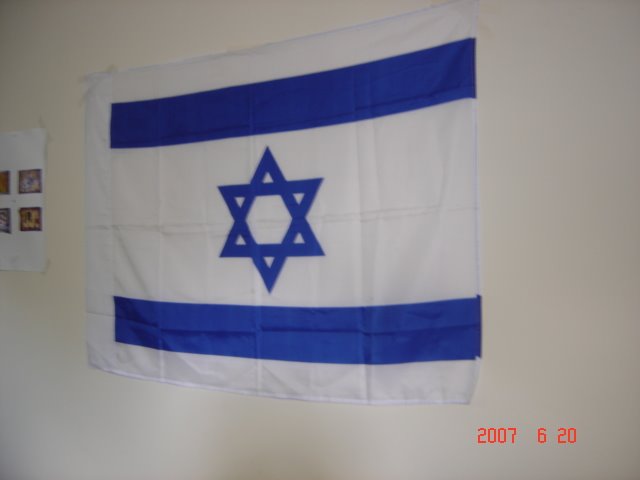
Wednesday, March 21, 2007

The New Palestinian Government

A. In light of the fact that the new Palestinian Government, based on the platform formulated and approved by it, does not accept the principles of the international community: recognition of Israel's right to exist, elimination of terror and the dismantling of terrorist infrastructure, and recognition of the agreements signed with Israel including the Roadmap, Israel will not be able to work with the Government or any of its ministers.

B. Israel will continue to work with Mahmoud Abbas in order to advance issues of security and issues pertaining to improving the quality of living of the Palestinian population.

C. The Palestinian Government's platform, which include, inter alia, the use of terror as a legitimate right, the acceptance of previous agreements with Israel based only in accordance with Palestinian interests, as well as limitations the Chairman of the Palestinian Authority took upon himself, including bringing any agreement with Israel to the authorization of the new Palestinian National Council and the Palestinian Diaspora, gives, in essence, a veto right to Hamas and other terrorist organizations over any agreement that would be reached with Israel, and limits the possibilities and range of topics which Israel can discuss with the Chairman of the Palestinian Authority.

D. Israel will continue to demand that the Chairman of the Palestinian Authority implement his obligations: to bring about the unconditional release of the abducted soldier Gilad Shalit, to stop Kassam missile attacks, to dismantle the terrorist organizations and their infrastructure in the Palestinian Authority and to fully implement the first stage of the Roadmap.

E. Israel expects the international community to maintain the policy it has taken over the past year of isolating the Palestinian Government, until it recognizes the three principles of the Quartet.

F. Israel has not changed its position; Israel is for peace with the Palestinians according to the Roadmap. Israel continues to stand for a two state solution. Israel is ready to initiate contacts with any government in the Palestinian Authority, whatever the composition of it may be, which fulfills the conditions of the international community, and will be willing to discuss all issues with it.

Friday, March 16, 2007

AIPAC CONFERENCE

AIPAC CONFERENCE

ADDRESS BY:

H.E. Tzipi Livni

Vice Prime Minister and Minister of Foreign Affairs

12 March 2007

Thank you.

Ladies and Gentlemen,

Dear Friends,

It is a great honor for me to be here today.

I believe that we are defined - as individuals, as leaders and as nations - by our values and by the choices we make to defend them.

The American-Israeli strategic alliance is a partnership built on common values and not just common interests.

In a world where so much is based on narrow interest, an alliance that is founded on shared ideals is unique.

This alliance transcends politics.

Here, in the U.S., it enjoys bipartisan support.

And in Israel – where we love to argue about almost everything – I can assure you that on the American-Israeli relationship you will hear only one voice.

We, the people of Israel, cherish this friendship.

Our governments are partners; our peoples are friends - in good times and in bad.

We must never take this for granted and – because of that – we will never take AIPAC for granted.

Let me say loudly and clearly on behalf of the government and people of Israel: Thank you AIPAC.

The U.S.-Israel relationship is of utmost importance, especially now.

We are in the midst of a struggle for the future of the free world.

The outcome of this struggle will shape this century and the kind of world we - Americans and Israelis - pass on to our children.

The cost has already been painful and our hearts go out to those families who lost their loved ones in this struggle.

Dear Friends,

There are moments in history where the threats are clear and prevention is possible, but only if we work together.

In order to confront threats, we must first identify and understand them.

Our world is changing and being divided between moderates and extremists.

Extremist forces seek to transform national conflicts, which are resolvable, into an endless religious war.

The extremists are not fighting for their own rights – they are fighting to deprive others of their rights.

The extremists use mass media, like Al Jazeera and the Internet, not to promote co-existence but to spread hate.

The extremists want to exploit our values – our desire to resolve conflicts peacefully and our tolerance for others.

The Middle East is also changing.

Yes, there are threats. We can see the extremists headed by Iran, with its proxy Hezbollah in Lebanon and Hamas in the Palestinian Authority.

But there are also new opportunities.

We can see the old divisions of the Middle East being replaced. Israelis, moderate Palestinians, and pragmatic Arab and Muslim leaders are moving into the same camp – sharing the same interests for a peaceful and stable Middle East.

We need a dual strategy that empowers the moderates while, at the same time, weakening the extremists.

Ladies and gentleman,

To address extremism is to address Iran.

This is a regime which calls for the destruction of a State, a member of the United Nations, Israel - my home.

This alone should deny it a place in the community of nations.

It is a regime which denies the Holocaust, while threatening the world with a new one.

It is a regime driven by a radical religious ideology with the goal of dominating the region, exporting terror, and preventing peace.

The Iranian threat is clear not just to Israel and the Western world. Many Arab and Gulf States feel it too. They also cannot afford a nuclear Iran and, believe me, love for Israel has nothing to do with it.

They know, as we do, that even if the Israeli-Palestinian conflict magically disappeared, Iran's radical ideology would remain.

And they know, as we do, that there is no path to a stable world, or a peaceful Middle East, that does not involve addressing this threat.

The international community must not close its eyes. It must defeat this danger not for Israel's sake, but for its own – for the sake of its own security and for the sake of the values it claims to hold dear.

We know that there is much more that needs to be done and time is of the essence.

The initial sanctions on Tehran have had an impact and, as part of our collective effort, they must be strengthened and expanded without delay.

And to those States, who know the threat, but still hesitate because of narrow economic or political interests let me say this: History will remember.

The free world is being watched.

The Middle East is a tough neighborhood. And when there is a bully in this neighborhood there are only two choices, to beat it or to join it.

If States in the region feel that the world will not stop Iran, they may feel the need to appease it.

We live in a region where images matter, and where the perception of weakness can have far-reaching consequences.

If we appease the extremists – if they feel that we are backing down - they will sense victory and become more dangerous not only to the region, but to the world.

This applies to the decisions made on Iran, it is true for Iraq; and it is true across the Middle East.

And it is why it is so important for the international community, with American leadership, to project strength, to demonstrate absolute determination in achieving its objectives and absolute commitment to its values.

The international community is also being tested in Lebanon.

The goals are clear: to establish an independent Lebanon, which exercises sovereignty over its territory, dismantles militias and enjoys peaceful relations with its neighbors.

But Syria, Iran and Hezbollah are determined to prevent this.

Security Council resolutions are clear on the actions that need to be taken.

The international forces in Lebanon have brought changes on the ground – but other parts of these resolutions must be implemented fully.

The immediate task is to enforce the arms embargo and prevent the ongoing efforts of Syria and Iran to rearm Hezbollah.

These illegal weapons destabilize Lebanon, endanger UNIFIL, and threaten Israel.

They must not and will not be tolerated.

Most painful for every Israeli is that the hostages Eldad Regev and Ehud Goldwasser remain in captivity.

Israel is one family. Eldad and Udi are our sons, and we will do everything, but everything, in our power to bring them home.

Our enemies see this desire as our weakness. They are wrong. It is our greatest strength.

Dear Friends,

When it comes to the Israeli-Palestinian conflict, our vision for peace is drawn from the ultimate goal of Israel, the reason for its existence – to be a Jewish and democratic State, secure in our ancient homeland.

We want to live in peace.

We have no desire to control Palestinian lives.

We deserve security.

Our children deserve a future, free of hate and full of hope.

Based on these core principles, the vision of peace is clear:

Two States, two homelands, for two peoples – Israel, homeland for the Jewish people wherever they may be. And Palestine, the homeland, the national answer for the Palestinian people, wherever they may be, including the refugees.

Two States living in peace and security – the meaning of this is also clear. The future State of Palestine cannot be a terror State.

And that is why President Bush's vision and the Roadmap insist that the road to statehood goes through the elimination of terrorism.

This is not a zero sum-game. This vision is not pro-Israeli or pro-Palestinian. It is pro-peace.

Israel has made its choice. Across Israeli society we have embraced this vision, and accepted the sacrifices that come with it.

The disengagement plan proved this. With great pain, we uprooted families from their homes in order to create an opportunity for peace.

Sadly, we received terror in return.

And yet, we have not stopped hoping that the Palestinians will make their choice for peace.

Unfortunately, in the last elections they chose Hamas, a terrorist organization driven by an extreme religious ideology.

Hamas's goal is not to create a Palestinian State, but to destroy the Jewish one.

The international community, through the Quartet, has repeatedly insisted that any Palestinian government must fully commit to three core principles: renunciation of terror, recognition of Israel, and acceptance of previous agreements.

These requirements are not obstacles to peace, but fundamental principles for peace.

I believe in dialogue - but there are some things that are not up for negotiation.

We cannot and we will not negotiate our right to exist. No-one has the right to do so in our name.

We cannot and we will not negotiate about the need to accept former agreements. They are the outcome of tough negotiations and mutual concessions - they are not a menu to choose from.

And, of course, we will never negotiate over terror. Israeli lives are not bargaining chips.

This is the test for the Palestinian government as a whole, regardless of its members.

We expect the international community to defend the requirements for peace. We expect it to stand against terror, not compromise with it.

Ladies and Gentleman,

Stagnation is not in our interest and is not our policy.

This is the reason that despite our disappointment from the Mecca agreement, we have not closed the door to dialogue with the moderates.

Just yesterday, Prime Minister Olmert met with Chairman Abbas.

But we must understand that the chance for peace depends on a clear distinction between the moderates and the extremists.

Being a moderate is a title that has to be earned.

A moderate is someone who is ready to confront terror; someone who believes in the two State vision and accepts its true meaning.

Israel remains willing to work with the moderates, if they are willing to empower themselves and distinguish themselves from the enemies of peace.

This includes undertaking genuine efforts to release of Gilad Shalit – who is in our prayers every day.

It includes bringing an end to daily attacks on Israeli homes and the smuggling of weapons across the Gaza-Egypt border.

And it includes preparing the Palestinian people for the compromises and historic reconciliation that any true peace will require from both sides.

Dear Friends,

All of us are eager to see peace in the Middle East. Nobody wants it more than Israel. This is about our lives and the future of our children.

Lasting peace is possible if it is built on solid foundations and shared values.

Despite all the challenges, I am optimistic - I can see new opportunities emerging.

Moderate and pragmatic leaders are beginning to see Israel not as an enemy of the violent past, but as a partner in a common and peaceful future.

The challenge we all face, as leaders in the Middle East, is to say this publicly to our people and to teach it to our children.

We are ready to do our part, and we hope our neighbors are ready to do theirs.

And today - from this podium - I call on Arab and Muslim States – those who condition their relations with Israel on the end of the Israeli-Palestinian conflict – not to wait any more.

You have the power to change reality, and to encourage Palestinians to embrace co-existence.

Do not wait for peace to come before you normalize relations with us – normalize now and peace will come.

Ladies and Gentleman,

As we say in Hebrew אין לי ארץ אחרת"" - we have no other homeland.

We also have no other values.

For 60 years we have fought for our existence without compromising our principles, our vision, or our dream for peace.

We are moderates by definition - we are not threatening to turn into extremists.

I believe in Israel and am proud to represent it.

I am proud of the strength and vitality of our economy.

I believe in the courage and innovation of our people.

And I believe in the U.S.-Israeli partnership and the values on which it is founded.

I know that you feel the same.

And the future depends on us.

Thank you.


Goldwasser Schalit e Regev

Os nossos filhos queridos voltarão à nossa Pátria ISRAEL

Veja Chaver:

http://www.banim.org/en/index_en.html

Eventos de uma nossa comunidade

OS PRINCIPAIS EVENTOS DA COMUNIDADE E OS ASSUNTOS MAIS INTERESSANTES ESTÃO NOWWW.GLORINHACOHEN.COM.BR

CONFIRA OS DESTAQUES DESTA EDIÇÃO:

ESPECIAL - PREFERÊNCIA NACIONAL: artigo da jornalista Danielle Curia sobre Miguel Mignatios, novo presidente da ADVB.- BRASIL E ISRAEL: acordo de cooperação bilateral em pesquisa e desenvolvimento industrial no setor privado.

- MAIOR PRÊMIO CIENTÍFICO DO BRASIL: Felipe Arditi, aluno do Colégio Bialik, é o ganhador.

- O SUCESSO DO RABINO SOBEL EM RIBEIRÃO PRETO.- RELAXAMENTO: música clássica é a melhor forma para relaxar, segundo recentes pesquisas.- VINHOS - O FRESCOR DOS BRANCOS NO VERÃO: matéria do jornalista Ricardo Perucchi mostra como escolher o melhor vinho, com vocabulário básico sobre o tema.

FIQUE POR DENTRO
- CURSOS VIVER ARTE 2007.
- CENTRO DA CULTURA JUDAICA: "Amores Insólitos - Três Contos de Moacyr Sclair", dia 15 de março e "Destaques da Literatura", dia 20 de março;
- ARTE JUDAICA NO ARTE DA VILA: dias 24 e 25 de março.
- CONCERTO DA BANDA SINFÔNICA ESTADUAL: dia 21 de março no Theatro Cultura Artística.
- ALMOÇO/JOGO DAS PIONEIRAS: dia 19 de março.
- EXPOSIÇÃO JAZZ SINFÔNICA NO MIS: a partir de 14 de março.
- O BAZAR DO GRUPO CHAVERIM: dias 26 e 27 de março.
FIRST CLASS - MY FAIR LADY: a noite de gala que beneficiou várias entidades.- ALMOÇO DE PURIM NO CENTRO JUDAICO NOVO HORIZONTE: os maiorais da comunidade prestigiam o rabino Noah Gansburg.- DIA INTERNACIONAL DA MULHER: a homenagem que a Wizo prestou a Jô Clemente, presidente da APAE.- JANTAR DE PURIM NO PALÁCIO DOS BANDEIRANTES: feito pela Sinagoga do Morumbi.
- SHOW DO BÓRIS KARLIK NO VILLAGGIO CAFÉ.
- LANÇAMENTO DO LIVRO DE LUIS GAJ, vice-presidente da Região Centro-Sul da B'nai B'rith do Brasil.
MEDICINA & SAÚDE - "CÂNCER - DIREITO E CIDADANIA" - artigo da advogada Adriana Zaits Susskind

Parshas Vayakhel- Pekudei 5767

Rabbi Label Lam


Taste and See HASHEM is Good!

For the cloud of HASHEM would be on the Tabernacle by day, and the firewould be on it by night before the eyes of all the children of Israelthroughout their journeys. (Shemos 40:38)

Perhaps your heart will say, “Just as it shined for Israel did it not alsoshine for the nations of the world?” So the verse comes to teach us, “tothe eyes of all the children of Israel”, - on all of Israel it shone butnot to the nations of the world! (Sifri)

How do we understand that the light shone for one group and not foranother?

The Alter from Kelm, Reb Simcha Zissel Ziv asked an important questionabout the following Mishne in Pirke’ Avos; “This is the way of Torah: Eatbread with salt, drink water in small measure, sleep on the ground, live alife of deprivation- but toil in Torah. If you do this, “Happy you will beand it will be good for you” – “happy” you will be in this world and itwill be “good for you” in the next world! (Avos 6:4) The Alter askedabout the latter part of the Mishne, that we can understand how this self-sacrificing approach can gain for men goodness in an-other-worldly settingbut how does the Mishne confidently promise happiness in this world?

The answer he offers emerges from a careful reading of the Mishne. Hehighlights the words, “If you do this”. If you are the one who is doing itthen you can be the one to experience true happiness. If a visitor from aricher culture and with an untutored eye, would peer into a hall of Torahstudy in Meah She’arim and observe the austere living and learningconditions within, it would most likely arouse feelings of pity. However,if you are the one who is doing it, learning with vigor and rigor then theexperience from within is a-sweet joy beyond- beyond.

Yawning at dawn in a Jerusalem study hall my early morning study partnerexplained something to me that I had always misunderstood andmisrepresented. Since we (I) were (was) so tired, I commented loosely,that I didn‘t know how the Vilna Gaon got away with only two hours ofsleep total in a 24 hour cycle. He told me that the Vilna Gaon did notsleep two hours daily. I insisted that it was true and that I had read itin an authenticated biography but he stubbornly refused to accept it. Thenhe explained, “The Vilna Gaon learned 22 hours each day! He was not intosleep deprivation as much a he was involved in the sublime joy oflearning.

I remember discussing with some friends in Yeshiva the idea of making amovie of some kind that would entice others to come join us in learning.The conversation concluded with a consensus that it was probably anexercise in futility. What would convince people that learning is fun?What could we possibly show? People shaking back and forth? How could wereveal in a visual medium the joy being generated in the minds of thoselearning- Torah?

The Nefesh HaChaim writes: “And so a person from the Holy Nation thatcontains the whole organization of the creation…he is also constructedlike the Tabernacle and the Temple and its vessels, corresponding to theorder and connections of the segments of the limbs and the ligaments andtheir functions. So it is detailed in the Zohar how the Tabernacle and itsvessels are each referring to Man.”

Like the Tabernacle, if the deep delight of the Vilna Gaon’s Torahlearning would be visible then the world would be blinded by the light.It’s an acquired taste, though, not accessible to dabblers through visualacuity alone, and so King David wrote in Tehillim: “Taste and see HASHEMis good!”

VAYAKHEL-PHEKUDEI

PROVE IT

RABI RAYMOND BEYDA


The final chapters of the book of Shemot outline the completion ofthe construction of the Tabernacle. Moshe called for a detailed audit ofall the materials collected for the project and the specific amounts anduse thereof. Our leader wanted teach that leaders must be above reproachand must keep accounts of all public monies that pass through their hands.
The Tabernacle is referred to as one of "testimony” i.e. ademonstration that Hashem had forgiven the people for their trespasseswith the Golden Calf. Another reason why the Mishkan was called atestimony is because it was the resting place of the Tablets of Testimonythat Moshe carried down from Har Sinai. The Midrash, However, givesanother surprising reason for the nomenclature.

"It is a testimony to all peoples of the World that Hashem commandedits construction." The commentators explain that the intent here is to saythat Moshe did not decide on his own to build a Mishkan -- rather it wasat the behest of G-d.

The question is: If Hashem wanted to clarify this fact, why waituntil the final stages of construction to hint at this principle? Wouldn'tit make more sense to clarify this point before the collection of all thevaluable materials needed to do the job?

Rabenu Yosef Hayim of Baghdad, zt'l, The Ben Ish Hai, explains with aparable. A King married a woman and treated her royally, showering herwith precious gifts and honor. He became infuriated over an act ofunfaithfulness and angrily separated from her. The members of the royalcourt predicted that he would never allow her to return.

However, after time had passed, he sent a message to his formerlove.

"Clean your palace and set your domain for a royal visit. I amplanning to come to see you."

Not long after the King arrived and entered the Queen's home. He ateand drank and chatted with her --much to the disbelief of the members ofthe court. When the fragrance of perfumes and oils came from the Queen'sresidence the people understood that the King had been appeased and thatshe was back in his majesty's favor.

Such was the case with Hashem and the people of Israel. He broughtthem to Mount Sinai and gave them His most precious possession -- theTorah -- and he dubbed them royalty -- a Kingdom of Kohanim. After only 40days they sinned and He left them and the nations of the world predictedthat He would never take them back. But, as soon as Moshe prayed on theirbehalf He did forgive His beloved.
Moshe then said: "I know that you have forgiven them but pleasedemonstrate beyond a doubt to all the peoples of the Earth that indeed youhave accepted my prayers"

Hashem replied: ''By your life, I swear that I have taken them back.Build for Me a Mishkan and I will come and dwell amongst them for theentire world to see. This Tabernacle will serve as a TESTIMONY that I haveforgiven the Jewish people.”

In these hard times of brutal exile we should all take this messageto heart. May Hashem return His presence to a New Temple in Yerushalayimand again demonstrate His love for us, His People, with the coming of

Mashiah speedily and in our days. Amen.

Shabbat Shalom

ADL

Cartas Ao Nosso Presidente:

Dear Andre Moshè Pereira,

For more than 30 years, ADL has produced an annual review and analysis of anti-Semitic incidents in the U.S. We have just released our 2006 Audit of Anti-Semitic Incidents. The 2006 audit reports approximately 1,500 anti-Semitic incidents across the U.S.

It is important to note that while the audit indicates a decline in anti-Semitic events in the U.S., we saw a troubling level of violent anti-Semitism, such as shootings, beatings, graffiti and other forms of vandalism. The deadly attack on the Jewish Federation in Seattle, an anti-Semitic assault of a Brooklyn woman on the subway and the brutal beatings of two Jewish men in Phoenix are sobering reminders that violent acts of anti-Semitism continue in the U.S.

Read the full 2006 Audit of Anti-Semitic Incidents for more information on anti-Semitic events on campus, harassment by hate groups, a slideshow of anti-Semitic incidents and a state-by-state tally of incidents near you. Help ADL continue to track and report anti-Semitic incidents and fight the ongoing battle against anti-Semitism.

O isso e eu - outro

André Veríssimo*
Presidente Koah, Dir CEIMOM


Ocorreu-lhe falar de – Isso? E por vezes (muitas vezes) pensar que é um Sujeito, e não uma Coisa?

A consciência é entendida, no sentido comum, como a atenção reflexiva aos próprios modos de ser, perceber e agir. Ela constitui a “experiência subjectiva do eu interior” (Chalmers Chalmers, D. J. 2004. “O enigma da consciência.” Scientific American, Edição Especial: Segredos da Mente, nº 4: 40).

1. ISSO PENSA: a noção de sistema não é completamente nova. Os economistas do século XIX utilizavam-no sem o saber quando tentavam rotular um paradigma geral de economia dando conta das relações entre a oferta, a procura, a moeda, o capital…; e Karl Marx também quando procurava por em relação numa visão global da sociedade as infraestruturas económicas e as superestruturas políticas, sociais e ideológicas. O pai da cibernética é Norbert Wiener, matemático do M.I.T. (Massachusetts Institute of Technology), (Cf. N. Wiener, Cybernétique et société, Paris, U.G.E. (para e edição francesa)). “Em 1940, trabalhava com um jovem na afinação de aparelhos de pilotagem automática para canhões antiaéreos. Descobriram então que tais servomecanismos apresentavam certas analogias assombrosas com o funcionamento do sistema nervoso; eles demonstram nomeadamente que, para controlar uma acção orientada para um termo (como a D.C.A.), a circulação das informações necessárias deve formar um «círculo» fechado no qual a máquina avalia dos efeitos das suas acções e corrige o comportamento futuro utilizando os desempenhos passados; o processo é designado pela noção de feed-back (ou retroacção). Desde logo, a via cibernética consiste em aplicar a todos os domínios de conduta e de gestão de organismos complexos os modelos nascidos do encontro entre a mecânica e a biologia. É fundado um seminário onde se reúnem matemáticos, neurofisiólogos e engenheiros electrónicos. Paulatinamente constituíram-se as bases duma linguagem comum (aprendizagem, memória, regulação, retroacção, homeostasia, etc.). Ao mesmo tempo, esta nova via estende-se a outras disciplinas como a economia, a gestão de empresas, a sociologia ou a antropologia; neste último domínio, Margaret Mead e Gregory Bateson mostram-se muito interessados pelas pesquisas de Wiener e esforçam-se em as aplicar à compreensão dos processos culturais”. Assim exprimem os teóricos Edmond Marc e Dominique Picard em L’Ecole de Palo Alto - Un Nouveau regard sur les relations humaines, Edição Retz, Paris. A noção de sistema é uma noção muito geral que tem sido objecto de numerosas definições. A mais corrente é a de «um conjunto de elementos em interacção tal que uma modificação de um deles implica a modificação de todos os outros». Vê-se que se trata de uma modificação extremamente lata e que pode aplicar-se praticamente a todo o fenómeno. Dizem Marc e Picard: “a célula de um organismo vivo pode ser considerada como um sistema; ela constitui uma totalidade que obedece a regras precisas; mantém a sua organização interna a despeito dos fluxos de energia e dos materiais que a atravessam. Para assegurar a permanência da sua estrutura e das suas funções, ela exige agentes de transformação, as enzimas, que são catalisadores que controlam a actividade celular, e dos ácidos nucleicos e centralizam as informações necessárias à reunião das proteínas e das enzimas e à reprodução da célula. Ela comporta assim as moléculas-sinais que permitem as comunicações. Uma membrana assegura a filtragem da comunicação com o exterior e controla entradas e as saídas da energia de informação. O controlo último da actividade celular passa pela síntese das enzimas realizada a partir dos modelos contidos no núcleo.” (Id.,Ib.). O microcosmos biológico está auto-organizado de forma eficiente e modelar.

2. EU-OUTRO: Se nós vivêssemos infinitamente não haveria nenhum interesse em maximizar os lucros, o conservar o tempo, organizá-lo eficientemente, etc. O si-mesmo, o self ou o ipsum necessita assim encontrar o seu lugar na vida, face à morte. É não somente certa a morte para o si-mesmo, mas também para o outro. Ao mesmo tempo, a morte não é algo que nós contemplamos sempre realmente mas que remanesce sempre em lugar remoto e destacado. Este fundo do tempo finito e de morte determinada é uma característica compartilhada da filosofia francesa de Montaigne (1910) a Levinas (1983). As obrigações morais vêm a ser porque nós nos defrontamos connosco e o outro na finitude (Weil 1998). Não são parte de uma escolha livre mas de constantes antropológicas. Isto é importante manter-se na mente enquanto nós encadeemos a ênfase do interpretativismo fenomenológico para compreender o outro com a obrigação de o considerar nas implicações das relações éticas. A ética está proporcionada pelo desejo teleológico por uma vida boa. Isto é baseado na compreensão aristotélica da ética e enfatiza a importância da teleologia como a base do pensar ético. A primeira etapa é pensar sobre normas e a construção da cooperação que devem sempre ser uma definição das nossas ideias individuais e colectivas de uma vida boa. A segunda etapa é o estudo em concreto da representação dos deveres e as obrigações que nos cercam. A moralidade é representada melhor por uma deontologia de prisma Kantiano, pela tentativa de encontrar as normas ou as máximas que são universalizáveis. Os aspectos normativos estão ligados proximamente como base hermenêutica e fenomenológica da filosofia de Emmanuel Levinas e particularmente com o conceito de outro. Outras figuras fortemente presentes na sua caracterização breve da ética como apontando para a vida boa, com e para os outros, em instituições justas (Ricœur, 1990). [Os níveis diferentes do raciocínio ético estão ligados também aos outros, por exemplo, às nossas comunidades de origem criptojudaica ou judaica com reconhecimento Halachico...]. A razão é que não estamos sozinhos e que mesmo uma noção compartilhada da vida boa nos não manterá seguros. A fim evitar e superar a violência nós necessitamos da transição da ideia teleológica da vida boa para regras e obrigações deontológicas. A ideia da violência é onde, a concepção de Levinas do outro, se incorpora no jogo, outra vez. As considerações éticas não podem ser limitadas ao si-mesmo e ao outro, mas há também o “terceiro” (Malka, 1984; Levinas, 1984). O terceiro é também alguém, outro, mas é distinto do outro como é apresentado acima pelo facto que não interage com o si-mesmo mas com o outro. Se o outro cometer a violência ao terceiro, o si-mesmo, pode ter a obrigação ética de intervir. Uma outra aproximação ao relacionamento da ética/moralidade e do outro é o conceito da responsabilidade. A etimologia do termo sugere que a responsabilidade está ligada de forma muito próxima à resposta, é a “resposta”. Isto significa que o outro é de importância constitutiva para a responsabilidade. A responsabilidade está ligada a todos os três dos níveis normativos. É baseada numa vista compartilhada da vida boa e permite a consideração das ocorrências futuras. A pesquisa de Fenomenologia Interpretativa reivindica frequentemente ser baseada em, ou usar pensamentos fenomenológicos, ao ponto em que Galliers (1991) iguala os dois. Fenomenologia como um termo é um tanto ambígua. Pode respeitar às descrições gerais da primeira-pessoa da experiência humana ou pode referir-se à aproximação filosófica desenvolvida por Husserl e estendida por outros autores como Heidegger ou Merleau-Ponty (Beavers, 2002). O alvo da fenomenologia era superar a inacessibilidade percebida da filosofia estabelecida e ir atrás das coisas mesmas e descobrir as suas essências. A fenomenologia assim tem que ver com a automanifestação (Moran, 2000). Para Heidegger (1993) a fenomenologia é a ciência do ser dos essentes (Wissenschaft vom Sein des Seienden) e parte assim da ontologia. Apesar do uso dos termos tais como a “essência”, as “coisas elas mesmas”, ou a “ontologia”, a fenomenologia não trata duma realidade objectiva, similar ao realismo. Antes, o ponto do começar da fenomenologia é tal que os fenómenos, as manifestações das nossas percepções, são resultados de actos conscienciosos e dados não independentemente. A razão porque temos um mundo é a de que a nossa consciência o abre até nós, o faz significante e o divulga.

Thursday, March 08, 2007

Parshas KiSissa 5767

Rabbi Label Lam

The Golden Thread of Our Existence

The Children of Israel shall observe the Shabbos, to make the Shabbos aneternal covenant for their generations. (Shemos 31:16)

What is meant by “for their generations”? Rebbi says, “All who keep theShabbos according to its specifications, the verse speaks about them as ifthey had kept every Shabbos from the time that HASHEM created His worlduntil the time of the revival of the dead!” (Mechilta)

It’s a gross understatement to say that Shabbos is an “important” day.What makes some days more important than others? There are certain daysfor which many other days are sacrificed. A short list would include, aBar Mitzvah, a wedding, Rosh HaShana.

When we examine a few of the examples mentioned above we discover thatthose single days for which so much has been invested are not single daysat all. They hold much more that meets the casual eye. A Bar Mitzvah boy-man is suiting himself up for manhood. He is effectively accepting uponhimself a lifetime of responsibility at those magic moments. Thefoundation for the building of his life is being poured. The steadinesshis entire structure rests upon the firmness of his commitment that day.So we dress it up and highlight its importance so it should not go byunderutilized. The same holds true of a wedding in a more obvious way.Similarly, the entire year and its events are scripted on Rosh HaShanamuch as DNA hold the code for all living organisms. These are not ordinarysingle days.

At a Bris in Jerusalem a guest Rabbi stood up to speak and wish well tothe grandfather of the new born on the occasion of his first grand-child, “Mazel Tov today you are a human being!” Everyone was stunned.

Maybe there is some hidden insult implied here. Until now he wasn’t human?Then he went on to explain that in the animal kingdom it is common to findcreatures that have an instinct to protect its young cub, kitten,fledgling you name it. However, only by humans does a grandparentdemonstrate love and care for his or her grandchild. This is symptomaticof real soulfulness to see one’s self in a grander historical or familialcontext and to care for the opinion of grandparents or grandchildren.

A great Rabbi, a well-known personality remarked almost sardonically thathis main goal at this later stage of his life was to impress hisgrandchildren. Then he added a caveat when the chuckle of laughterquieted, “I’m not kidding!” One grandmother commented with an uncommonfrankness about her feelings of extra love and adoration for her ShomerShabbos grandchildren over and above her other biologicalgrandchildren, “When I see these children I see the whole past and thewhole future! When I see those, I don’t see the past and I don’t see thefuture!”

To be Shomer Shabbos explains the Ohr HaChaim is to wait and anticipatewhen it will arrive, like one awaits an important guest. He learns thisfrom Yaakov who rebuked Yosef outwardly for revealing the dreams to hisbrothers but the verse records that he privately kept the matter, andRashi explains that he waited with great anticipation when it will berealized. From there we learn the definition of keeping the Shabbos! Welive for and work for, investing in Shabbos a whole week.

Shabbos, though, is not just a single day in the weekly cycle. Everythingis contained in that day, the entire past and the entire future. It can besaid that Shabbos is not less than the golden thread of our existence.

Friday, March 02, 2007

Well Oiled System

bs"dTETZAVEH-ZACHORA

FRIDAY NIGHT: Command the Children of Israel to bring clear olive oil, beaten for the light, so the Menorah can burn continuously. (Shemot 27:20)

One again, Parashat Tetzaveh is also Parashat Zachor, when we recall the roots of Haman. Ironically, since Tetzaveh begins speaking about the Menorah, it is really more akin to Chanukah than to Purim. However, this too has to be a function of Hashgochah Pratit (Divine Providence) whichmeans it is no coincidence about this, and that there has to be meaning in this as well.

What is also ironic is that, of all the parshiot that Zachor lines up with, Tetzaveh is the one in which Moshe Rabbeinu is not mentioned, for having told G-d to erase him from the Torah if G-d destroyed the Jewish people because of the sin of the golden calf. It’s almost like going to battle against Amalek without our main warrior, the one person who knows how to actually battle Amalek.
However, upon giving this matter further thought, you might recall that when it came time to the actual fight against the people of Amalek, Moshe Rabbeinu was indeed absent from the battlefield. And, it was not because he was some kind of paper-pushing general out of harm’s way, because when it came time to fight Sichon and Og, he led the charge himself.Yet, in the war against Amalek, it was Yehoshua who was appointed and led the troops into battle, while Moshe Rabbeinu climbed the mountain and raised his arms Heavenward to help the Jewish army succeed. In other words, he was there but behind the scenes, so-to-speak, which is not whatone might expect in such a crucial battle, unless, of course, that was the whole point of the battle.
In fact, the Vilna Gaon explains that when G-d told Moshe Rabbeinu, at the end of Parashat Beshallach, to speak “b’aznei Yehoshua” (in the ears of Yehoshua) regarding the ongoing war against Amalek, it was an allusion to the necessity of Sod (Hidden Torah) to defeat Amalek. For, the gematria of “b’aznei” is 70, the gematria of Sod, and even the act of “whispering” into the ear of Yehoshua is symbolic of the hidden. And, as we say with respect to Purim: “When wine goes in, secrets come out”, since the gematria of “yaiin” (wine) and “sod” (secret) are the same.
This is also exactly what the shemen zayit (olive oil) in this week’s parshah represents as well, especially with respect to Chanukah and the Menorah. The olive itself represents the world of Pshat, which conceals the hidden mystical reality of the oil inside, only made visible once it is “squeezed” from the olive and then ignited. Thus, the overall message of Chanukah is: Nothing is necessarily on the inside what it seems to be on the outside, or in more colloquial terms: “You can’t judge a book byits cover”.
This was and is, certainly true about Amalek. Indeed, Yehoshua had to find soldiers who knew how to deal with Black Magic since the Amalekians were experts at it. The war against Amalek was far from being conventional, and it is always unconventional, which is why we often don’t know that we’re in the middle of a battle against him until, unfortunately, it is too late. For, like an iceberg, most of which is below the surface of the water, hidden from view, Amalek does most of his fighting behind the scenes and only goes out in the open once all of his groundwork has been laid.
That is why Megillat Esther traces Haman’s rise to power, from obscurity to second-in-command over all of Persia. He was not born into power, explains the Talmud, but actually began as a slave. Likewise, Hitler, y”s, began as a bar-room brawler, and then all-of-sudden one day, he and his cohorts rose to power until he actually became chancellor of one of the most important and powerful European countries, with his cohorts who became his all-powerful commanders.

“If only we had known what they would all become, then we might have…”

Wishful thinking, but after the fact.
SHABBAT DAY:
Remember that which Amalek did to you on your way when you left Egypt, encountering you along the way and attacking the weak who straggled after you, while you were tired. He came after you and did not fear G-d.(Devarim 25:17-18)
It is like comparing the taking of vitamins to antibiotics. We take vitamins to maintain our health, but we take antibiotics to restore it.
There is a big difference between the two approaches, since to maintain health one need only to make sure his body is getting all its proper nutrients, which are natural and healthy, so that the body can do its job of warding off attacks from vicious bacterial or viral invaders.
Not so with antibiotics. Antibiotics contain the very bacteria that we are trying to remove from our bodies. However, since the bacteria is already in the system and attacking it, the immune system has to be coaxed into overdrive to push it out. Therefore, we inject our bodies with a safe amount of the bacteria in order to “kick-start” our immune system against the real intruders.
Not only this, but since the body is already beset with illness, it may tire more easily and show other signs of breaking down, such as watery eyes, etc. The unwell person has to change his eating habits and increase the amount of sleep he gets, and may be unable to accomplish even a fraction of what he does when he is feeling good. So much time, energy and focus has to be shifted to the new demands of the body, which can be very disheartening.
The thing is that we can be in the midst of becoming ill for an entire week and not even know it, since most of the attack takes place internally. It is only after the illness has more or less vanquished our bodies already that we are finally forced to take note of our health status and tend to it in order to recover our health, well after the fact, a process that can sometimes take weeks to complete, if not longer. The rules that apply for maintaining health no longer apply during the times of regaining it.
It’s all about signs, and about being able to read them. Just like countries have early-warning systems, bodies do as well. They may be small, and they may be subtle, but they are the only “eyes” we have into the future, and to remain healthy and safe one must become sensitive to them and be prepared to deal with them as early as possible. This is why the first gate about which the Ramchal writes in “Mesillat Yesharim” is called “Zehirut”, often translated as “Watchfulness”.
The trouble is that, in order to maintain such vigilance, requires an ongoing act of will. It is so easy to fall asleep on the job, especially when the world around us, on the surface of things, seems so quiet and stable. Of the many dangerous assumptions about life that we make, one of the most dangerous is that if we can’t actually “hear” the battle taking place, we assume that there isn’t one. However, history has proved that by the time a battle becomes evident to the eyes and the ears, it is well after the fact and we usually find ourselves vulnerable and on the defensive.
To avoid such negligence, countries send spies out to settle in the countries of concern to keep an eye on the potential dangers. While the rest of the citizens back home go about their daily activities with a sense of safety and security, the spies live their lives as if they are secretly at war, looking at whatever they can see or listen to, and whatever they can hear to know if an enemy exists,in order to know what he is doing behind the scenes in advance of an overt attack. This is especially true when it comes to Amalek, who, apparently, never takes a break from his battle against the Jewish people.
If Amalek doesn’t take a break in the battle, how can we? If he works behind the scenes to attack and destroy us, shouldn't we be doing the same to at least prepare ourselves for what he has planned for us, and try to eliminate him altogether?
Encountering (korchecha) you along the way: Yet another explanation is that it is the language of “kur v’chum” (cold and hot), as if to say that he made you cold and lukewarm after you had been boiling. For, all the nations were afraid to war against you and this one came and led the way for others. It is like a boiling hot bath into which no living being could enter, until a wild person came and jumped into it. Although he scalded himself, he made it cooler for others. (Rashi, Devarim 25:18)
SEUDAT SHLISHIT:
Now we can appreciate the role of Sod, and Moshe’s hiddenness in this week’s parshah and in the
battle against Amalek. You can’t fight what you can’t see, and you can’t see what you don’t understand. They say that, at first, the original tribes of America could not see the approaching ships even though they were there, since they had never before seen any ships of that size. All they saw were ripples in the water, until eventually their minds adjusted and they could perceive the big boats much to their surprise and shock.

We don’t see the bacteria or viruses in our body that are there every day, all the time. We don’t know about the raging battles taking place in our immune systems, so oblivious to the reality below the surface, that we may live our lives in such a way that jeopardizes our very success in that battle. If only we could see what is going on in our bodily system on a microscopic level, we’d live a whole different existence.


We’re just not quite at that point, technologically-speaking, where we can be attune to that, out in the streets or just sitting on our living room sofas. So, instead we go to doctors and do blood-work on a regular basis to try and catch microscopic anomalies while they are still microscopic and before they get out of hand, in order to deal with them with a minimal amount of disruption of our daily lives.
There is a lot of curiosity about Kabbalah today, what it is and what it can do to empower a person.


However, the real point of Kabbalah is to provide a Jew with a glimpse of the hidden world of Creation, the inner mechanism that makes it all work, in order to better equip a person that he take responsibility for his actions, and to recognize the signs early on before things don’t go the way they ought to go. It is the true blueprint for Creation so we can see why and what can go wrong.
Armed with such knowledge, one’s vision of reality is different. It’s almost like putting on special glasses that provide x-ray vision. As a result, a person is able to get a glimpse of the hidden world of Amalek, and see what he is up to even before he brings his war to the actual battlefield. This is what gave Mordechai his ability to see what Haman was before he came into power, and the foreknowledge with how to deal with him, avoid Haman's plans to destroy him, and eventually do away with Haman himself.
This is because we are living in Amalek’s world only on the level of Pshat. Therefore, by ascending the mountain, Moshe Rabbeinu rose above the reality of Amalek, and worked to elevate the Jewish people. By holding his arms upward, the Jewish people were only victorious when their vision of reality became elevated to a higher spiritual plan, neutralizing the power of Amalek.
In this way, both Chanukah and Purim represent the same idea: victory over the enemy comes not from without, but from within. For, the process of going from Pshat to Remez, and then to Drush, and finally to Sod is the same as going from Nefesh to Ruach, and then to Neshamah, and finally to Chiyah. The deeper one penetrates Torah, the higher the level of soul they access until they become so spiritual, they move themselves out of the reach of Amalek completely.
MELAVE MALKAH:Nefesh HaChaim, Chapter 22 (Final Chapter)
When Moshe brought the Torah down to earth, it was no longer considered to be in Heaven, lest a great man of understanding say, “I, who sees the secrets and the reasons behind the mitzvot as they pertain to the forces and the upper worlds, determine that it is right for me, according to the root of my Neshamah, or for someone else, according to his root, to transgress a particular mitzvah, G-d forbid, or to ignore some detail from its performance, or to perform with less stringency that which the rabbis have stipulated, or to alter its designated time, G-d forbid.
Thus, the Torah concludes by saying, “No other prophet has arisen likeMoshe…” (Devarim 34:10). From the verse, “These are the mitzvot” (Vayikra 27:34), the rabbis learn that a prophet is not allowed to create any new [mitzvot] (Shabbat 104a). The Torah itself states, “All that I have commanded you… you must not add to or detract from. When a prophet arises among you…” that is, to add or to detract from the mitzvot, G-d forbid, “Do not listen to the words of that prophet… After G-d, your G-d, you must go…”. (Devarim 13:1-5)
Chizkiah HaMelech saw through Ruach HaKodesh that an unfitting child (Menashe) would come from him, and therefore he didn’t want to marry (Brochot 10a). His pure intention was to reduce the amount of evil in the world, yet Yeshayahu brought word to him from G-d that “You are going to die… and you will not live” (Melachim 2:20:1); that is, you are not even going to the World-to-Come since you did not fulfill the mitzvah to have offspring. His superlative righteousness was not enough to bring him to the World-to-Come, because he did not fulfill one mitzvah from Torat Moshe, even though he saw with Ruach HaKodesh that an unfitting son would come from him, and all he did was to abstain [from having children]. The reasons and purpose of the mitzvot have yet to be revealed to anyone in this world except for Moshe Rabbeinu and Adam HaRishon, before he transgressed. This is what the Talmud refers to as, the “wine that is guarded within the grapes since the six days of creation” (Brochot 34b), and the “light that served on the first day allowed Adam to see from oneend of the world until the other”. (Chagigah 12a) The holy Torah in our midst is beyond us, beyond our intellectual grasp. Does man understand and possess the knowledge to begin to change its laws and its appointed times? This is what Yeshayahu told Chizkiah:
“What business have you with the secrets of G-d? What you were commanded to do you must fulfill; that which is good to G-d you must do.”
And though, while prophecy was still amongst the Jewish people, a prophet could do something novel based upon the demands of the moment, even if it meant violating a command of G-d, as in the case of Eliyahu on Mt. Carmel.

This too is part of Torat Moshe, which commands us “to listen to him” (Devarim 18:15), a warning to heed the words of a prophet even if he says in His name to violate a command when the moment requires it, except as the rabbis learn, to perform idol worship. (Yevamot 90b)
But, G-d forbid, that he should establish the novelty for all generations. When Esther, who is counted as one of the seven prophetesses (Megillah 14a), requested from the Chachamim to record the events for the generations, they answered her, “It has already been recorded three times” (Mishlei 22:20); [in order to record this particular “war” against Amalek] they had to find another verse to rely upon (Megillah 7a). And, in order to justify the obligation to light Chanukah candles, they also relied upon a verse…
Ever since the time that our transgressions caused an end to prophecy amongst the Jewish nation, even should the wisest among Israel, to whom the secrets of Creation and the Merkavah have been handed over, with their deep understanding and pure minds try to change even a single detail of any mitzvah, or only to advance or delay its time of performance, we cannot listen or consent to them — even though a Heavenly voice calls out, “Torah is no longer in Heaven”! (Bava Metzia 59b)
During the period of the redaction of the Talmud, it was still permissible for the leaders to create new decrees, like the lighting of the Chanukah candles or like the “Eighteen Decrees” (Shabbat 13b), if they found a source for such in the Torah, However, once the holy Talmud was closed, it is only for us to protect and perform that which is written in the holy

Written Law and the Oral Law, according to their judgments, their laws, their times, their details, and their specifics, without the slightest deviation.

When a Jew performs mitzvot as they ought to be done, even though he lacks intention, and even though he lacks knowledge of their reasons and their secret meanings, but nevertheless he does the mitzvah, then he rectifies worlds and he increases their holiness and light, each mitzvah accordingto its source and its role; he “strengthens” G-d. This is the way G-d established the world, that it should respond to the actions of man, and every mitzvah functions to achieve a unique purpose.
For the person who merits to understand the secrets of our holy Torah, which were handed to us for by the heavenly rabbis of the Talmud, such as Rabbi Shimon Bar Yochai and his colleagues and students, and from those who drank from his waters in subsequent generations, such as the holy and awesome man of G-d, the Arizal, who enlightened our eyes with some of the reasons and intentions of the mitzvot; it is only to allow each individual, according to his mind and ability to fathom, to realize just what an impact each act, word, or thought can make on the worlds and forces both above and below.
It is for the sake of inspiring him to fulfill each mitzvah, and all aspects in the service of G-d properly and carefully, in awe and in fear, with a deep love and a holy, happy and pure heart. In this way, a greater rectification can occur than that which would have occurred, had the mitzvah been performed without such holy and pure intentions. However, the essence of each mitzvah is in the specific way it was meant to be carried out [since the time Torah was given, and explained by the rabbis of the Mishnaic and Talmudic period].
Have a great Shabbat,

PW

Feliz Purim

Wij wensen u allen een Vrolijk Poeriem
We wish you all a Happy Purim
Bep en Kehillah or Ahayim en
de gehele
and the wholefamilie

Parashá Tetzaveh

YomTov, vol. XII # 8
Rabbi Yehudah Prero

Week of Parshas Tetzaveh
Topic: Why to Eat, Drink and Be Merry
------------------------------------------------
“. . . and the month which was turned to them from sorrow to joy, and from mourning to a holiday; that they should make them days of feasting and joy. . .” (Esther 9:22)
Rav Tzadok of Lublin writes in Machshavos Charutz (19) that the holiday of Purim is encapsulated in the last portion of the verse cited – “days of feasting and joy.” In practical terms, we find specific celebratory mandates: that one is obligated to drink wine on Purim, that one is obligated to have a special Purim feast. Clearly, there is a focus on this rejoicing with food and drink on Purim.
The story of Purim itself revolves around feasting with food and drink. At the beginning of Megillas Esther, we read of the extravagant parties that King Achashverosh threw. It was because of these parties that the nation of Israel found itself in trouble. They were not to have derived any benefit from the feast of the wicked king (Megillah 12a). Yet they did, and for that reason, they deserved punishment. Later in the Megillah, we read how the king having too much to drink led to Vashti being removed and Esther becoming queen. This feast was the beginning of the salvation of the nation.
What is the point of feasting? Why do we have celebratory gatherings? Rav Tzadok says that feasting and celebrating are meant to bring people together. Such events should join people in feelings of brotherhood and love. The feelings of joy lead to heightened feelings of closeness and endearment. There is a true value to such gatherings.
Yet, the feasts that we read about in the Megillah did not accomplish the purpose that they should. As stated above, Achashverosh threw an elaborate feast for all of his subjects. The Megillah states (1:8) that Achashverosh ordered that the will of “ish v’ish,” every man, should be fulfilled. The Talmud (Megillah 12a) notes the repetition of the word “ish” in the verse. One mention alludes to Mordechai, one to Haman. The Maharsha quotes the Targum on this verse, and explains that Mordechai was there to serve the Jews, to ensure that they did not partake of forbidden food, and Haman was there to do the will of the citizens of the other nations, to feed them and ply them with the drink they desired. Although all were together in the same room, there were no bonds of kinship. They stayed separate. They ate separately. They drank separately. And Mordechai ensured that it stayed that way. This was not a party that brought people together. Vashti, as well, bore witness to that.
Esther herself threw two small parties. Haman and Achashverosh were the only guests at those small feasts. Haman truly believed that the point of these parties was to engender closeness and to establish a relationship with the new queen. He could not have been more wrong. The point of these parties was to establish a distance between Esther and Haman. As Haman eventually learned, the parties actually led to his demise.
The Megillah mentions the “reversal” of fortune for the nation of Israel. In the Megillah, we read of deception. That which appeared to be true was actually false. We read of people manifesting a desire to bring people together, to foster unity, by celebrating together. In actuality, these celebrations accomplished just the opposite. They created vast divisions and pushed people away from each other.
Purim is the time when we are supposed to truly celebrate. We recognize what true joy and happiness is – a joy that unites people. We do not engage in the farce of a celebration the Megillah describes. We have a tradition, as the Megillah states, of the “reversal” on Purim. When we celebrate on Purim, we are to do the opposite of what happened originally. We are supposed to have a day of feasting and joy – when we feel united, as one family, rejoicing together. We celebrate the close relationships we have with one another. We celebrate the close relationship we have with Hashem. Our celebrating with food and drink is not a mere physical indulgence; it is a tool to bring the nation of Israel together, using expressions of happiness, thanks and joy as the ties to bond us. It is this celebration that has value. It is this celebration that Purim is all about.

Courage to care

Fighting Hate on Campus College campuses are one of the most common places for acts of bias to occur. Recent incidents at Guilford College and Clemson University illustrate the need for ADL's A CAMPUS OF DIFFERENCE™ program.

Remembering a Righteous Hero Ernst Leitz II, the late producer of the world-famous Leica camera, was recently honored with ADL's Courage to Care award, given to those who rescued Jews during the Holocaust.

Combating Holocaust DenialOf all the recent anti-Semitic incidents and events, none draws more attention and disgust than the Iranian-hosted Holocaust-denial conference. In January, ADL successfully lobbied for the passage of the U.N. resolution condemning Holocaust denial.

Friday, February 23, 2007

TERUMAH

bs"d
Terumah

Rabino Pinchas Winston


FRIDAY NIGHT:

G-d told Moshe, “Tell the Children of Israel that anyone who desires to bring to Me an elevated-offering should do so.” (Shemot 25:1-2)

There are few Hebrew words that can be used to refer to a “gift”, but when it comes to the procurement of the materials for the construction of the Mishkan in this week’s parshah, the Torah uses the word “terumah”, which means “elevated-offering”. Giving to the construction of the Mishkan wasnot only about making a gift of it, it was about elevating the gift to a higher level of sanctity so that it can become worthy of being used for the Mishkan.
The truth is, just by designating something for Temple use is enough to change its halachic status. One moment you can be drinking from a glass cup without having to think twice, and the next moment a person can be guilty of misappropriation of Temple property if in-between sips he giftedthe glass to the Temple. Same glass, different owner, and more importantly, a different level holiness.
In fact, we could look at all of this differently. It would seem that the goal was to build a Mishkan, and that the terumot were just a means to do so. But, maybe it was the other way around. Maybe the goal was to give terumot, and the Mishkan was just the means for doing that. After all, the Mishkan was only the response to the golden calf, and as the commentators point out, had it not been for the calf, each and every Jew would have been his own Mishkan.
“They shall make a sanctuary for Me so that I may dwell among them.” (Shemot 25:8)
Why does the posuk say, “so that I may dwell in them” and not, “so that I may dwell in it [the Mishkan]?” Rav Chaim Volozhin says that the Mishkan was a prototype for what a person should be: a temple in his own right.
However, when we allowed the golden calf to come into existence, we lost the right to be our own temples, and it was transferred to an actual building, the Mishkan.
Had we become our own temples, then we would have been responsible for using our terumot for that. And, we certainly would not have had to build all the various different elements about to be described in the upcoming parshiot. Then what would have been the terumot and how would we have given them? What would we have “elevated”?
Our da’at — our perception of G-d and reality. And that translates into what we give to G-d, or what we should be trying to give to G-d. We are told that G-d does not need sacrifices. Then why do we have to bring them? On one level it is for a tikun of the four elements of Creation that Adam’s sin blemished. By using salt with the sacrifice, we rectified the mineral world. By using wood to burn the sacrifice, we rectified the world of vegetation. The animal itself was to help the animal world achieve rectification, and by consuming the sacrifice, man became rectified as well.
However, the deeper purpose of the sacrifice was to affect the da’at of the person bringing it. The actual sacrifice was a means to achieve that result, because human beings need to see things or experience them before they can truly comprehend the reality of them. The experience of bringing a sacrifice with all of its parts and details was a powerful way to snap into reality and reach a higher level of awareness, and only once that was achieved did the person actually give to G-d what He was waiting for: an elevation of da’at, the true terumah, and the real “Elevated-Offering”.

After all, what does G-d want from Creation? As the Arizal explains at the beginning of Otzrot Chaim,
G-d made Creation so that someone would exist who would call Him “Master”, or so someone would exist to whom He can be merciful or gracious to, and therefore be called “Merciful” or “Gracious”.A king without a kingdom is not a king at all, so G-d made a kingdom over which He could be King.
But, explains the Arizal, not for His own good, but for our good. He doesn’t need to be called “king” or “merciful”, or anything else for that matter. It is our opportunity, not His, to recognize Him, and to “see” Him in life. That’s all He wants us to be able to do, to see Him. That, of course, is always a function of da’at, and the more elevated one’s da’at becomes, the greater a terumah it is.
SHABBAT DAY:
G-d said, “My spirit that is upon you and My words that I have placed in your mouth…” (Yeshayahu 59:20)
What exactly is da’at?

It all depends on which level you are talking about. On the simplest level, it just means knowledge. On a more complicated level, it means perception. With regard to the simplest level, it is already there regardless of whether or not you take the time to learn it. However, perception is something that is built, based upon knowledge that comes either from learning or actual experience.
However, human beings are not computers. When computers build their “da’at”, they simply accumulate and organize information. For the most part, they can only relate to facts as facts, being unable to sense nuances of ideas or deeper levels of interconnectivity. They can be programmed to relate to information on this level somewhat, but they certainly can’t “feel” the truth or falsehood of an idea, as human can.

On the other hand, they can’t reject an idea for emotional reasons either. There is no such thing as “cognitive dissonance” when it comes to computers. Whatever I “teach”, my computer faithfully accepts without scrutiny, and when I ask it to retrieve what I “taught” it, it does so faithfully without corruption. But then again, computers don’t go to the World-to-Come.
Recently, I gave a many-part presentation of material that is the basis of my own perception about the events of current history, the goal being to motivate people to see outside of their box in order to take a more active role in the redemption-process. When I do this, I am strict about not using my own personal opinion to gain leverage with my audience, and instead I try to stick only to the relevant sources and let them speak for themselves.
Granted, I get worked-up about them. Granted I present them in a way that underlines my goal in sharing them with others. However, I still believe that I leave plenty of room for those listening to evaluate the merit of the ideas on their own, in a way that they can choose to accept or reject them.
It must be true, because when the presentation was all said-and-done, one participant told me, “Though most of what you've said was new to me, I still remain skeptical about what you've said. I have cognitive dissonance,” he explained. He added, to justify his c.d., “When Group A made their fantastic claim about Moshiach, what happened in the end? He died. No Moshiach…”
“True,” I tried to explain to him, “but there is a fundamental difference between accepting opinions, no matter how many there are, about the greatness of another human being and his role in history, and taking the time to appreciate sources that are not only acceptable, but they are mainstream.”
The debate didn’t last long, because it was clear to me that he wasn’t open to changing his opinion, and the only walls I try to talk to these days is the Western one in the Old City. Furthermore, when someone volunteers that he has cognitive dissonance, that is usually a banner that reads, “Don’t bother trying to convince me. The store’s closed.” Cognitive dissonance is not a rare intellectual disease. We are all plagued by it on some level. Any time a person refuses to accept theimplications of an idea, or at least pursue the veracity of an idea that appears to be true, he is in a cognitive dissonant way. This is especially true if the idea happens to be sourced somewhere in a mainstream Torah work, even if other opinions exist to the contrary.
For, every piece of intellectual information we come in contact with, especially if it comes directly from Torah, it is part of an ongoing dialogue with G-d. It is like playing chess, where one person sits around planning his next move while the other person sits there making his at the same time. Sometimes it even seems as if each person is playing his own game and the two just happen to be sharing the same board.
While we learn something new and chart the course of our lives, G-d is already planning to give us our next piece of information. Many people look at it as if it fell from the sky like debris from the space station, and have no problem shrugging it off as if there is no meaning in seeing it. In fact, it is G-d’s latest move on the board, aimed at us, and aimed at intellectually vanquishing to His side of reality, for our own good, not His.


SEUDAT SHLISHIT:

The sacrifices of G-d are a broken spirit; a broken and a contrite heart, O G-d, You will not despise. (Tehillim 51:17)
Not only do I speak for G-d, but we ALL do. Although, listening to the way some people talk, it is hard to believe that G-d has anything to do with their mouths. However, that is precisely why they are punishable for what they say: they “force” G-d, for free-will purposes, to be involved in such profane matters.
However, when it comes to divrei Torah, then for sure G-d is behind the words, even if the person speaking them seems far from being any kind of prophet. However, if G-d can speak to us through the mouths of our enemies, He can certainly talk to us through the mouths of our friends, especially those who mean well and want to share what they have learned with others.
And, He does this because He always wants us to build up our da’at, as part of an ongoing process to enable us to better relate to Him. As the Rambam says, to know G-d is to love G-d. And, to know better His plan for Creation is to be better prepared to help out, and to become the partner with G-d man was created to become. You’re either with G-d or against Him; there is no neutral ground, except that history has shown how easy it is to think that you are with Him when in fact you are tragically against Him. Hence, the ultimate “Elevated-Offering” is an elevated da’at. What seemsso obvious on a Pshat-level becomes less so on the levels of Remez, Drush, and Sod. The opposite is true as well: what seems so abstract from a Pshat - level becomes increasingly clearer and logical as one moves from Remez to Drush to Sod. And, as one’s mind moves from level to level, a person is given the free-will choice to move with it, resulting in the ultimate sacrifice and gift-offering man can make:
The sacrifices of G-d are a broken spirit; a broken and a contrite heart, O G-d, You will not despise. (Tehillim 51:17)
What! G-d is not happy unless we walk around broken and in emotional upheaval? We were made in the image of G-d, and expected to live that way, and that is not the way G-d lives, so-to-speak. Then what can it mean, except that G-d waits for us to learn truth and then we subjugate ourselves to it? The “broken spirit” to which Dovid HaMelech refers is our ability to change our course in life when we find out that we are wrong about what G-d wants, and also go where history is in fact going. It is, in fact, our willingness to overcome cognitive dissonance and face the truth as it stands, so that we can learn to march to the beat of G-d’s drum.
That is the real terumah that we can offer, and a good lead-in to next week’s parshah: Parashat Zachor.

MELAVE MALKAH:
Nefesh HaChaim, Ch. 21
Thus, it is with man, that if he is involved with Torah for the proper reasons, in order to protect and uphold all that is written within it, then his entire being is purified. This is as the rabbis learn:Why is “tents” juxtaposed with rivers? Just as rivers purify a person from spiritual impurity, so too do tents elevate a person from demerit to merit. (Brochot 16a)They expressed the same idea through a comparison of purification in a mikvah, about which it says “all your flesh in the water...” In other words, just as the entire body is purified by the water, so too is the entire body elevated through Torah. (The rabbis specified a volume of one amah by one amah by three amot in height, corresponding to the three worlds, Nefesh, Ruach, and Neshamah, or action, speech, and Torah thought.)
Furthermore, just as the entire body of a man is purified through involvement in Torah and mitzvot, so too are the Worlds, which are set up like a man, as I wrote in Chapter Six. They also become refined, purified, and elevated.
A proper and true servant of G-d does not allow himself to become distracted during his service of G-d, even to elevate and purify his body and soul. Rather, he intends with a pure mind and directs his thoughts Upward to rectify and purify the holy Worlds.
This was how our Forefathers served, and the early Righteous individuals, who fulfilled the Torah before it was given, as the rabbis learn from the verse, “From a pure animal...” (Bereishit 7:8), commenting that from here we learn that Noach learned Torah. Regarding Avraham, they said, “Avraham fulfilled the entire Torah (Yoma 28b). (The same thing is found in Bereishit Rabbah, Parashah 14, and in Midrash Tanchuma, Parashat Behar, and in Midrash Tehillim, Mizmor 1.)
It wasn’t that they were commanded and that they did so as a matter of obligation. For, if so, they could never have even considered violating the command of G-d, G-d forbid, even if the Root of their Neshamah saw a need to, such as in the case of Ya’akov who married two sisters, and Amram who married his aunt. Rather, they acted as a result of their pure minds which grasped the rectification that results from each mitzvah in the Worlds, the Upper and Lower Forces, and the tremendous damage and destruction that results, G-d forbid, when the mitzvot are not fulfilled. Noach specifically offered a pure animal because he saw and understood the Force and Root inherent in each animal. The ones whose Root emanated from holiness he offered; the animals whose Nefesh was from the side of impurity and the Other Side, he did not choose to offer to G-d because he knew that they would be unacceptable.
This is the meaning of the words, “And Chanoch walked with G-d” (Bereishit 5:24), and “With G-d Noach walked” (Bereishit 6:9), and, “G-d, with whom my fathers walked” (Bereishit 48:15); for, the word “Elokim” means the “Master of all Forces.” In other words, they grasped the concept of the Upper and Lower Forces, the order by which the world is run, and the interconnections and joinings that result from the actions of men, and each one of them accustomed himself to act accordingly, based upon what he saw and understood according to the Root of his Neshamah, about the upper rectifications.

Therefore, when Ya’akov Avinu understood that, based upon the Root of his Neshamah, a great rectification of the Upper Worlds would occur by marrying the two sisters, Rachel and Leah, and that from the two of them the House of Yisroel would be built, he made great effort and worked hard so that they should be married to him. This was also why Amram married Yocheved, his aunt, from whom came Moshe, Aharon, and Miriam. This is also one of the reasons why the Torah was not given to Noach and the holy Forefathers. For, had they received the Torah, then Ya’akov could not have married two sisters, nor Amram his aunt, even if they had known through the Root of their Neshamot that this would accomplish good, and that in truth, this would have built up Bait Yisroel, the “Treasured Nation,” and that it would have rectified the Upper and Lower Worlds. This is also the idea behind the statement, “And if you want to say that Kayin married his sister, then, ‘A world of kindness You built’ (Tehillim 89:3).
Have a great Shabbat,


PW

"The Great Redemption"

Rabino Yaakov Feldman

"The Great Redemption"
The Rectified World: Ch. 5


This has been a very, very long and arduous exile for us indeed, which hasn't escaped anyone's attention. In fact, the idea that our people have seemingly been left to its own devices for all these many years has caused people to doubt G-d's plans for us. The more cynical have taunted, "TheirG-d must be asleep!" (Esther Rabbah 7:12), and we ourselves have asked Him plaintively, “Why do You stand so far away, G-d? Will You hide Yourself in times of trouble (like this)?” (Psalms 10:1), because we've almost lost hope. And those sorts of attitudes tend to embolden the side of unholiness.

But just as we're told that “G-d looked upon the people of Israel and ... knew (their plight)” (Exodus 2:25) at a crucial point in the first exile, He'll certainly do the same for us. But with a distinct difference that's aside from the ones we've learned about until now.
"I still have to explain a certain mystery" Ramchal adds here in relation to what will set this final redemption apart from that first one. It's the fact that the greatest event to come about in the days of the Moshiach "will be the emendation of the body". Which is to say that the universe will be so rich with radiance then that even what had been earthy, mundane, and ordinary would teem with holiness. In fact, "much of the world’s emendation" itself will depend on "this ... very important principle". "After all," Ramchal adds rather matter-of-factly and cryptically, "wasn’t the soul sent to this world to emend the body?"


So he starts to lay-out the relationship of the body and the soul in this world to help us understand the significance of all this. We learn that "the body had been corrupted by Adam’s sin" in the Garden of Eden, and that all the other losses and downfalls that humankind has experienced since then has "followed in its wake". Ramchal adds though (and quite frustratingly), that "since these things are (already) known to those who know the truth," and "inasmuch as I spoke about it a lot elsewhere, Iwon’t delve into it at length here". So let's take a quick look at some of what he'd already said about this.

As he'd explained at length in "The Way of G-d" and elsewhere, humankind was originally to have been an equal mix of the spiritual (soul) and the material (body), and had Adam and Eve not eaten from the Tree of Knowledge, the soul would have dominated the body forever and ever, and humanity would have achieved perfection in short order. For spirit would have so purified matter that the two would have partaken of the ultimate reward right in this world.
But the damage was done, and the body was charged to endure death while the soul was made to separate from it in the Afterlife as a consequence. As a result of the Great Redemption, though, body and soul will be rejoined (in the course of the Resurrection of the Dead, which will follow the Great Redemption), and all will be primed for the ultimate perfection (in The World to Come, which will follow the Resurrection of the Dead).


It's in the course of The World to Come then that the soul -- which would have been emended already to a great degree in the Afterlife and The Resurrection -- will come to fruition and will emend the body and thus fulfill its raison d'être in this world, as Ramchal said above.
Ramchal explains the subtle and transcendent process of body-emendation elsewhere in great detail, but suffice it to say for our purposes that all of that will begin to occur in the course of the Great Redemption.

Thursday, February 22, 2007

Hamas leaders

Hamas leaders comment on the Mecca Agreement and the demands of the Quartet
The following are quotes by Hamas leaders since the signing of the Mecca Agreement with regard to the demands of the Quartet:


Ahmed Youssef, Adviser to Premier Haniyeh:
Interview to Reuters, 10 February 2007:
The issue of recognition was not addressed at all in Mecca, Ahmed Youssef said. "In the platform of the new government there will be no sign of recognition (of Israel) regardless of pressures the United States and the Quartet would exert."

b. Interview to Al-Jazirah TV, 10 February 2007:

... He noted that the political guidelines for the next government do not include the recognition of Israel. This was clear with regard to them, and what is written in the Mecca agreement is also clear, despite attempts by some to include the recognition of Israel in the agreement. He reiterated that they wanted to be "as clear as the midday sun" that there would be no recognition of Israel and that the matter was outside the scope of the document of national consensus. Therefore all talk about it or any European pressure in that direction (is rejected), we say that there is no recognition of Israel by Hamas as a movement and this has been made clear in talks with the Europeans".

c. Al-Hayat, 11 February 2007:
He estimated that the USA would maintain pressure to the last moment to extract acceptance of the three conditions of the Quartet: recognition of Israel, of the agreements with Israel and the cessation of violence. Youssef revealed that the Europeans would ignore the condition of recognizing Israel."

2. Ismail Radwan, Hamas spokesman
Interview to AFP, 9 February 2007:

"The agreement reached at Mecca does not mean recognition of the Israeli entity... The position of Hamas is firm and well known and it is one of non-recognition of the legitimacy of the Zionist entity... Hamas is one thing, the government is another, but the government is based on the document of national consensus which does not recognize the Zionist entity... The government is not required to recognize Israel; the PLO did, and that is its concern."

Khalid Mash'al, Head of the Hamas Politbureau
a. Al-Hayat interview 10 February 2007:

"The question of recognition did not arise in the discussions held. Nobody asked us to do so. We agreed on the guidelines for this government and we are part of the government like the other groups and we are obligated to the understandings stressed in the document of national consensus, to the letter of appointment we accepted as a government, these political guidelines are shared by all the Palestinian factions, but each faction retains its own political ideas."

b. Interview to Tareq Abbas, journalist, Jeddah 11 February 2007:
"We have no complexes about dialogue with any country in the world including the USA- except the Zionist entity."
Interview to Al-Akhbariya TV, Saudi Arabia, 12 February 2007:How do you describe Hamas’s lack of recognition of Israel and the reality of the situation that would require meetings with Israeli officials as well as contacts?"Every movement in the Palestinian arena has its own view program and specifics, and has total freedom to adopt the political program that it is convinced of and believes in. This is what we agreed upon, that each faction has total freedom. However, the Palestinian government is a national unity government and as long as it is a national unity one in which all Palestinian factions are participating in, naturally its political program will not be one of a particular faction. Not Hamas’s and not Fatah’s and not any other program, but the government will be based on a political program that is the common denominator among all factions and this is what we agreed upon. The national accord document is a unanimous national program that all Palestinian agree on. Regarding the letter of designation, Hamas and Fatah agreed on its language and content to be, along with the national accord document, a program for the national government that we aim to form."

Musa Abu Marzouk, deputy head of Hamas Politbureau
a. Interview to "Al-Arabiyya" 12 February 2007:"

"It is not necessary that the basis for founding a Palestinian state should be mutual recognition, because it is an absolute Palestinian right. The basis (for relations) between states is not just a matter of recognition or non-recognition. There are various sorts and the matter will be discussed after the founding (of the state) and recognition of that Palestinian right."

b. Interview to Hamas website 17 February 2007:
Q: What were the concessions made by Hamas to ensure success at the Mecca talks?
A: I stress again strongly that Hamas wishes to strengthen national unity, but what Hamas agreed to at Mecca was no different from the agreements in Damascus. There were thorough debates about the words "respect" and "obligation" (with reference to documents signed by the PLO) and it was clear to all that Hamas could not agree to anything that was not covered by its political positions.
Q: Does this mean that Hamas made concessions about the distribution of portfolios but not with regard to political matters?
A: Politically Hamas was very flexible, and made no concessions regarding Palestinian principles. Hamas reached the limits of its flexibility and cannot go further politically. At the Damascus talks between Fatah and Hamas, I think Hamas went as far as it could politically, and could not go further. Neither side gave way when it came to concessions. Both sides made concessions for the sake of the Palestinian people, and it was Abu Mazen who agreed to the use of the word "respect" in the letter of appointment, thus enabling agreement to be reached.

5. Bassem Naim, PA Health Minister
Interview to Mustafa Amarah, Al-Zaman, Cairo, 12 February 2007:
"Hamas will not recognize Israel, that we have said repeatedly, we shall not give up our principles and we shall pragmatically respect the signature of the PA on its agreements with Israel."
"The Palestinian government does not have to recognize Israel - the PLO already did so".
"Hamas does not accept the existence of Israel and will not negotiate with Israel."
"As for the Quartet's and other international demands may I state that from the beginning the Hamas delegation to Mecca declared that they do not recognize Israel and would not bow to those demands."
Usama al-Mazini, senior Hamas official
Interview to Radio Sawt al-Arab 19 February 2007:
"We shall not agree to any concession regarding our eternal national rights, we shall not recognize the state of that entity, we shall not yield on the refugees, Jerusalem or our heroic prisoners. We shall not abandon our principles no matter what pressures may come."

7. Usama Hamdan, representative of Hamas in Lebanon
From an extensive interview to Al Manar TV:

Regarding the establishment of a national Palestinian unity government he said:
"We can try to change this structure from the role that others may have expected it to play, to another one so that it can be part of the (armed) resistance, and we said we could do that."
The Oslo agreements were an historic error – "All treaties with the occupation were historic errors because they implied recognition of the legitimacy of occupation and opposition to further resistance."
He said they had not halted the resistance nor promised to stop it. "Everyone knows that one of the conditions for recognition of the government and opening the flow of money to it was to be the end of violence and resistance. We said resistance would continue and we have carried out actions such as capturing the Israeli soldier Shalit, as well as other actions against the aggressive occupation."
"I think that Hamas still sees resistance as a strategic option and will not make any concessions until - if Allah wills it- we shall be victorious in Palestine."
"There is no doubt that nations that surrender will die. Surrender will determine life or death for us. A nation may be wounded but if it refuses to surrender it will not die."

8. Khalil Abu Leila, member, Hamas politbureau
Interview to BBC in Arabic 16 February 2007
"I believe that Mecca was a success, because the aim was reached, but as far as the principles of Hamas are concerned, Hamas maintains its positions for the higher Palestinian interest. It continues to reject and defy the demands of the Quartet."
"The government does not have to recognize Israel. We must learn from the past. The PLO fully recognized the Zionist entity and abolished paragraphs in the Palestinian Covenant referring to Israel but nothing was achieved. The Zionist entity is procrastinating and has the support of the West and the European community."
The reorganization of the PLO was designed to let all Palestinian factions in, that was important, the PLO must be reunited, the Covenant must be redrafted to reflect the highest interests of the Palestinian people, and then we shall all come as members of the PLO, to reexamine what the PLO did in the Oslo Agreements, and all the negotiations with the Zionist entity, and we shall see if it at all matches the higher interests of the Palestinian people. If there is no conflict, then we can go down that route, but if we find that there are contradictions we shall have to reevaluate and say: Stop, the agreements must be reexamined."
Q: What you are saying seems to contradict the Mecca agreements, where Hamas said it would accept or respect agreements made by the PLO.
A. Only as concerns matters that do not contradict the higher interest of the Palestinian people. That is important. We as Palestinians can negotiate with the help of our Arab brethren and say: "Where then is the higher Palestinian interest? If we can agree, we shall act according to that agreement. I say that the way of the previous government, based on Palestinian unity, was in the right direction, for the higher Palestinian interest. If we can find that interest in the agreements (signed by the PLO) we shall abide by them. But if the interest lies elsewhere we must get rid of them (the agreements) and return to jihad (war) with the oppressive Zionist enemy."

9.Fawzi Barhoum, spokesman for Hamas
Hamas website 14 February 2007

"The national unity government was based on the document of national consensus signed by all factions. Basically it was the "Prisoners' Text", only amended."
He said the government would not recognize the occupying state and would maintain armed resistance.
Following, for your reference, are two quotes from the document of national consensus, amended 28 June 2006, regarding resistance:

a. para 3:
"The right of the Palestinian people to resist and to uphold the option of resistance of occupation by various means and focusing resistance in the territories occupied in 1967 in tandem with political action, negotiations and diplomacy whereby there is broad participation from all sectors in the popular resistance."

b. para 10:
"To work on forming a unified resistance front called the "Palestinian Resistance Front" to lead and engage in resistance against the occupation and to unify and coordinate resistance action and work on defining a unified political reference for the Front."

Tzippi Livni

Jerusalem, 20 February 2007

Israeli Foreign Minister Livni discusses the Palestinian Issue
with Visiting Latvian Foreign Minister Pabriks
(Communicated by the Foreign Ministers' Bureau)

Today (20 February, 2007), Israeli Vice Prime Minister and Minister of Foreign Affairs Tzippi Livni met in Jerusalem with Latvian Foreign Minister Mr. Artis Pabriks. During their meeting, Foreign Minister Livni made the following statements regarding the recent 'Mecca Agreement' on the formation of the Palestinian unity government and the trilateral meeting held yesterday in Jerusalem between Israeli Prime Minister Olmert, US Secretary of State Rice and Palestinian Authority Chairman Abu Mazen (Mahmoud Abbas):
Regarding the 'Mecca Agreement' on forming a Palestinian Unity Government

"The understandings recently reached between the Hamas and Abu Mazen are a disappointment for all those who supported the process aimed at isolating the Palestinian extremists from the moderates and creating an alternative leadership for the Palestinian Authority. This agreement does not fulfill the three principles stipulated by the Quartet."
"Any recognition of a Palestinian unity government which does not recognize these three principles endangers our ability to promote the two state solution."

Regarding the prerequisites of the international community:
"The Quartet's principles do not present an obstacle to peace, but rather they are the key to get the process moving. These principles are the foundation of the whole peace process and as such, they must not and cannot be compromised."

"For Israel, these three principles are non-negotiable: Israel's right to exist, the essential need to fight terror and the acceptance of agreements signed as a result of negotiations."
"The test is the same for every Palestinian government. Israel will not recognize a Palestinian government that does not agree to the Quartet's three principles."

On continuation of talks with the Palestinians:
"The Prime Minister and Abu Mazen agreed on the continuation of bilateral meetings between them. The intention is that at these meetings, they will discuss means for improving the living conditions of the Palestinian population, the implementation of Phase I of the Roadmap and most importantly, the Palestinian war on terrorism."

We made it clear to Abu Mazen that our ability to continue our dialogue with him is dependant upon his willingness to separate himself from the Hamas in both word and deed. On the declaratory level - to support the two-state solution, to recognize Israel, to adhere to the Roadmap and to the Quartet's principles. And regarding his concrete actions - to secure the release of Gilad Shalit, to stop the Kassam rockets from being fired into Israel and to stop the smuggling of arms and ammunition."

Regarding the position of the international community:
"The international community must continue to be decisive with regard to the three principles. A lack of international pressure on the Palestinian government and any agreement to vague formulations will only weaken Abu Mazen and the Fattah in relation to Hamas. Without international pressure, Abu Mazen and Fattah will find it difficult to contend with the Hamas."
"It is especially important at this time that the international community clearly and demonstratively enunciates and adheres to the Quartet's three principles."

Ehud Olmert

Meeting of Prime Minister Ehud Olmert
with the Foreign Press in Israel
February 21, 2007

Prime Minister Olmert:
Distinguished members of the foreign press in Israel,


I vividly remember the last such meeting that took place in precisely the same room as this one. I guess since then I had several meetings in this room, the last one was two days ago, so let me start, perhaps, by referring to this meeting, and then I'll make two other short comments and afterwards I'm sure that you may have one or two questions for me.

The trilateral meeting which took place Monday here was a very serous meeting, and I think it was very candid. I said what I had in my heart, the President of the Palestinian Authority shared with me what he has in his heart and we heard also, of course, the opinion of the Secretary of State, Condoleezza Rice. We appreciate very much the American efforts to keep the momentum of contacts between us and the Palestinians. I think this is very important for all, and Secretary of State Condi Rice is playing a very positive role in creating the necessary environment, which is very helpful to both sides. I think it's well known and everyone understands that we were very unhappy with the reconciliation agreement that did not explicitly recognize the Quartet principles. And I shared my view with President Abu-Mazen, and I also shared it with President Mubarak, but in a different telephone call, and it was clear that Israel will not be able to maintain any kind of formal or practical contact with a government that will not accept explicitly the principles of the Quartet. That was said by us, it was said by the Americans, it was side by the Quartet members on the 2nd of February, and immediately following the announcement of the agreement it was said again by all the Quartet members and I believe that it will be repeated today at the conclusion of the meeting of the Quartet members in Europe. However, at the same time, I made it clear that I will not cut my contacts with Abu-Mazen. I will continue to maintain the bilateral track, I will meet with Abu-Mazen, my staff will meet with his staff on a regular basis, hoping to create the necessary environment that will be helpful for the relations between us and them. We want to contribute to the quality of life of the Palestinian people living in Gaza and in the West Bank. We believe that however mistaken their leadership come sometimes be, people don’t have to suffer from the mistakes of their leaders, and inasmuch as we can contribute to the upgrading of the quality of life, under the present circumstances, we'll make these efforts, and if necessary, in cooperation with Abu-Mazen. And also we expect Abu-Mazen to make exceptional efforts to stop the terrorist attempts and the suicide attacks against Israelis. What may have happened yesterday is just a reminder to all of us of how dangerous and serious terror can be and how easily it can break up every pattern of cooperation that we are trying to build. So I believe that this bilateral track will continue. I believe that the Secretary of State will continue to play this positive role in inspiring these contacts between us and the Palestinians, and I want to believe, and I hope, that if indeed a new government of the Palestinians will be established, this government will be explicitly, publicly and officially committed to the principles that were adopted by the international community, to the Roadmap, and to the Quartet principles.

Today is the last day that was designated by the international community and by the UN Security Council Resolution 1737 for the adoption of the parameters of cooperation by Iran with IAEA, with regard to their attempts to acquire nuclear capacity. It appears that up until now the Iranians did not respond in a manner that all of us wanted and therefore the international community will have to think of additional measures in order to influence the Iranians to change their basic position. My personal view is that the sanctions that were already applied and other measures taken by the international community, including financial measures, are effective. They influence and they make an important contribution to what may eventually appear as a new perception of opportunities and realities for the Iranians. It's not enough. A lot more has to be done. But I think that the Iranians are not as close to the technological threshold as they claim to be and unfortunately, they are not as far as we would love them to be. So there is a lot that still can be done and ought to be done, and the sooner it will be done, the better it will be. If there will be a concerted effort by the international community, both diplomatic, economic and political effort by the international community, I think that there are serious chances that it will have an impact that may change the Iranian attitude. And so I think that this is the main area of focus that should engage us. I personally believe that this can be a productive way and I urge all the international community, particularly in light of the refusal of the Iranians officially to extend their cooperation with the IAEA to stop the efforts for enrichment, that additional resolutions – effective resolutions – will be adopted and applied in this area of economy, financial measures, diplomacy.

And finally, since we didn’t meet for such a long time, I want to take this opportunity to also report to you of what I think was the record, historic record year for the Israeli economy. I don’t know how many of you are aware of the fact that this last year we had, in spite of the fighting through July and August, we had a very remarkable growth of our economy of over 5 percent, inflation rate in Israel last year was minus 0.7, which is quite unusual for the economy to grow so rapidly and at the same time to have such low inflation. We had last year a record export, first time that our balance of payment was positive and we sold overseas more than we bought, and the surplus was more than 6 billion dollars. We also had – and we still have – record of our stock exchange, which I think is an expression of the confidence of investors, both in Israel and outside of Israel, in the Israeli economy. Another indicator of confidence in the economy was the highest ever foreign investments in the history of the State of Israel. Last year we had 23.2 billion dollars of foreign investment, of which more than 12.5 billion dollars were in tangible assets, in Israeli properties and industries. The other part was financial investments. And of course, the interest rate of Israel is one full point below the American prime rate, which is certainly something quite unusual, which I think, again, reflects the strengths of the Israeli economy and the confidence of the international community in the economy of the State of Israel. And so we were not surprised that people like Warren Buffet thought that Israel is a target for their investments. First time that Warren Buffet ever invested outside of the United States of America, he chose to invest 4 billion dollars in one of the leading Israeli industries, the Iscar Industries, and he never even visited the State of Israel. When he finally came to see what he bought, and he was so gracious to come and see me, he told me: I have never seen any such place in the world. I am going now to go everywhere to speak so highly of the enormous and unbelievable achievements of your economy and your industries, and I think that this is a very positive indication. Coming in the same year that Intel decided to invest 5 billion dollars in new facilities, manufacturing facilities and research facilities in the State of Israel, I think it is a very strong signal of the successes of our economy last year, and our anticipation is that this year, the year 2007, will also be a year of growth in our economy and continued foreign investments in Israel. So we are looking forward with great hope for the coming year and of course we will make every possible effort that every other front of our lives will be as successful as this.

Thank you very much.

Questions & Answers

Q: Jackie Roden from A-Jezeera. Prime Minister, what would Israel be willing to give up in territorial terms in exchange for a lasting peace with Syria?

PM: I think we first have to start negotiations and then we will find out precisely how much and what kind of territories we want to give up. I think it's a little bit too early. It is true that President Assad talked about starting a peace process with Israel, and I think I said several times – and this is our position – that we would be very happy to make a serious, genuine, credible and trustworthy peace agreement with the Syrians. But for the Syrians to want to make peace is not only just to say that they want to talk with Israel in order to make peace. They have to stop their daily involvement in encouraging terror, in smuggling arms to Lebanon, in assisting the terror in Iraq and in assisting the brutal actions sponsored by the Iranians in our part of the world. Just to say that you want peace and at the same time to sabotage the legitimate government of Lebanon and to continue the assistance to Hizballah to smuggle arms and to provoke all kinds of terrorist actions, is not a genuine signal that can convince Israel that they are really ready for a peace agreement. If there will be a positive change, they will find Israel ready, and when we will sit to the table of negotiations, I am sure that they will find out exactly what are the kind of compromises that we are ready to make.

Q: BBC. Two questions. First of all, President Ahmadinijad in Iran has reportedly repeatedly called for the destruction of Israel. What red line do the Iranians have to cross before you would carry out a military strike against Iran? And secondly, when the Israeli public voted you into office a year and a half ago, it was on your promise to withdraw from large parts of the Occupied Territories. Why are you still building in the West Bank?

PM: I think I've outlined what I think should be the strategy to deal with the Iranian thereat. There is a genuine threat by Iran. The fact that a leader of a nation of almost 80 million people, which is a member- State of the United Nations, can stand up publicly and openly and threaten the very existence of another nation, which is a member-State of the United Nations, this in itself is totally intolerable. The fact that this leader is doing it and at the same time is trying to build up nuclear capacity for his country and delivery systems that could use this capacity in order to destroy another nation, is totally unacceptable. And I think it is incumbent upon the international community not only to take practical measures to stop this threat, but also to take practical measures that will indicate the extent of the disapproval of this language, of these attitudes and of these approaches, as spelled out by President Ahmadinijad of Iran. No country in the world, which is a member of the United Nations, can hesitate or contemplate its position about it. Every nation has to take a very strong stand against anyone who threatens the annihilation of another nation. And that's what we expect the international community to do. I believe that the coordinated effort, the diplomatic and the economic and financial measures, can cause the result that we are looking for. And therefore I'm not defining any other thresholds or timetables. I believe that the goal that we have set for ourselves can be achieved in this way, and naturally this is my priority.

Is it already a year and a half since I was first elected to Prime Minister? I think the elections took place on March of 28th, so we are slightly less than a year. Anyway, it is true that I said that I want to reach a new agreement, preferably that will allow the Palestinians to have their State alongside the State of Israel. This is my vision. This is the vision of the United States. This is the vision of the international community, and I share this vision entirely. I am in favor of the creation of a Palestinian State that will live in peace and security alongside the State of Israel, which has the same right to live in peace and security. As you know, unfortunately, some of the circumstances that developed over the last year did not make it any easier. Just in the Palestinian front – we pulled out entirely from Gaza, we disengaged, no one can claim that we hold one inch of territory which is claimed by the Palestinians in the south part of the country. And yet there was not one single day since the disengagement from Gaza in which the Palestinians did not shoot rockets on innocent Israelis living in the south part of the country. Now we have agreed on a cease-fire with the Palestinians in Gaza in November. Since then, again, there was not one single day they didn’t violate this agreement. And we didn’t respond up until now. So I think that there is no basis whatsoever to come to the Israeli side and to argue: why haven't you yet not accomplished everything that you wanted to do after less than one year, with all these violations that were committed by the Palestinian side, and I haven’t yet even started to talk about the brutal abduction of the Israeli soldier Corporal Shalit and the numerous attempts of suicide attacks, the last one was yesterday, by the Palestinians against the State of Israel. And on top of it, of course, the divisions amongst the Palestinians, the fact that the Palestinians keep fighting against each other. They have appointed a government which is boycotted by all the international community because they are not prepared to make pace with Israel and are not prepared to recognize the State of Israel. And as I already said at the beginning of this talk, unfortunately, the agreement signed between the Fatah and the Hamas does not promise any change in the basic position of the Palestinian government with regard to the basic principles of the Quartet, which are the guidelines for any future agreement. So these are the main obstacles for the fulfillment of the vision of a two-state solution, and unfortunately it takes more time as a result of this. But the strategy has remained the same and I haven’t changed my vision and I haven’t changed my commitments, and I'm going to do everything in my power to continue to build up bridges between me and Abu-Mazen that will allow both of us to move forward on this direction that I have set forth for my country when I ran for the election. There is not any violation of the basic Israeli commitment that there will not be any building outside of the existing settlement limits as they were. So there is natural growth and everything that was done was done within the framework of the existing settlements as a result of natural growth. There is not any government building, there is no policy of building, there are no government investments in the territories, certainly not in the last year.

PM: I will answer and refer to the questions. So the first was how long will you restrain your responses to the terrorist attempts and the shooting of Qassam rockets against Israelis? The last two Qassam rockets just landed now in the south part of Israel. So the answer is that we are not going to restrain ourselves forever, and I made it clear to Abu-Mazen when I met with him and I think that the Palestinians know very well. However, I'm not going to give you now any specific timetable or dates of when we are going to respond, but it is clear that the patience of Israel is being tested only too often and I think that it is a terrible mistake by the factions in Gaza that are stretching and challenging the Israeli patience for such a long time. At the end, we will respond and we will reach out for those who are responsible for the threats and for the shooting against innocent Israelis.
The other question was about the appointment of the new inspector-General. There is not yet an appointment, there is a proposal by the Minister of Police, this proposal will have to be examined by a special committee according to the formal requirements, and then and only then will it come to the approval of the cabinet. When it comes to the cabinet, it will be reviewed by the members of the cabinet. I think that right now it will not be appropriate that I will pass any personal opinion before a committee is requested to review this proposal and to pass its recommendation to me and to the cabinet members.


Q: Jonathan Ferziger from Bloomberg News. You've said that you conveyed your concerns about the Mecca agreement to Abu-Mazen. What's the point of keeping up the appearance, the process, if you don’t expect any substance to come out of a joint government with Hamas? And how many more trips will Condoleezza Rice have to make here? Aren’t you just spinning your wheels?

PM: Jonathan, I'll never lose my desire to talk with every Palestinian that I will find a genuine potential partner for peace with the State of Israel. How many do I have to want not to meet with Abu-Mazen? Unfortunately, there are not too many, and I personally think that we have to realize that the Palestinians are divided. I will not speak with Hamas, I will not speak with Mashal, I will not speak with Haniyeh, I will not speak with a government which does not accept the very right of Israel to exist as a Jewish state as it is. But if the Palestinian President, who was directly elected by the people, shares these basic commitments and repeats it publicly and formally, do I have to also say to him: I will not talk with you? I will not try in every way to find ways that together we can work towards peace? I think it would be a mistake. So I don’t ignore the complexities, and of course the reluctance of the majority of the Palestinian members of the national council now, who are members of Hamas, to recognize Israel and to negotiate with Israel, and therefore we will not coordinate any efforts with a government which is not obliged to these basic principles. But Abu-Mazen is different and he is not afraid of spelling out his difference, in spite of the agreement, and I think that I have to maintain that link between us and the Palestinians in order to be able to continue this dialogue, and hope that one day, perhaps, the promise of this dialogue will be stronger than the fears and the threats and the hatred and the viciousness of Hamas and its supporters.

Q: Mr. Prime Minister, Ahmed Budeiri from BBC Arab Service. Obviously everybody knows here or maybe some know, that you were actually the Mayor of Jerusalem for many years. The question, sir, Israeli Antiquities Authority said a couple of days ago that there is actually a room under the Mugrabi Gate there and that they have hid this evidence from the public. Now the Turkish team is going to come to the region soon. Why, sir, you are hiding the evidence in this delicate, sensitive issue? Second question, sir. Israeli people actually voted you to do the Realignment Plan, and this was the campaign of Kadima. Are you still committed to this in a sense that there is no final status negotiations with the Palestinians? Are you still committed to Realignment? Thank you very much.

PM: First of all, I want it to be clear. Israel doesn’t work at all on Temple Mount. There are not any kind of works by the Antiquities Authority of Israel in the Temple Mount, and the fact that so many are using the Temple Mount to describe what we do is false, is untrue, is part of an attempt made by the most radical anti-Israeli Islamic group in Israel to stir the emotions and to provoke violence between us and Arabs. I repeat again – the walkway is entirely outside of the Temple Mount. That's number one. Now, everything involved – everything involved – all the information was shared in advance by the Antiquities Authority with all the interested parties, including the Waqf and others inside and outside the State of Israel. There was nothing new that was not revealed in advance by the Antiquities Authority. Now I can only say one thing, that I'm very proud that we are such a democracy that even the most extreme, fundamentalist, radical groups of the Islamic movement within the State of Israel can express their positions and their provocations in our democracy. I just suggest that we will not be carried away too much by their false statements and their provocations.
Finally, when I met with the Prime Minister of Turkey, Mr. Erdogan, and he certainly showed some concern because what he knew was based on what he heard on some of the reports, which were not accurate, to put it mildly. I suggested to him that his ambassador will come to visit the site, as did so many other ambassadors that were invited by us, and he suggested that maybe with his ambassador he will send a special representative, one or two of his own. So I said: why not? Everything is in the open, everything is exposed, actually there are television cameras that broadcast live everything that happens there and if you want to send more than one person you can send, but of course, there is no inspection committee, there will not be any inspection committee, there is no need for any inspection committee, but we always welcome everyone that wants to come and look around and see everything, and I believe that after such a visit will take place by the Turks or by others, they will report to the Prime Minister of Turkey, and he will do precisely what he said he wants to do, which is to say that everything is alright.
You also asked me about the Realignment plan. What I said before the elections, and I kept saying all along the way, is that we have the same vision, as America and many others, which is a two-state solution. The Realignment is a process. The vision is a two-state solution. Now, the most important part, of course, is the substance, or what is the vision. What is the final permanent situation that we envision for the Palestinians and ourselves? And I am absolutely loyal to the same position that I expressed before the election, that there should be a two-state solution and that the Palestinians will have a contiguous territory in the West Bank and that they will be able to live their own secured, independent lives in their own State. And this has not changed. How to come about it, how to accomplish it, how to carry out this plan depends on circumstances. I hope that the circumstances will allow us to reach an agreement with a Palestinian government that will recognize the Quartet principles and will accept the right of Israel to exist as an independent State. And in that case, this will be the best possible way in which I will be able to carry out my commitments.
Question not clear.

PM: We knew exactly in July that there is no government that we can talk with. Now, we want to talk with our enemies, but the pre-requisite for such talks ought to be that they will agree to talk to us. And I'm sure that you heard what the real leader of Hamas said, Khaled Mashal, that he will never talk to Israel, will never make peace with Israel, and will never recognize a two-state solution, so I think that this question of when will you talk to your enemies, should not be put to us. We are ready to talk with our enemies, but there must be a basis for such talks, and the basis which was accepted by all the international community is the Quartet principles. We accept the Quartet principles. Everyone that will share with us this acceptance will be a partner of negotiations.

Q: Danish media. There's been a lot of talk about international agreements and whether to accept them and who accepts them and who does not accept them. As far as I remember, the international agreement with the Palestinians was done between the Israeli government and the PLO. Could you explain to us why do you insist now on the recognition by a government that we apparently all understand will not recognize Israel for the time being. Why do you not, as the Palestinians suggest, go into further negotiations with the head of the PLO, Mr. Abu-Mazen, who you're meeting already and you say to us that you want to meet? Are you going to engage with him in negotiations? And I just want to add an extra question because I think both the Palestinian side, and if I'm not wrong also the Israeli side, the public is dead tired of politicians who seemingly don’t do what the people want, make peace. I know it seems and maybe sounds a bit simple, but that's the basics. If you go into the Palestinian areas, they are sick and tired of Fatah and they are sick and tired of the Hamas, and I won't tell you who they are sick and tired of in Israel. Thank you.

I am sure that you know what the basis that you have to speak for the Palestinians and for the Israelis at the same time is, for the public. I'm not certain that there is one voice in our country. We are a democracy, there are many voices, and I am afraid that also there are quite a few voices amongst the Palestinians. Now, what you ask me to do is to speak with the body which does not represent the majority only because the majority is against talking with me. But a body which does not represent the majority today amongst the Palestinians will not be able to actually carry out any commitment that will make any such talks valuable and meaningful. Let's not bypass the issue. The fact is that indeed the majority amongst the Palestinians voted for people who don’t want to make peace with Israel, and without a change amongst the Palestinians it will be very difficult to accomplish this. What you suggest is that we will be talking as if the 13 years or 14 years that passed since the Oslo Agreement did not exist and that we will go back into 1993. But we live in 2007 and there is a certain reality in 2007 and the only way to deal with this reality is to look into its eyes openly and seriously and to deal with it. What you suggest or some may suggest is that we will ignore all of this. So it's good when you want to fool yourself, but we don’t have this privilege. We have to take care of the problems every day and when a party says not only that we don’t want to make peace with you, but we will continue our efforts to commit suicide attacks and to shoot rockets on your cities, I am not certain that ignoring this can be of any help to the creation of a real and sustainable peace process between us and the Palestinians.

Q: Walid el-Omari, Al-Jazeera Satellite Channel. Mr. Prime Minister, you mentioned Abu-Mazen more than six times, that you are ready to negotiate with him and you want to meet more with him, but in the last meeting that you held with Abu-Mazen here in this hall, you accused him that he deceived you in this Mecca agreement. This on the one hand. On the other hand, Abu-Mazen existed before the Palestinian elections, before the winning of Hamas, and in that time, he was the President, and Israel refused to negotiate with Abu-Mazen around the disengagement from Gaza and now you're going to choose your counterpart with whom you want to negotiate with the Palestinian side. How do you want the Palestinians to respect the result of the negotiations if you want to negotiate only with 50%, if you neglect 50% of the Palestinians, which mean the Hamas people? Why didn’t you negotiate with the Palestinian leadership from the Hamas and from the Fatah together?

PM: I never accused Abu-Mazen of deceiving me. And I don’t remember that you were in this very intimate meeting that I had with Secretary Rice and with Abu-Maze. There was no one else there. There was only an interpreter and I'm certain that this interpreter didn’t tell you this because it never took place. I never accused Abu-Mazen of deceiving me. I accused him of making an agreement which, unfortunately, is not productive and is not constructive and is not helpful in creating the necessary environment for an agreement and the dialogue between Israel and the Palestinian government. That I said, and I regret very much that Abu-Mazen was not more consistent on this issue. But at the same time, as I said before, I know of no other person that has any kind of authority amongst the Palestinians who is a better candidate for a dialogue with me and therefore I want to continue to meet with Abu-Mazen. I never said that this will be easy, nor did I say that it will be simple. It will be difficult and it will be complex. It will require the utmost patience by me and by him from his respective point of view, which I can understand even if I disagree with, and we will have to work together and meet and meet again and again and again. What we can't do, of course, is to…
End of first side of tape

PM: And of course, I don’t accept the legitimacy of his position. But I think it will be fair to say that he is more sincere than you. Why don’t you accept the fact that Khaled Mashal says openly, publicly and formally in every platform in the world, that he doesn’t want to negotiate with Israel and he doesn’t want to make peace with Israel? That's what he says. It's regrettable. It's sad. The fact that the leader of more than 50% of the Palestinian electorate openly says that he will do everything to destroy the State of Israel is very sad. But why don’t you accept that this is the reality and why do you come to the Israeli side and blame the Israelis for not wanting to sit with someone who is aiming a gun at your head and says: if you come close, I'll kill you?

Q: NHK, Japanese Public TV. I'm very interested in your opinion about Israeli Arabs. First of all, would you tell me what kind of significance do you see of the appointment of Mr. Majadleh as a first Muslim Arab minister? And second, what kind of role would you expect Israeli Arabs to play in the context of a peace process between Israel and the Palestinians? Thank you.

PM: The fact is that Raleb Majadleh is the first Israeli Arab who was appointed to be a member of the cabinet. So this in itself is an historic turning point which no one can ignore or disregard. I think it's very symbolic, it's very important. It's one more step in a long and painful process that will have to take place between the Israeli citizens who are Arabs, both Muslims and Christians but mostly Muslims, who are 90% of the Israeli Arabs, and the other citizens of the State of Israel, mostly Jews. The Israeli Arabs, I am sure, many of them, the majority of them, are torn between their natural emotional identification with other Arabs and Muslims in the neighboring countries and between their commitments to the State of Israel, of which they are a part as equal citizens in our country. And this is a source for a very painful emotional conflict which characterizes their lives. Now, I think that what we need to do is to find the pattern that will allow them to resolve this conflict without violating their commitment to the State of which they are citizens and at the same time not to entirely dissociate themselves of their emotional connections to the people that they identify with, and this is something that we have to invest a lot of energy in and a lot of effort in, and we are doing it. It's not simple. The fact that we have reached a point that in spite of the complexity of this conflict which characterizes the Israeli Arabs, there is an Israeli Arab member of the cabinet, is a very significant step forward. It's not a solution, it's not the only thing which has to be done in the build up of a better understanding and tolerance between us and the Arabs living in Israel, but I think that this is a step forward. The fact that we have 10 members, Arab members in the Knesset who can, almost on a continuous basis, on a daily basis, speak out their heart and mind, which happens to be completely, wholeheartedly against the consensus of the vast majority of Israelis, I think is a testament to the strength of the Israeli democracy, of which we are so proud.
Question not clear.

PM: I hope that the relations that will be built and will be improved all the time between the Israeli Arabs and the Israeli Jews will help create the appropriate environment that will encourage the upgrading of our dialogue with the Palestinians.

Q: I would like to ask you about the hint you gave last week concerning the release of Gilad Shalit, which could maybe change your attitude towards the Palestinian unity government. Would you please clarify on that, and I would like also to ask more in general, which place on the Israeli priority list does the release of kidnapped soldiers still posses today?

PM: I don’t remember any particular hint that I gave last week about Gilad Shalit. Now, certainly, Abu-Mazen said all the time that the first requirement, the pre-condition for the creation of a national unity government, will be the release of Gilad Shalit. So if indeed such a government is about to be formed and if Abu-Mazen is a part of this effort, then I hope that the first condition that he set for such a government would be fulfilled, which is the release of Gilad Shalit. But I never said that the release of Gilad Shalit can come in exchange or instead of the acceptance of the Quartet principles. There is no way that we can make a trade-off here between the principles of the Quartet and the release of Gilad Shalit. Gilad Shalit has to be released, unconditionally, immediately! As, by the way, the two abducted soldiers in Lebanon ought to be released immediately, because this was the first demand of the 1701 Resolution of the United Nations Security Council. Now, the release of Gilad Shalit does not mean that we then are going to ignore all the other basic principles, which are the necessary foundation for any future negotiations between us and the Palestinians.

Q: Mr. Prime Ministers, Steven Erlanger from the New York Times. The other day in parliament before a committee, army intelligence officer, Mr. Baidatz, testified that he thought Hizballah was stronger today than it was before the war, and your Defense Minister, Mr. Peretz, said: no, no, no, that's not really true. Their potential is to be stronger, and that was an unusual debate. I'm curious to ask you, as the head of the government, whether Hizballah is stronger now than it was before the war, and if that is true, is that a failure of Israel's campaign this summer?

PM: Since the answer is no, I don’t think I have to go into the second part. I think that Hizballah is weaker, much weaker, than they were. It is true that they are trying to smuggle arms into Lebanon. It is true that they are making efforts in order to rearm themselves to the level that they had before the war, but it is also true that the south of Lebanon now is filled with 30,000 or 25,000 soldiers of the army of Lebanon and of the international force, which make the life of Hizballah almost intolerable in that part of the country, and the fact is that since August 14th, there was not one case that a Hizballah soldier surfaced in uniform and with guns in the south of Lebanon, and when it happened, by the way, then they were killed by the Israeli army when they were present there. And when they try to surface now, they are disarmed and arrested by the international force and the Lebanese force. So I think the fact that all along the Israeli border there are not any more bunkers of the Hizballah, that they don’t have the same freedom of movement that they had, that there is an international force in the south of Lebanon together with the Lebanese force, has changed dramatically the basic situation in the south of Lebanon and has definitely weakened the options of Hizballah in comparison to what it was. Now, I can only say to you that the newly appointed Chief of Staff, General Ashkenazi, today said the same thing, that according to his assessment, the assessment that was made by one of the officers of the intelligence, or what was attributed to him because I never heard him so I have to be very careful, what was attributed to him, I think was incorrect. The Hizballah is still a major obstacle to an important change in Lebanon. They are the allies and partners of Iran and of Syria. They are making every possible effort in order to destabilize Lebanon and to continue to service the Iranians' ambitions in this part of the world. And therefore, we have to have a very close look at what they are doing and to make sure that they will not be able to rebuild the same kind of fortresses which were in the south of Lebanon under their command prior to the 12th of July. I don’t think that the situation today is what it was. I think it is much better. I'm not certain that they have any appetite to fight with Israel again and I think that there is still a lot to do so that the threat of Hizballah will be removed entirely. It has not been removed entirely, but it has changed in a very significant way, and I think that therefore the result of the war in Lebanon, or the fighting in Lebanon, in this respect, was very important, but we still have a way to go.

Q: Mr. Prime Minister, Joel Greenberg from the Chicago Tribune. A question about Syria again. You've argued, and you argued again today, that the problem with talking with Syria now despite their rhetoric is that they actively support terrorist groups, Hizballah radical groups in Damascus. The question is: isn’t that the point of the negotiations? In other words, wouldn’t it be wise to check their intentions and through that, to get them to stop their activities? Isn’t that the logical way to proceed in order to get them to stop the activities you say are blocking negotiations? Aren’t negotiations the key to stopping this activity?

PM: This is a very dangerous distinction that you have drawn, which must be clarified. The purpose of negotiations is to make peace, if they take place, not to find out that the other side that you are negotiating with is not interested in the main thing which is the driving force for you, which is peace. So as I said, we are interested in peace, not in the "industry of peace". We are interested in peace, not in the process of peace. We are interested in peace with Syria, not in helping Syria pretend that it is now a peace-loving country and therefore it has to be released of all the efforts made by the international community to establish an international tribunal to inquire the assassination of the former Prime Minister of Lebanon and of the violent Syrian involvement with Hizballah in Lebanon. In other words, if the Syrians are really interested in genuine peace with the State of Israel, they can't at the same time be actively involved in making the opposite against the State of Israel, and in order to find out what they are doing on a daily basis, I don’t have to negotiate with them. I can see and you can see and everyone can see, they are assisting terror in Iraq, they are assisting the Hamas in their terrorist attempts against the State of Israel, they are assisting the Islamic Jihad. The attempt yesterday, which, almost by an extraordinary chain of circumstances, was prevented, was coordinated by the Islamic Jihad whose headquarters is in Damascus. So what the Syrians are doing we know. If they want to make peace, at some point they have to stop it. Then we will still have a long way to go in order to accept the terms of peace. But how can you try to make, sit and negotiate with someone who at the same time is preparing your assassination from the backside?

Thank you very much.